
Lansweeper Full Edition: Enterprise Features, Pricing
You're reviewing a reseller quote that says Lansweeper full, but the document doesn't define whether “full” means every feature, unlimited assets, or just a paid subscription. That ambiguity is a procurement risk. Lansweeper doesn't use “Full” as a clear current SKU name, so you need the official edition, asset allowance, discovery scope, integrations, support terms, and renewal mechanics in writing before approving the purchase.
Lansweeper began in Belgium in 2004 as a network discovery tool. By June 2021, it reported discovery and monitoring coverage of around 100 million connected devices across more than 25,000 customers, including Mercedes, Michelin, Sony, Nestlé, IBM, Maersk, and Samsung, alongside a €130 million investment from Insight Partners. Those figures show enterprise reach, but they don't turn an informal label such as “full” into a defined license. (Lansweeper's 2021 investment announcement)
Procurement question | What you need confirmed | Why it matters |
|---|---|---|
What does “full” mean? | Official edition and SKU | Prevents vague reseller wording |
How many assets are included? | Licensed asset quantity and measurement rules | Discovery can expose unplanned scope |
Which discovery methods are included? | Network, agent, cloud, OT, and IoT coverage | Determines whether your estate is actually visible |
Which integrations are licensed? | API, ITSM, CMDB, reporting, and export rights | Avoids feature assumptions |
What happens at renewal? | Term, pricing basis, overage, and true-up language | Protects budget predictability |
What Lansweeper Full Actually Means for Enterprise Buyers
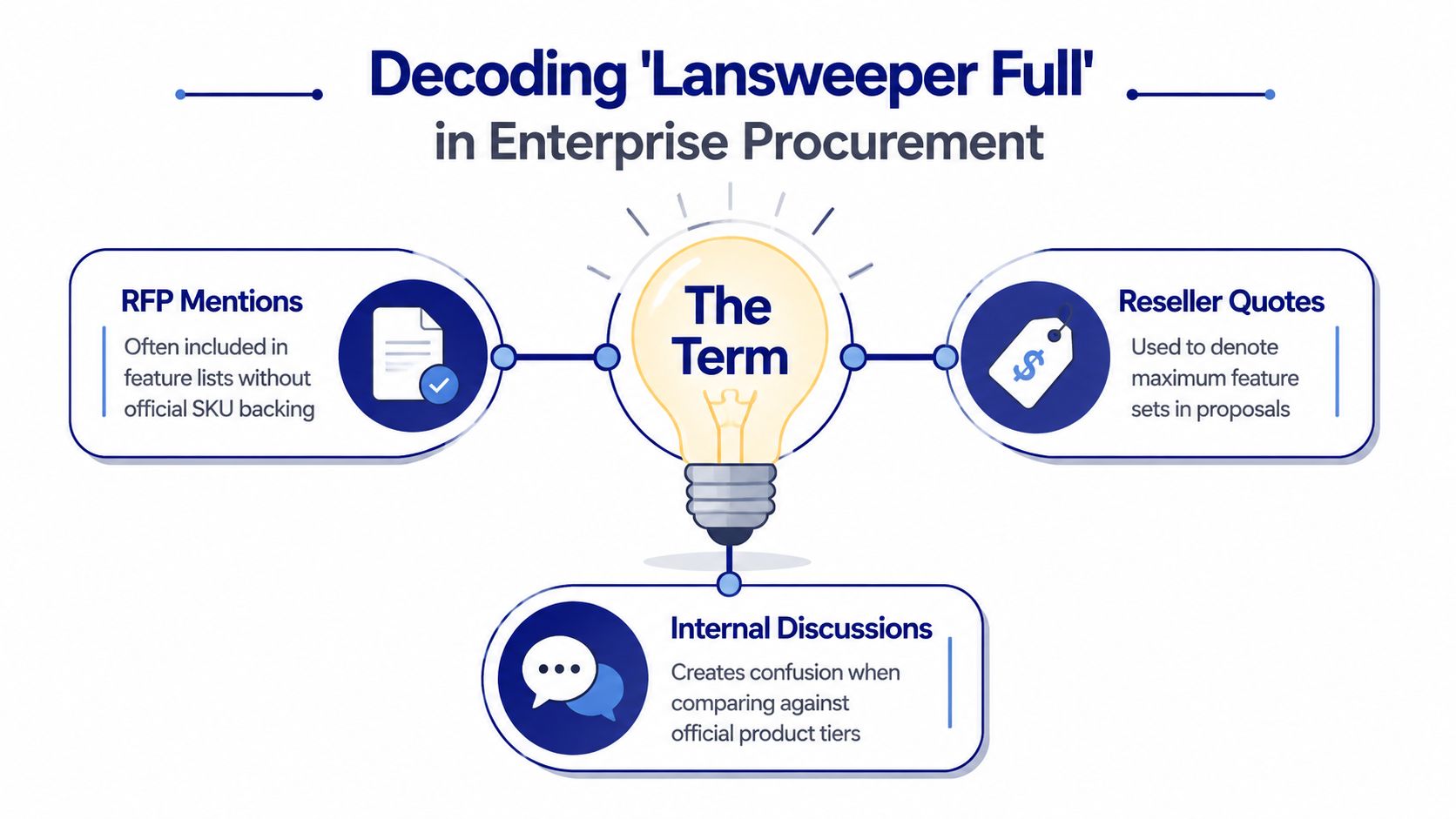
The phrase “Lansweeper full” usually appears in internal discussions, RFPs, and reseller proposals rather than in Lansweeper's formal product terminology. One buyer may mean the broadest feature set. Another may mean unlimited asset coverage. A third may mean a paid plan instead of a free or limited deployment.
That distinction matters because feature completeness and asset capacity are separate procurement questions. A quote can mention advanced discovery while leaving the licensed asset quantity, installation model, API permissions, support scope, and renewal treatment unclear. You shouldn't approve a quote until those items map to an official edition and contract schedule.
Why the label creates scope gaps
Lansweeper positions its platform as a technology asset intelligence system covering IT, OT, IoT, and cloud assets. Its capabilities include dashboards, vulnerability information, lifecycle insights, benchmarking, normalized discovery data, and support for asset rationalization and compliance work. (Lansweeper product capabilities)
Those capabilities are valuable, but the word “full” doesn't automatically confirm that every one is included in your commercial package. Treat claims such as “full API access,” “unlimited sites,” “OT scanning,” or “advanced automation” as items requiring explicit contract confirmation.
Ask the reseller to provide:
Edition name: Record the current official plan, not informal shorthand.
Asset definition: Clarify whether servers, cloud resources, mobile devices, OT equipment, and unmanaged endpoints count toward the licensed quantity.
Discovery scope: Confirm which network, agent, cloud, and OT discovery paths are enabled.
Integration rights: Validate API, CMDB, ITSM, reporting, and data export permissions.
Deployment terms: Document installation limits, scan zones, and multi-site architecture.
Commercial model: Identify subscription or perpetual rights, renewal basis, support tier, and upgrade rules.
Procurement rule: Never let “full” appear as the only description of what you're buying. Replace it with an edition, an asset quantity, a feature schedule, and written renewal terms.
Lansweeper's official pricing structure is the reference point for interpreting a reseller quote. Use the Lansweeper procurement overview to organize the requirement, then ask the seller to reconcile every quoted entitlement against the vendor's current terminology. Historical contracts may use older names such as Full or Express, so your renewal review should compare legacy entitlements with the current commercial structure rather than assuming the old label transfers unchanged.
Comparing Lansweeper Starter, Pro, and Enterprise Editions
The practical buying decision is between Starter, Pro, and Enterprise, not an undefined Full edition. Lansweeper's public pricing information describes a Starter tier for 2,000 assets, a Pro tier that starts at 2,000 assets and scales to 9,000, and Enterprise for 10,000 or more assets. (Lansweeper pricing)
The structure points to a straightforward rule. Starter is a bounded entry point, Pro is the scaling option for a defined estate, and Enterprise is designed for larger deployments where asset coverage and commercial terms need a different conversation.
Lansweeper Edition Comparison Matrix
Feature / Capability | Starter | Pro | Enterprise |
|---|---|---|---|
Asset position | Fixed tier for 2,000 assets | Starts at 2,000 and scales to 9,000 assets | Available for 10,000 or more assets |
Discovery foundation | Technology asset discovery | Broader deployment needs with scalable coverage | Enterprise-scale coverage and operating model |
IT, OT, IoT, and cloud visibility | Confirm scope in quote | Confirm scope in quote | Confirm scope and architecture in quote |
Reporting and dashboards | Confirm included reports and limits | Validate custom reporting requirements | Specify advanced reporting and governance needs |
Automation | Confirm task and deployment rights | Validate automation depth | Require a written automation feature schedule |
Access control | Confirm roles and administration | Map roles to operating teams | Define administrative separation across sites |
API and integrations | Don't assume access | Confirm exact API and connector rights | Put API, ITSM, and CMDB requirements in the order |
Support | Confirm service level | Confirm escalation path | Negotiate named support and response obligations |
Best procurement posture | Pilot or bounded estate | Cost-conscious scaling | Distributed, complex, or high-volume estate |
The matrix deliberately marks several capabilities as “confirm”. Public plan names alone don't prove that your quote includes a particular API, integration, automation control, or deployment right. That's where procurement teams often overread marketing language.
Where buyers commonly choose badly
A mid-market organization may select Enterprise because “full” sounds safer, even when Pro covers its actual asset count and operating requirements. That creates unnecessary commercial exposure if the team doesn't need the higher-capacity tier or its associated enterprise terms.
The opposite mistake is more dangerous. A company may buy Pro based on its current inventory, then discover that cloud resources, remote endpoints, OT equipment, or newly acquired assets push the estate beyond the contracted range. The resulting upgrade discussion happens after the deployment has become operationally important.
Older renewal documents can add another layer of confusion. If a contract refers to Full or Express, ask the vendor or reseller to produce a written entitlement crosswalk showing the modern equivalent, covered asset quantity, and preserved features. The Lansweeper category library can support your research, but the signed order form remains the authority for what you own.
How Lansweeper Discovery Works Across IT, OT, and Cloud Assets
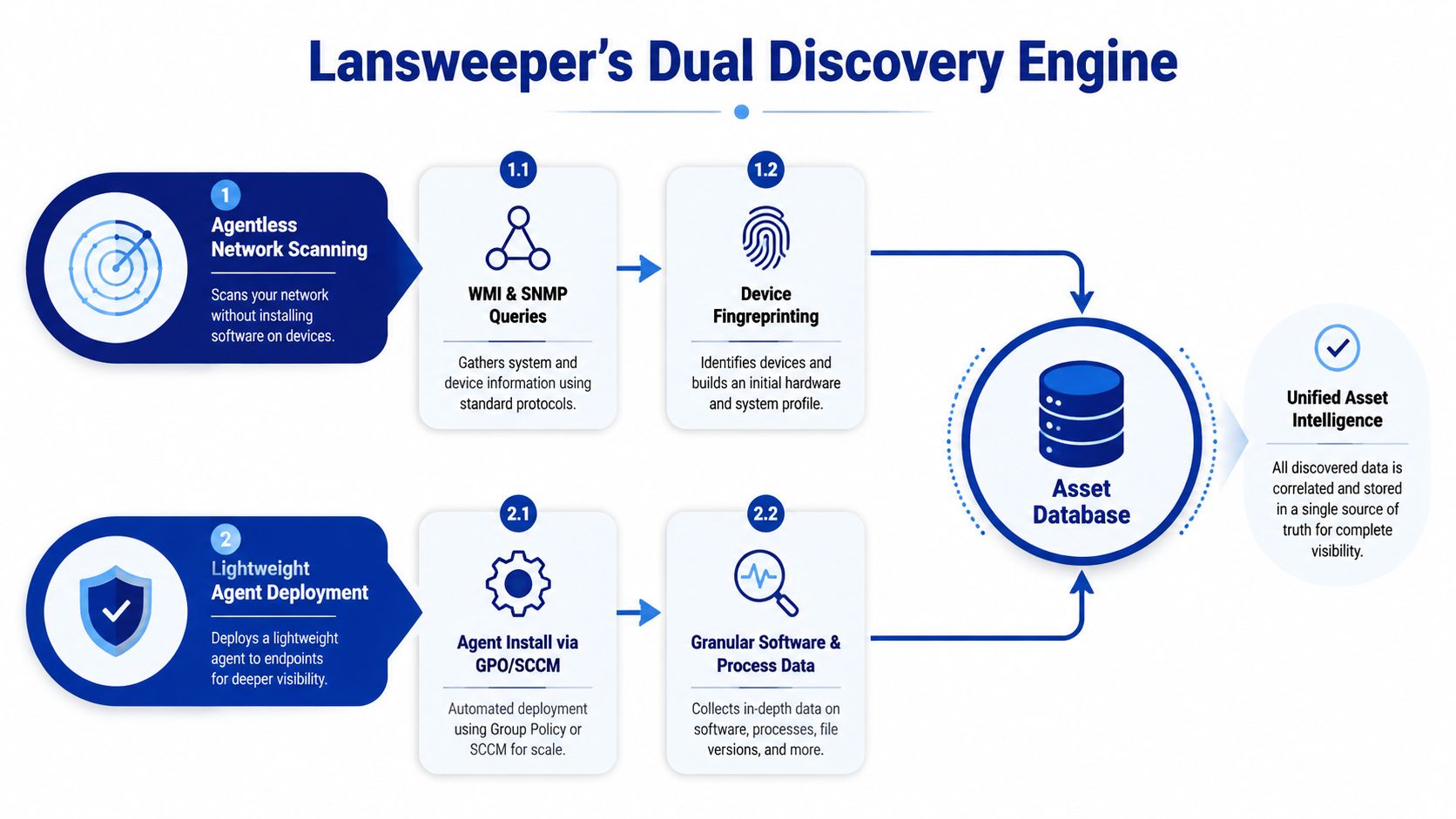
Lansweeper Discovery uses separate paths for Network Discovery, IT Agent Discovery, and Cloud Discovery. Network Discovery targets connected infrastructure such as servers, workstations, IoT devices, and OT equipment, while IT Agent Discovery is intended for endpoints that are off-network or only intermittently connected, such as hybrid-worker laptops. (Lansweeper Discovery documentation)
That architecture matters more than the word “full.” You need to match each environment to a discovery method and then confirm that your selected edition and contract support the required operating model.
Use agentless scanning where the network is reachable
The documented workflow lets administrators create an Agent-less discovery action from the Discovery or Scanning area, select a target, and define the discovery activity. (Lansweeper network discovery configuration)
Agentless discovery reduces endpoint deployment work. It can be a sensible fit for network-connected infrastructure, including equipment where installing software isn't practical. Independent review coverage also describes Lansweeper as supporting both agentless and agent-based discovery, along with hardware, software, cloud, mobile, rogue, and unmanaged endpoint identification. (Independent Lansweeper technical review)
For an enterprise deployment, plan the operational controls before scanning:
Define scan zones. Group networks by location, trust boundary, and ownership.
Assign credentials carefully. Use least-privilege accounts and document who owns rotation.
Separate sensitive environments. Treat manufacturing, clinical, and corporate networks as different operational domains.
Measure coverage. Review which ranges respond and which assets remain unidentified.
Normalize the output. Reconcile duplicate records and connect asset data to service management processes.
Lansweeper OT can scan, detect, and identify a range of OT devices using native OT protocols. That capability is important for industrial environments, but you should still validate manufacturer coverage, safety controls, maintenance windows, and the commercial entitlement in the quote.
Use agents for roaming and intermittently connected endpoints
An agent-based path helps collect data from devices that don't consistently connect to corporate networks. Hybrid-worker laptops and remote endpoints are the obvious examples. Cloud discovery adds another route, bringing cloud asset information into a unified inventory rather than leaving it in separate provider consoles.
The procurement implication is direct. Don't buy “full discovery” as a phrase. Write a discovery coverage schedule that lists network ranges, remote endpoints, cloud accounts, OT segments, expected asset types, and ownership responsibilities. You can also compare this requirement with broader IT asset management approaches before deciding whether Lansweeper is the right inventory foundation.
Which Edition Fits Your Organization Size and Use Case
Choose the edition from the estate you must govern, not the number of devices currently visible. Lansweeper's own enterprise-scale announcement described around 100 million connected devices across more than 25,000 customers, which illustrates the platform's reach, but your contract still needs to reflect your specific asset population and deployment design. (Lansweeper enterprise scale and investment)
A single office with a stable inventory has a different licensing problem from a healthcare group with remote clinics, cloud workloads, and strict audit requirements. Use the following matrix as a starting point, then test the recommendation against growth, acquisition, and compliance scenarios.
Lansweeper Edition Fit by Organization Profile
Organization Profile | Asset Range | Recommended Edition | Key Decision Factors |
|---|---|---|---|
Small pilot or bounded environment | Within the Starter allowance | Starter | Fixed scope, limited rollout, clear discovery boundary |
Mid-market IT estate | 2,000 to 9,000 assets | Pro | Scalable coverage, reporting needs, integration depth |
Distributed enterprise | 10,000 or more assets | Enterprise | Multiple locations, broad asset classes, governance |
Regional healthcare network | Depends on verified inventory | Enterprise when the estate reaches the enterprise threshold | Remote discovery, clinic segmentation, audit readiness |
Single-location manufacturer | Around 2,000 endpoints | Pro if the contracted scope fits | OT coverage, network reachability, controlled expansion |
Acquisition-heavy organization | Variable and rising | Pro with a documented upgrade path, or Enterprise if the threshold is reached | Temporary asset spikes, integration work, renewal flexibility |
The healthcare example deserves special attention. Remote clinics can create blind spots if the architecture only assumes always-connected corporate endpoints. Confirm how agentless network discovery, IT Agent Discovery, cloud discovery, and OT visibility will work across each location before you choose the plan.
Manufacturing creates a different trade-off. A single-location plant with roughly 2,000 endpoints may fit a Pro-oriented commercial discussion if the actual licensed population and feature requirements support it. OT discovery still needs a technical validation, because the existence of an OT capability doesn't guarantee that every device, protocol, or operational constraint is covered under your proposed terms.
Four questions should decide the purchase
How many assets must be governed? Count discovered and expected assets, not only the current spreadsheet.
How distributed is the estate? Remote offices, roaming users, cloud accounts, and industrial networks increase architecture complexity.
How deep are integrations? CMDB, ITSM, API, reporting, and security workflows can matter more than raw inventory.
What happens if the estate grows? Require a written upgrade, overage, and renewal position before signing.
CIO guidance: If Pro covers your verified scope and operating model, don't pay for Enterprise merely because a reseller calls it “full.” If your estate is already enterprise-scale or expanding through acquisitions, under-licensing creates more operational risk than a disciplined Enterprise evaluation.
Licensing Costs, Renewal Risks, and Procurement Friction
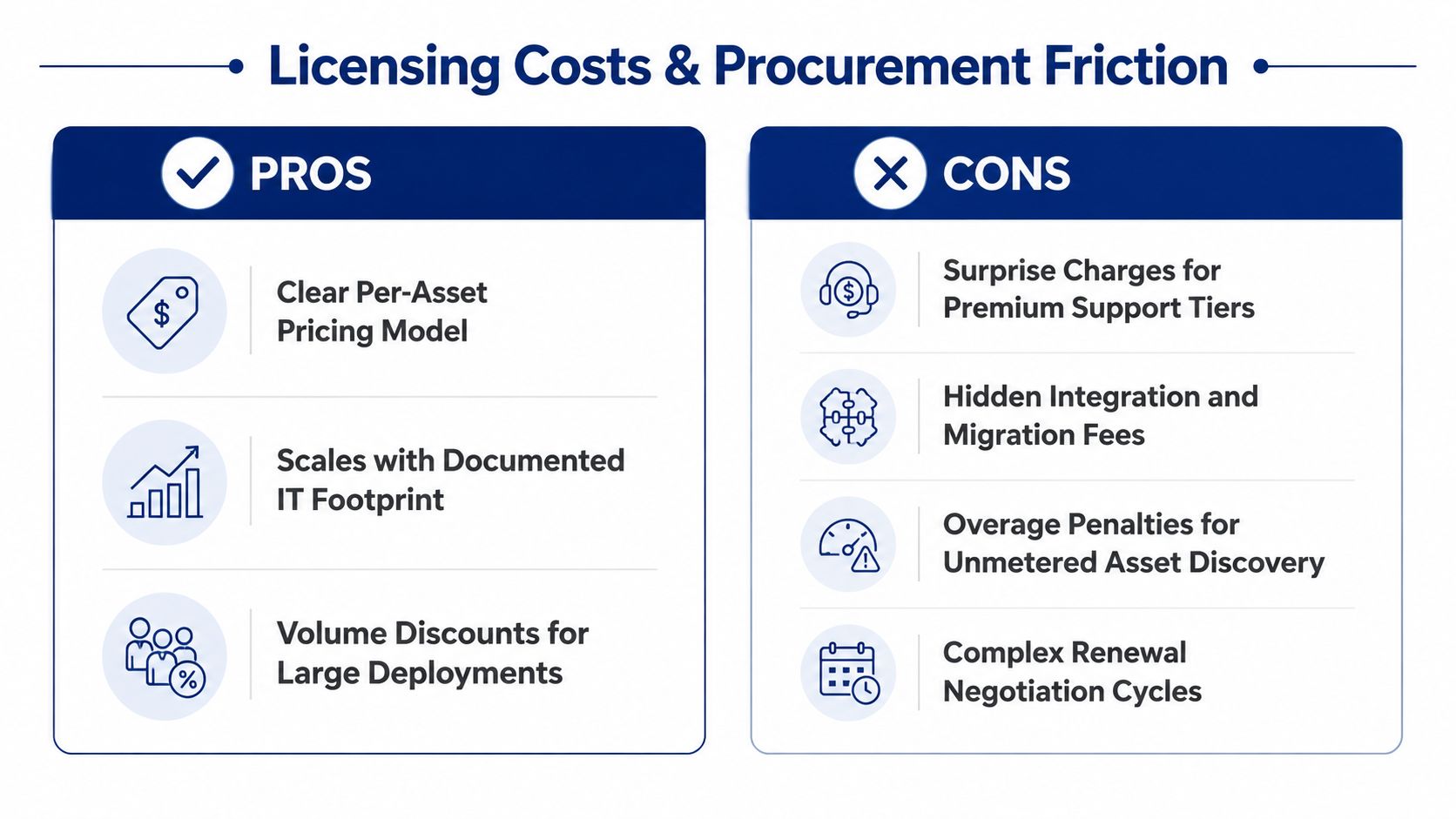
Lansweeper licensing is asset-oriented, so the commercial conversation starts with the quantity and type of assets you intend to cover. Public pricing information shows the key tier boundaries, but it doesn't answer every question a CIO needs answered, such as overage treatment, support inclusions, integration charges, migration services, or the handling of newly discovered assets. (Lansweeper's public pricing structure)
Discovery can expose shadow IT and unmanaged devices that weren't included in the initial estimate. That's useful from a security perspective, but it can also change the commercial scope. Your RFQ should therefore include both the known inventory and a documented approach for assets discovered after deployment.
Protect the renewal before the first order
Review these clauses with the same care you apply to functionality:
Asset measurement: Define what counts as an asset and when it enters the billable population.
True-up mechanics: Ask whether a later audit can create retroactive charges.
Renewal movement: Identify any automatic increases, repricing rights, or tier changes.
Support boundaries: Separate standard support from premium response, success, or advisory services.
Exit rights: Confirm data export, license portability, and assistance if you replace the platform.
Direct procurement often forces you to negotiate the software license, reseller discount, complementary security tools, and renewal terms in separate conversations. That makes comparison difficult and leaves your team responsible for assembling a commercial picture from disconnected proposals.
A marketplace RFQ can reduce that friction by capturing the same asset assumptions and requirements for multiple authorized sellers. It won't eliminate the need for technical due diligence, but it can give procurement a cleaner side-by-side view of price, term, support, and scope. For related cost planning, compare the commercial questions raised in IT service management cost planning, while keeping Lansweeper's asset-based model separate from any other vendor's pricing method.
How to Procure Lansweeper Through a Unified Marketplace
Treat Lansweeper as part of your technology portfolio, not as an isolated inventory purchase. The strongest RFQ describes the estate, discovery methods, integrations, support expectations, renewal position, and complementary tools that may need to sit beside the platform.
Stackingo operates as a marketplace-first enterprise IT licensing platform. It aggregates software and hardware licensing options into an RFQ-led purchasing process, so you can compare multi-vendor responses through one commercial front rather than managing every negotiation separately.
A practical RFQ workflow
Submit your requirements. Include asset quantities, edition preference, locations, IT, OT, IoT, cloud, remote endpoint, integration, and support requirements through the Stackingo Lansweeper RFQ process.
Consolidate responses. Ask for authorized reseller quotes that use the same assumptions, so the comparison isn't distorted by different asset definitions.
Compare terms. Review edition, capacity, subscription duration, support, overage rules, renewal language, and license portability side by side.
Finalize provisioning. Select the offer that meets the technical and commercial requirements, then document the deployment and renewal owner.
A marketplace approach can also support bundling Lansweeper with related IT management or security licensing under clearer commercial coordination. That doesn't replace vendor validation. You should still verify authorization, technical fit, data handling, and the exact entitlements in the order documentation.
Use the word “full” only as a search phrase or an internal shorthand. In the final approval record, replace it with measurable requirements and a named SKU. That single discipline prevents many post-signature arguments.
Frequently Asked Questions About Lansweeper Full
What does Lansweeper Full mean?
Lansweeper Full isn't a clearly defined current SKU name in the public pricing structure. Buyers often use it to mean the highest-capacity Enterprise option or a paid license with broad feature access, so the quote must specify the official edition, asset quantity, discovery scope, integrations, and support terms.
Is Lansweeper Enterprise the same as Lansweeper Full?
Not automatically. Enterprise is the official tier associated with deployments of 10,000 or more assets in the public pricing structure, while “Full” is informal wording that may appear in proposals or legacy documents. Ask for a written entitlement crosswalk before treating the terms as equivalent. (Lansweeper pricing details)
Does Lansweeper full include OT and cloud discovery?
Lansweeper supports discovery across IT, OT, IoT, and cloud assets, with Network Discovery, IT Agent Discovery, and Cloud Discovery paths. Your contract should still identify which capabilities, environments, connectors, and support services are included in your selected edition. (Lansweeper Discovery documentation)
Should a mid-market company buy Enterprise?
Usually not without a clear requirement. If your verified asset population fits the Pro range and your integration and governance needs are covered, Pro may be the more disciplined choice. Enterprise becomes more defensible when asset volume, distribution, and operational complexity justify it.
How can procurement teams compare Lansweeper quotes?
Standardize the RFQ around asset definitions, edition, discovery methods, integrations, support, renewal, overage, and deployment scope. A unified marketplace can collect comparable reseller responses, but your team must still validate the technical and contractual details.
Stackingo can help you turn an ambiguous Lansweeper full request into a structured RFQ with asset assumptions, edition requirements, discovery scope, integrations, and renewal terms. Submit your requirements through Stackingo to compare licensing options and move from reseller shorthand to a purchase decision you can defend.
