
Solarwinds Lansweeper
The popular advice to choose SolarWinds or Lansweeper as if they were interchangeable misses the enterprise architecture question. SolarWinds is strongest where network performance, events, and operational telemetry matter. Lansweeper is stronger for broad, agentless asset discovery and detailed inventory. In many environments, the better decision is to use both, assign clear data ownership, and control how records synchronize.
Why SolarWinds and Lansweeper Are Not Always Competitors
Treating SolarWinds and Lansweeper as direct substitutes creates a false procurement choice. The platforms can overlap around discovery, but their operational centers of gravity differ. SolarWinds is associated with network and IT operations visibility, while Lansweeper has developed around technology asset intelligence and a continuously validated inventory view.
The distinction matters during a real deployment. A network operations team may need performance trends, fault alerts, and infrastructure context. An IT asset team may need hardware history, installed software visibility, user associations, and a reliable record of changes. One product can be asked to serve both purposes, but that doesn't mean it will serve both equally well.
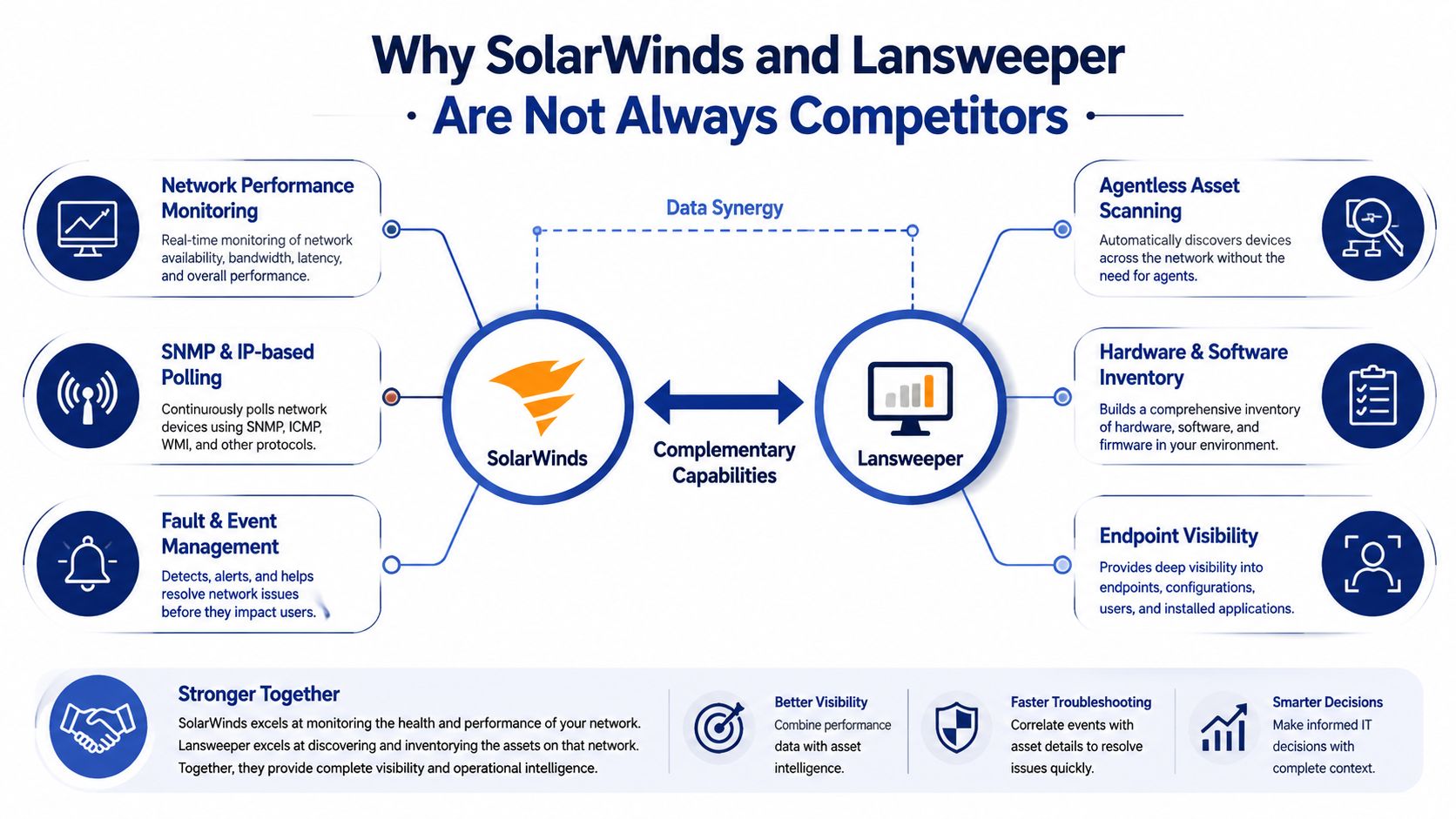
The architecture question is more important than the feature checklist
SolarWinds Web Help Desk explicitly supports Lansweeper 5.x as a discovery source, alongside Active Directory, Apple Remote Desktop, SMS/SCCM, and SolarWinds asset synchronization, as shown in SolarWinds' Lansweeper configuration documentation. That integration is important evidence that coexistence isn't an edge case invented by comparison writers. It is a supported operating pattern.
SolarWinds' community documentation also describes two integration paths, through the discovery connection and asset options. Administrators can use a filtered SQL view when they need to limit which records enter Web Help Desk, according to the relevant SolarWinds community discussion.
Your evaluation should therefore answer four questions:
Discovery ownership: Which platform is authoritative for endpoint and software inventory?
Network authority: Which platform owns infrastructure topology and performance telemetry?
Reconciliation logic: How will duplicate devices, renamed assets, and retired records be resolved?
Security boundary: Which credentials, APIs, and synchronization accounts can access each system?
Practical rule: Never approve a dual-tool design until someone documents which system wins when the two systems disagree.
The hidden cost isn't only license duplication. It includes connector administration, field mapping, failed synchronization jobs, duplicate cleanup, access reviews, and the time analysts spend deciding which record is trustworthy. A single-tool design can reduce those costs, but only if the chosen platform provides sufficient discovery depth and operational context for the environment.
Core Capabilities and Market Position
SolarWinds and Lansweeper occupy different practical positions in an enterprise tooling portfolio. SolarWinds is often evaluated as part of an IT operations monitoring strategy. Lansweeper is evaluated as an asset intelligence platform that helps teams understand what technology exists and how it changes over time.
Lansweeper's historical significance comes from its evolution into a large-scale technology asset intelligence platform. In July 2026, Bridgepoint announced an agreement to acquire a majority stake, describing Lansweeper as a leading platform headquartered in Ghent, Belgium and founded more than 20 years earlier, as reported in Lansweeper's acquisition announcement.
The same announcement describes a view across IT, OT, cloud, and IoT assets. Lansweeper also tracks history for hardware, software, and Windows users by default, while configurable scan intervals can capture additional history such as IP address changes. That historical layer supports change auditing, compliance work, and lifecycle decisions more effectively than a static device list.
Core capability matrix
Capability | SolarWinds | Lansweeper |
|---|---|---|
Primary operating focus | Network and IT operations visibility | Technology asset intelligence |
Discovery orientation | Network, service, and operational context | Broad hardware and software inventory |
Useful data depth | Device, network, performance, and event context | Device attributes, software, users, history, and topology detail |
Typical ownership | Network operations and IT operations | ITAM, security, procurement, and infrastructure teams |
Integration role | Can consume or synchronize asset data through service workflows | Can provide detailed inventory data to service management tools |
Main procurement risk | Modular scope and overlapping product functions | Duplicate records if discovery ownership isn't defined |
Independent market-intelligence data cited in 6sense's Lansweeper and SolarWinds Service Desk comparison lists 862 Lansweeper customers versus 523 SolarWinds Service Desk customers in the referenced 2025 summary. The same source places Lansweeper 14th in IT asset management by customer count and SolarWinds Service Desk 23rd, with category shares of 1.11% and 0.68%, respectively.
Those figures aren't a complete measure of product quality. They do, however, give procurement teams a market signal for asset-management adoption, peer references, and the availability of integration patterns. If your primary requirement is asset inventory, Lansweeper has the stronger direct category signal in the cited comparison. If your requirement is network operations, category-share comparisons for service desk asset management shouldn't decide the purchase.
For adjacent ITAM evaluations, ManageEngine AssetExplorer is another product to place in the same requirements matrix, particularly when you want to compare discovery, CMDB, and lifecycle-management scope rather than compare brand familiarity.
Asset Discovery Depth and Agentless Visibility
Discovery quality separates a useful inventory from a reassuring but incomplete list. Lansweeper is repeatedly described by users and review summaries as stronger than SolarWinds for passive, agentless discovery and detailed hardware and topology inventory. The comparison evidence highlights device-level details, switch port visibility, and clickable asset actions, while the SolarWinds alternative is described as exposing mainly name, IP, model, and open ports in that context, as documented in the SolarWinds community comparison.
That difference affects daily operations. During an incident, knowing that a device exists is less useful than knowing its hardware identity, connected switch port, software context, and relationship to other assets. During an audit, a broad network map won't replace reliable software and hardware records.
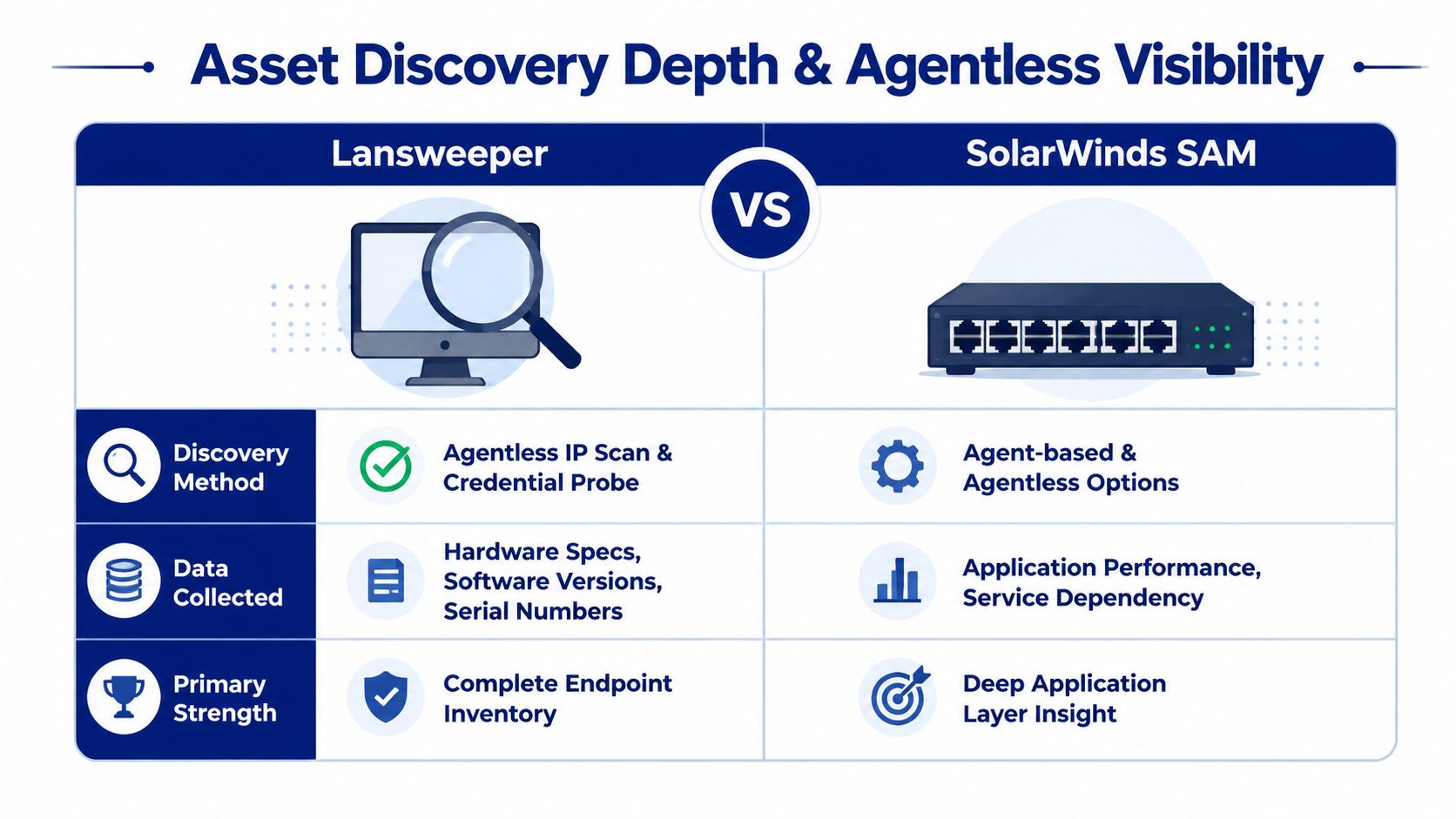
What the operational difference looks like
Use Lansweeper when your first question is, “What technology is present, what software does it contain, and how has it changed?” Its history functions can support lifecycle review and change auditing, while deeper asset attributes reduce the manual reconciliation burden between scanners, spreadsheets, and service records.
Use SolarWinds when your first question is, “Is the infrastructure performing normally, and what event or dependency explains the failure?” Network operations teams generally value telemetry, alerting, and service context more than a highly granular endpoint inventory.
The comparison isn't just agentless versus agent-based. It is breadth versus operational depth, and the answer depends on what your team must do after discovery.
For incident response: Port-level and topology detail can help analysts connect an endpoint to network infrastructure.
For software governance: Hardware and software history provides a stronger foundation for review and reconciliation.
For network operations: Performance and event context helps teams understand service impact.
For audit preparation: A record that preserves changes is more useful than a one-time scan result.
If asset discovery is the primary requirement, Lansweeper's asset intelligence offering deserves a direct proof-of-value assessment. Don't accept a vendor demo that only shows a populated dashboard. Ask the team to demonstrate unknown-device handling, duplicate resolution, historical changes, port mapping, software detail, and export or synchronization behavior.
Security Incidents and Trust Boundaries
The SolarWinds supply-chain attack remains foundational to any procurement review involving SolarWinds. In December 2020, CISA warned that active exploitation affected SolarWinds Orion Platform versions 2019.4 HF 5 through 2020.2.1 HF 1, released between March 2020 and June 2020, as documented in CISA's SolarWinds alert.
Independent analysis estimated that roughly 18,000 customers downloaded the trojanized update, while fewer than 100 organizations and nine U.S. federal agencies were selectively exploited. The same analysis reported that SolarWinds products were used by more than 300,000 customers worldwide across 117 countries. Those facts illustrate the central risk: a trusted management platform can become a high-scale supply-chain node even when the attacker selectively targets only a small subset of installations.
This history changes how you evaluate integrations. An inventory connector isn't just a convenience feature. It creates a trust relationship among discovery credentials, service-management records, APIs, databases, and synchronization jobs.
Security posture comparison
Security Dimension | SolarWinds | Lansweeper |
|---|---|---|
Historical procurement concern | The Orion supply-chain compromise remains material to vendor-risk reviews | The main concern is the breadth of credentials and network access used for discovery |
Integration boundary | Web Help Desk can consume Lansweeper data and synchronize assets | Lansweeper data may flow into service-management and operational systems |
Exposure question | Internet-facing SolarWinds environments require strict patching and exposure control | Discovery permissions and connector scope require careful least-privilege design |
Evidence to request | Patch advisories, secure development controls, incident response evidence, and deployment guidance | Credential architecture, scan permissions, data retention, API controls, and access logging |
A second issue emerged in early 2026, when Microsoft and CISA-linked reporting described active exploitation of SolarWinds Web Help Desk flaws, including CVE-2025-40536 and CVE-2025-40551. CISA placed CVE-2025-40536 on the KEV list and urged rapid patching, according to the supplied security reporting context. That makes exposure minimization and patch cadence part of the asset-integration decision, not a separate security task.
Your CISO should ask whether synchronization accounts can write records, whether discovery credentials are segmented by domain, and whether an exposed service desk could become a path into inventory data. For a broader compliance and audit comparison, Device42 compliance and audit capabilities can serve as an adjacent reference point in the evaluation.
When to Choose Each Platform
The right choice depends on the operating problem, not on which product has the longer feature list. SolarWinds makes more sense when network uptime, infrastructure performance, event management, and application context dominate the requirements. Lansweeper fits better when your organization needs detailed, agentless asset discovery across a mixed technology estate.
Choose SolarWinds when network context comes first
SolarWinds should lead the evaluation when your network operations team needs a monitoring-centered operating model. Prioritize it when:
Performance is the main outcome: Your team needs ongoing visibility into network health, events, and operational behavior.
Infrastructure telemetry drives decisions: Network devices and their performance relationships matter more than endpoint software detail.
Existing investment is substantial: Your organization already operates SolarWinds workflows and can extend them without creating another control plane.
Service workflows are connected: Web Help Desk or related SolarWinds processes already provide the service-management context your teams use.
Choose Lansweeper when inventory accuracy comes first
Lansweeper should lead when the asset record is the foundation for security, procurement, lifecycle, and audit work. Favor it when:
Discovery must be broad: You need visibility across heterogeneous IT, OT, cloud, and IoT environments.
Agentless collection is important: You want to discover devices without placing persistent software on every target.
Hardware history matters: Teams need to review changes, ownership, and lifecycle evidence rather than retain only current-state attributes.
Software visibility affects decisions: Procurement and security teams need more than network reachability data.
The cost model also needs discipline. The supplied evidence doesn't establish comparable public total-cost figures for both platforms, so a buyer shouldn't claim that one always costs less. Instead, calculate license fees alongside implementation, connector maintenance, credential administration, data cleanup, training, and renewal complexity.
Run a pilot with representative network segments and endpoint groups. Measure whether the tool finds the assets you already know about, how it handles unknown devices, how much manual cleanup is required, and whether the resulting records can support an actual service or audit workflow. SysAid asset management is another adjacent option to include when the requirements extend beyond discovery into broader IT service processes.
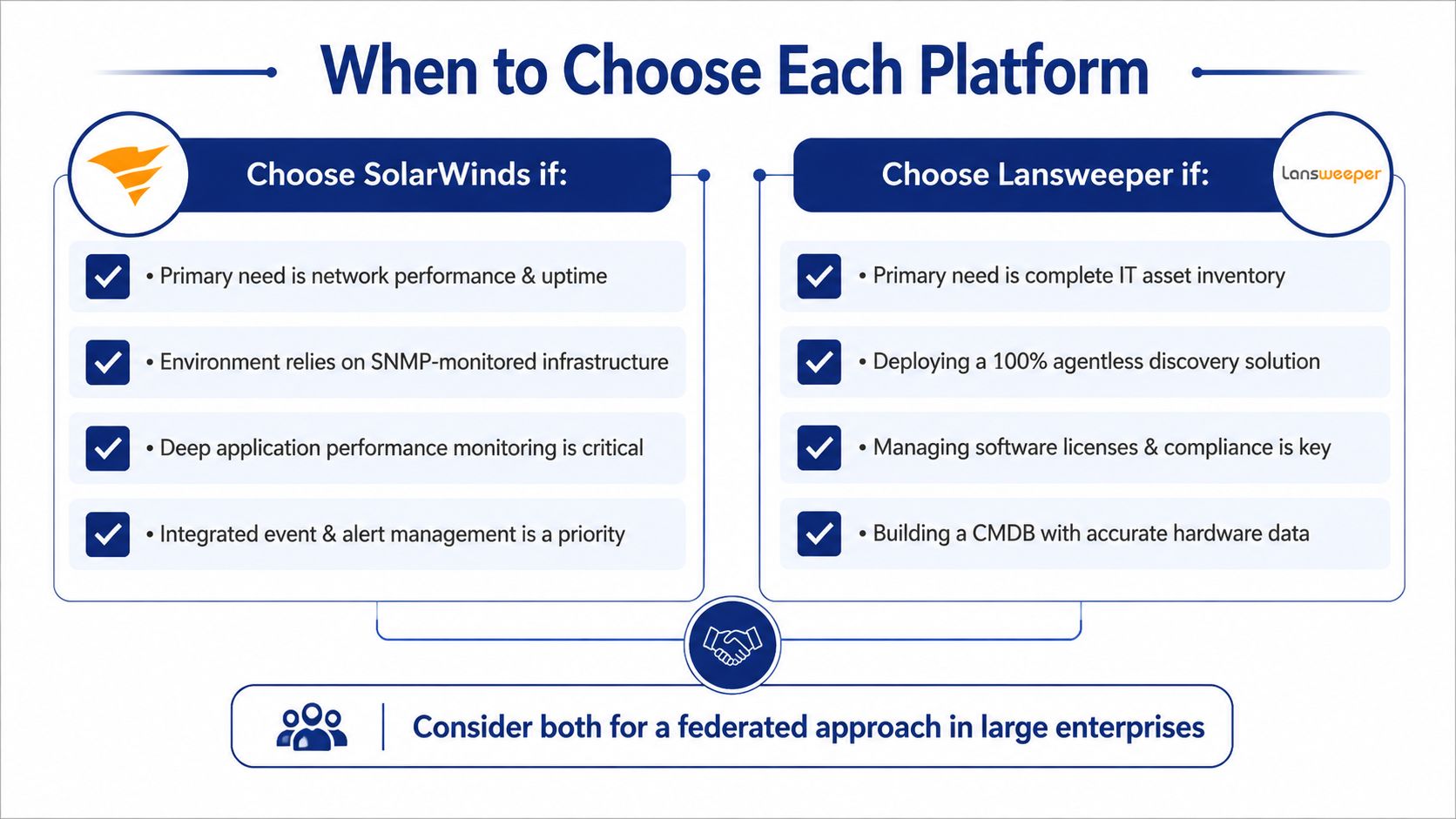
Building a Federated Asset Discovery Architecture
A federated design works when each platform owns the data it is best positioned to collect. Without that boundary, teams create two competing inventories and spend their time reconciling symptoms rather than managing assets.
Lansweeper can own endpoint, hardware, software, and user-oriented discovery. SolarWinds can own network infrastructure context, performance telemetry, and event data. A service-management or CMDB platform can consume normalized records, but it shouldn't become an unquestioned authority just because it receives data from both systems.
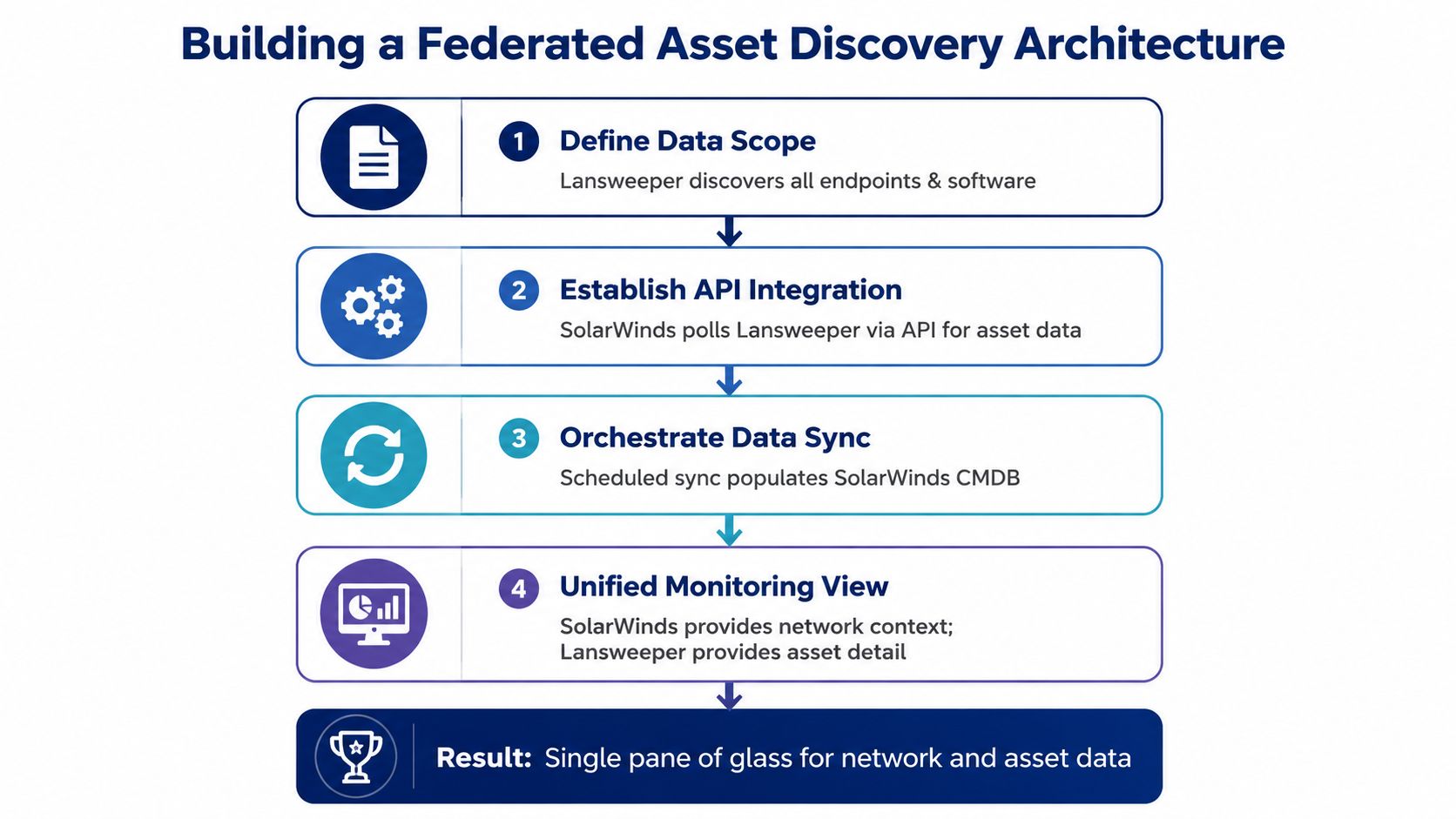
Define ownership before integration
Start with a written data contract. For every important field, specify the source, update behavior, conflict rule, and accountable owner.
Data domain | Recommended authority | Reconciliation rule |
|---|---|---|
Endpoint identity | Lansweeper | Match on stable identifiers, then review ambiguous records |
Installed software | Lansweeper | Preserve source timestamp and software version history |
Network topology | SolarWinds | Prefer current network relationships from monitoring discovery |
Performance and events | SolarWinds | Keep telemetry in the monitoring system and publish context outward |
Service relationship | CMDB or ITSM platform | Accept validated records from both sources under governance |
Lifecycle status | ITAM owner | Resolve retirement and reassignment through controlled workflow |
Use APIs, CMDB connectors, or service-management integrations to move only the fields that another system needs. SolarWinds' documented Lansweeper integration, including field mapping and handling for deleted or missing assets, provides a concrete example of the controls that should be specified before deployment.
Reconcile records instead of copying them blindly
A synchronization job that copies every record creates noise. Establish matching logic around stable identifiers, hostname changes, serial data, network relationships, and source confidence. When two systems disagree, preserve the source value and record the conflict rather than overwriting one system with another.
Security boundaries should follow the same logic. Use read-only access where possible, separate discovery credentials from synchronization credentials, limit connector scope, and review permissions when a platform or integration changes. Device42 IT operations can be included in adjacent architecture discussions where dependency mapping and operations context are part of the target operating model.
The strongest federated design isn't a “single pane of glass” created by duplicating everything everywhere. It is a governed data product in which each record has an owner, each transformation is explainable, and every synchronization path has a defined security purpose.
Real-World Implementation Scenarios
Consider three deployment patterns, without treating them as invented customer case studies.
A global financial-services organization might assign SolarWinds to network performance and event monitoring while using Lansweeper to inventory endpoints and specialized operational technology. The procurement trigger is usually visibility separation. The friction appears when network identifiers don't match asset records, so the team needs stable matching rules and a review process for ambiguous devices.
A distributed healthcare provider might standardize asset inventory in Lansweeper while retaining SolarWinds for WAN and infrastructure monitoring across clinics. The benefit is clear ownership: the asset team maintains hardware and software records, while network specialists manage availability and performance. The security review should examine credential scope, service exposure, and whether sensitive inventory fields are being copied into systems that don't need them.
A manufacturing group might operate a federated model in which Lansweeper supplies detailed asset records and SolarWinds supplies operational telemetry to a separate network operations dashboard. In that design, the difficult work isn't the dashboard. It is deciding how retired, renamed, relocated, or duplicated assets move through the reconciliation process.
Across all three patterns, the same procurement lesson emerges:
Don't buy integration as a slogan: Require a field map, synchronization behavior, failure handling, and ownership model.
Don't measure discovery only by device count: Test data depth, historical changes, duplicate handling, and operational usefulness.
Don't separate security from architecture: Every credential, API, and exposed service changes the trust boundary.
Don't compare license lines alone: Include administration, cleanup, governance, and renewal effort in total cost of ownership.
Stackingo is relevant when you need to compare enterprise licensing options across vendors and structure an RFQ around quantities, scenarios, and commercial requirements rather than evaluate each platform in isolation.
Frequently Asked Questions About SolarWinds Lansweeper
Are SolarWinds and Lansweeper direct competitors?
Not always. SolarWinds is commonly used for network and IT operations visibility, while Lansweeper is positioned around detailed technology asset intelligence. Many enterprises can use both if they define ownership and reconciliation rules.
Can SolarWinds Web Help Desk integrate with Lansweeper?
Yes. SolarWinds documents Lansweeper 5.x as a discovery source for Web Help Desk and describes field mapping, synchronization, and handling for assets that disappear. The exact integration design should be validated against your deployed versions and data-governance requirements.
Which platform is stronger for agentless asset discovery?
The supplied comparison evidence describes Lansweeper as stronger for passive, agentless discovery and deeper device-level inventory, including switch port visibility. SolarWinds remains more appropriate when network monitoring, performance, and event context are the primary objectives.
What security issue should buyers examine first?
Review the trust boundary created by the platform and its integrations. SolarWinds' 2020 supply-chain attack and later Web Help Desk exploitation reporting make patching and exposure control important, while Lansweeper deployments require careful control of discovery credentials, scan permissions, and API access.
Should an enterprise deploy both products?
Deploy both when network performance and detailed asset intelligence are separate operational requirements. Use a federated model with clear source ownership, controlled synchronization, conflict handling, and least-privilege access.
If you're evaluating SolarWinds, Lansweeper, or a federated combination, Stackingo can help structure comparable enterprise licensing options and RFQs across vendors. Bring your asset scope, discovery requirements, integration model, and renewal constraints, and use that information to request a procurement path built around your actual operating architecture.
