
SymphonyAI Supply Chain Management Pricing - up to 30% off list
Updated: 1 day ago
The unit of charge for SymphonyAI Supply Chain Management Pricing is called, literally, a unit — and SymphonyAI's own AWS Marketplace listing says a unit may reflect deployment scope such as stores, SKUs or data volume, and directs buyers to confirm the mapping with the vendor. That is unusually candid, and it is also the whole story: with the unit undefined, the figure attached to it is a placeholder for private offers rather than a rate anyone pays. What can be fixed in advance is the discount — up to 30% below SymphonyAI list through Stackingo, with a contractual floor of 10%, across the GCC, UK & Ireland, Europe, Oceania and the US.
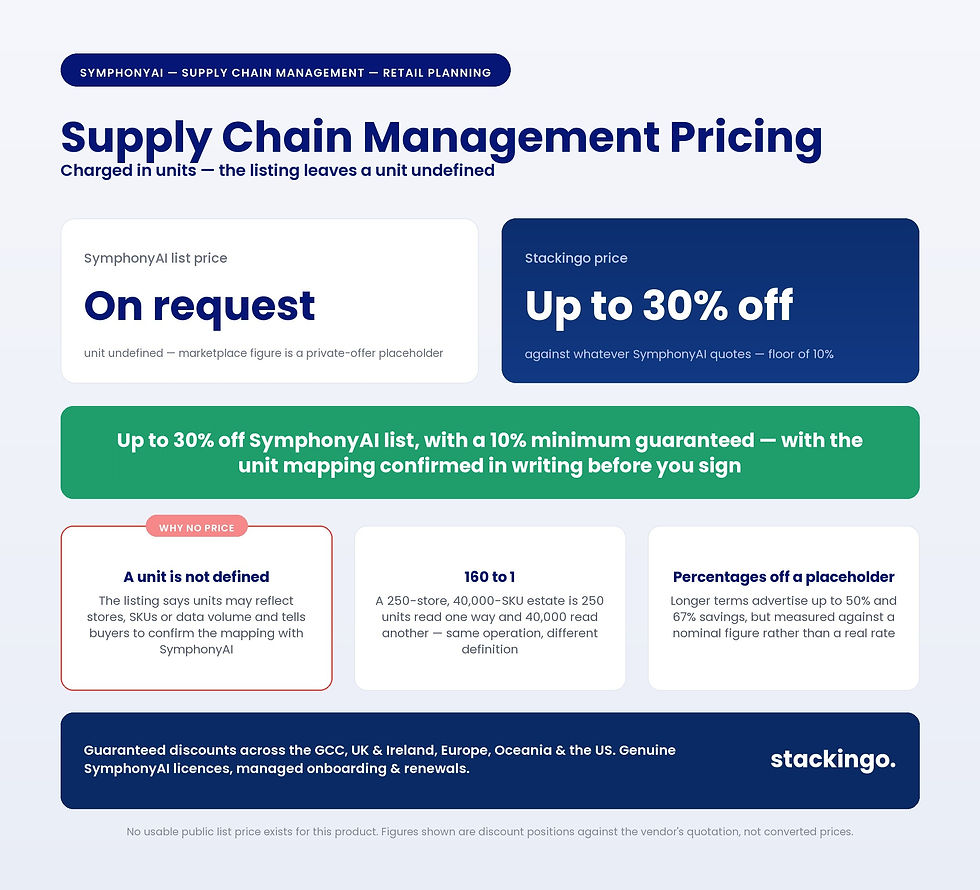
What does SymphonyAI Supply Chain Management Pricing look like at a glance?
It looks, at first glance, like a priced product. There is an AWS Marketplace listing published by SymphonyAI, it has a contract term, and it has a dimension with a figure beside it. Look closer and the figure is a nominal one attached to an undefined quantity, which is a placeholder used to enable privately negotiated offers. The contrast with the same seller's shelf-scanning listing is instructive: that one carries a genuine seven-figure contract price and a stated minimum. This one carries a unit nobody has defined. Reporting it as a rate would be misleading, so the honest entry is On request.
Plan | List (per month) | Stackingo | Scope of the licence |
Retail — Supply Chain Management, the single marketplace listing | On request | Up to 30% below list | Planning, replenishment and supply chain execution for retail, charged in units that the listing says may reflect stores, SKUs or data volume. The published unit figure is a private-offer placeholder; the mapping must be confirmed with SymphonyAI before any total exists. |
Two things follow from that row, and both are worth carrying into the first meeting. The listing advertises longer terms as saving up to 50% on two years and up to 67% on three, but those percentages are calculated against the placeholder rather than against a real rate, so they describe the listing's own arithmetic and not your saving. And because the unit is undefined, the same estate can produce wildly different totals depending on how it is read. The Stackingo position sits outside both problems: up to 30% below whatever SymphonyAI finally quotes, never less than 10%.
What does a SymphonyAI Supply Chain Management subscription include?
A subscription here means a term licence to the planning and execution platform, sized by a quantity of units, with the software delivered as a service and the cloud infrastructure charged separately underneath it. That is the whole shape of the thing, and it is worth stating plainly because the word subscription is doing less work than usual: this is not a monthly cancellable service but a multi-year commitment with an agreed quantity written into it, and quantity is the variable that decides what a SymphonyAI Supply Chain Management subscription actually costs.
What sits outside the licence deserves the same plain treatment. Cloud infrastructure is billed by the platform provider, not by SymphonyAI. Data preparation — getting demand history, inventory positions, supplier lead times and store master data into usable shape — is a programme in its own right. Model configuration after a range review may be services rather than subscription. Ask for each to be confirmed in writing as included or excluded. Stackingo lists them explicitly in the quotation and applies its up-to-30% discount, floored at 10%, to the SymphonyAI licence line.
Who needs SymphonyAI Supply Chain Management licenses, and how many?
Most planning vendors answer this with a seat count: so many planners, so many licences, so many pounds each. SymphonyAI does not work that way here, and the difference matters when you are comparing quotations. Where a rival will price twelve planners at a published per-user rate, SymphonyAI prices a quantity of units that may correspond to stores, to SKUs or to volume of data — so the two quotations are not measuring the same thing at all, and lining them up requires converting one into the other's terms before any comparison is meaningful.
The practical answer, then, is that SymphonyAI Supply Chain Management licenses are not counted by people. Nobody in your planning team should be added or removed from a spreadsheet to model this. What you count instead is the deployment: how many stores, how many active SKUs, how much history. Establish which of those three the vendor intends to charge on before anything else happens, because the answer changes the shape of the negotiation entirely — and Stackingo's discount of up to 30% below list applies whichever basis is settled on.
How the SymphonyAI Supply Chain Management plans differ
Work an example and the risk becomes obvious. Take a 250-store chain carrying 40,000 active SKUs. Read a unit as a store and the deployment is 250 units. Read it as a SKU and the same deployment is 40,000 units — a ratio of 160 to 1 on identical operations. Read it as data volume and the number depends on how many years of history you load. Nothing about the estate changed; only the definition did. That is why the SymphonyAI Supply Chain Management plans need reading in this order:
The unit definition — the first thing to settle, before any term. The listing states units may reflect deployment scope such as stores, SKUs or data volume, and tells buyers to confirm with SymphonyAI. Get the mapping and the counting method in writing; everything else is arithmetic on top of it.
The 12-month contract — On request, up to 30% below list with Stackingo. The listing's baseline term. Its published figure is a nominal placeholder for private offers rather than a rate, so treat the term as a structure and not as a price.
The 24-month contract — advertised as saving up to 50% against that baseline. A percentage calculated against a placeholder is not a saving you can bank. Ask for the two-year total as an absolute figure and compare it against twice the one-year total yourself.
The 36-month contract — advertised as saving up to 67% on the same basis. Longer terms genuinely do buy rate protection on a unit-based licence, which is the real argument for them. Pair it with a written mechanism for adding and removing stores mid-term.
Settle the definition first and the plans become a straightforward term-length decision. Leave it unsettled and you are negotiating a total whose basis can be reinterpreted later, which is the single worst position to be in on a multi-year agreement. Stackingo insists on the mapping before quoting, then applies up to 30% below SymphonyAI list with a contractual floor of 10% to the resulting licence, and prices mid-term expansions from the held rate rather than from fresh list.
Is Stackingo the right SymphonyAI Supply Chain Management reseller for you?
If you want the definition of the unit pinned down before a number is discussed, yes. That is the specific value on this product, and it is worth more than a few points of discount: a licence sized on stores behaves completely differently at renewal from one sized on SKUs, because store counts move slowly and assortments move constantly. A SymphonyAI Supply Chain Management reseller that does not raise the question before quoting has not read the listing carefully enough to be negotiating on your behalf.
Beyond that, the commercial answers are the same ones any buyer should demand: a written discount of up to 30% below SymphonyAI list, a contractual floor of 10% beneath it, expansions priced from the rate you already hold, renewals tracked rather than remembered, and invoicing from an entity in your own jurisdiction. Where Stackingo is not the right answer is where you need deep bespoke implementation delivery rather than licensing and commercial management — that is a different kind of firm, and the two work perfectly well side by side.
How a SymphonyAI Supply Chain Management distributor simplifies procurement
By turning an ambiguous listing into a document procurement can actually process. Left alone, a buying team faces a marketplace page with an undefined quantity, three terms priced against a placeholder and a note telling them to contact the vendor — which is not something a procurement committee can evaluate, approve or benchmark. A SymphonyAI Supply Chain Management distributor converts that into a specification, a confirmed unit mapping, an itemised quotation and a discount stated as a percentage with a floor.
The second simplification is administrative rather than commercial. One counterparty issues the invoice, holds the renewal date, prices the expansion when the estate grows and answers for the agreement when the people who signed it have moved on. On a product where the billing basis has to be established by conversation rather than read from a page, that institutional memory is not a nicety. Stackingo carries it across the GCC, UK & Ireland, Europe, Oceania and the US, on a position of up to 30% below list, minimum 10%.
Why buy through a SymphonyAI partner?
Follow what actually happens in the two routes and the difference is easy to see. Direct: you request pricing, SymphonyAI scopes and quotes, you negotiate against a number already on the table, and any discount is argued for after the anchor is set. Through a SymphonyAI partner: the scope and the unit mapping are agreed first, the discount position is registered with the vendor before pricing, and the first figure you see already carries the reduction. Same licence, same tenant, same support — different order of events, and the order is what determines the price.
There is a second-order effect worth naming. Because the position is registered rather than requested, it survives changes of personnel on both sides and is measured against a list price that has been capped for uplift in the same schedule. Stackingo writes the discount as up to 30% below SymphonyAI list with a contractual minimum of 10%, applies it to the licence line rather than blending it across services, and keeps the unit mapping attached to the agreement so a later renewal cannot quietly reinterpret it.
Where can you buy SymphonyAI Supply Chain Management?
In practice there are two routes and they converge. The first runs through the AWS Marketplace listing, which exists so that a negotiated agreement can be transacted against a cloud commitment — useful if your organisation has one to draw down, irrelevant if it does not. The second is a direct agreement with SymphonyAI or with an authorised partner. Either way the substance is identical: scope, unit mapping, quotation, negotiation, signature. You cannot buy SymphonyAI Supply Chain Management from a shopping basket, whatever the listing appears to offer.
So choose the route on treasury grounds rather than on convenience. If a cloud commitment exists and drawing the spend against it is worth something to finance, take the marketplace route and have the agreed figure published as a private offer. If it does not, the direct agreement is simpler and gives you a cleaner set of contractual terms to negotiate. Stackingo's commercial position is the same on both: genuine SymphonyAI licences at up to 30% below list, with a contractual floor of 10%, and identical entitlements to a direct purchase.
SymphonyAI Supply Chain Management cost, converted into local currency
There is nothing to convert, and saying so plainly is more useful than filling the column with arithmetic. What the table does record is where Stackingo contracts, which currency each entity is invoiced in, and the fact that the discount position does not vary between them. For a retail group running stores in more than one of these markets, that last point is the one worth checking early: a supplier that can only invoice from a single jurisdiction turns a straightforward renewal into an intercompany recharge exercise every year.
Market | Currency | List (per month) | Stackingo (per month) |
Australia | AUD | On request | Up to 30% below list |
Austria | EUR | On request | Up to 30% below list |
Bahrain | BHD | On request | Up to 30% below list |
Belgium | EUR | On request | Up to 30% below list |
Bulgaria | EUR | On request | Up to 30% below list |
Croatia | EUR | On request | Up to 30% below list |
Cyprus | EUR | On request | Up to 30% below list |
Czechia | CZK | On request | Up to 30% below list |
Denmark | DKK | On request | Up to 30% below list |
England | GBP | On request | Up to 30% below list |
Estonia | EUR | On request | Up to 30% below list |
Finland | EUR | On request | Up to 30% below list |
France | EUR | On request | Up to 30% below list |
Germany | EUR | On request | Up to 30% below list |
Greece | EUR | On request | Up to 30% below list |
Hungary | HUF | On request | Up to 30% below list |
Ireland | EUR | On request | Up to 30% below list |
Italy | EUR | On request | Up to 30% below list |
Kuwait | KWD | On request | Up to 30% below list |
Latvia | EUR | On request | Up to 30% below list |
Lithuania | EUR | On request | Up to 30% below list |
Luxembourg | EUR | On request | Up to 30% below list |
Malta | EUR | On request | Up to 30% below list |
Netherlands | EUR | On request | Up to 30% below list |
New Zealand | NZD | On request | Up to 30% below list |
Northern Ireland | GBP | On request | Up to 30% below list |
Oman | OMR | On request | Up to 30% below list |
Poland | PLN | On request | Up to 30% below list |
Portugal | EUR | On request | Up to 30% below list |
Qatar | QAR | On request | Up to 30% below list |
Romania | RON | On request | Up to 30% below list |
Saudi Arabia | SAR | On request | Up to 30% below list |
Scotland | GBP | On request | Up to 30% below list |
Slovakia | EUR | On request | Up to 30% below list |
Slovenia | EUR | On request | Up to 30% below list |
Spain | EUR | On request | Up to 30% below list |
Sweden | SEK | On request | Up to 30% below list |
United Arab Emirates | AED | On request | Up to 30% below list |
United States | USD | On request | Up to 30% below list |
Wales | GBP | On request | Up to 30% below list |
Frequently asked questions
What exactly is a unit on the SymphonyAI Supply Chain Management listing?
Undefined in public, which is the single most important fact about this product's pricing. SymphonyAI's own AWS Marketplace listing says a unit may reflect deployment scope such as stores, SKUs or data volume, and instructs buyers to confirm the mapping with the vendor. Until it is confirmed there is no total, only a placeholder. Stackingo pins the mapping down before quoting, then applies up to 30% below list, floor 10%.
The AWS listing shows a figure per unit per year. Can we budget from it?
No. It is a nominal placeholder attached to an undefined quantity, which is how a marketplace listing is set up for privately negotiated offers. Compare it with the same seller's shelf-scanning listing, which publishes a genuine seven-figure contract price and a stated minimum, and the difference is obvious. Budget from a scoped quotation, discounted by up to 30% below SymphonyAI list with a contractual minimum of 10%.
Are the advertised savings on the two- and three-year contracts real?
They are real percentages calculated against an unreal baseline. The listing advertises up to 50% on twenty-four months and up to 67% on thirty-six, but those are measured against the placeholder rather than against a rate anyone pays. Ask for each term as an absolute figure instead. Stackingo's discount of up to 30% below list, never less than 10%, is applied to whichever term you sign.
How many licences does a planning team of twelve need?
The question does not apply. This licence is not counted per planner: it is sized in units mapped to the deployment — stores, SKUs or data volume — so a team of twelve and a team of thirty can sit inside identical entitlements. Count the estate, not the people. Whatever quantity is agreed, Stackingo holds up to 30% below SymphonyAI list on it, with a floor of 10%.
What five things should the quotation state explicitly?
The unit mapping and how units are counted; the quantity included; the overage treatment if the estate grows; whether cloud infrastructure and data preparation sit inside or outside the licence; and the uplift cap at renewal. Those five turn a vague total into a testable one. Stackingo requires all five before quoting and applies its up-to-30% reduction, minimum 10%, to the SymphonyAI licence line.
Does the discount apply if we transact through a cloud marketplace?
Yes. The route affects how the invoice is raised and whether the spend draws against a cloud commitment; it does not affect the commercial position. Stackingo's up to 30% below SymphonyAI list, with a contractual floor of 10%, is agreed at the quotation stage, so it is already inside whatever private offer is published for your organisation to accept.
Can Stackingo invoice a European or Gulf entity for this licence?
Yes — the GCC, UK & Ireland, Europe, Oceania and the US, in AED, SAR, QAR, GBP, EUR, SEK, AUD, NZD or USD, with the exchange rate fixed at signature. The list column reads On request everywhere because SymphonyAI publishes no usable figure in any currency, while the discount of up to 30% below list, floor 10%, is the same in each of them.
Related Stackingo pricing guides
Worth reading alongside it: SymphonyAI Supply Chain Intelligence Pricing, whose marketplace listing carries the same kind of placeholder, and SymphonyAI Demand Forecasting Pricing and SymphonyAI Demand & Allocation Pricing, which are usually scoped in the same programme. SymphonyAI Store Intelligence Pricing is the useful counter-example — the one retail listing from this vendor that publishes a genuine contract figure and a stated minimum. All carry the same Stackingo discount position. The SymphonyAI Supply Chain Management product page carries the transactional overview.
Ask what a unit means before you ask what it costs. Send Stackingo your store count, your active SKU count and the history you intend to load, and the quotation comes back with the unit mapping confirmed in writing and the licence, infrastructure and data work separated — genuine SymphonyAI licences, discounts of up to 30% off list, with a 10% minimum guaranteed, across the GCC, UK & Ireland, Europe, Oceania and the US.


