
Lansweeper Gartner Coverage and Enterprise Procurement Guide
Gartner estimates that organizations can save up to 30% of software spend in the first year of a Software Asset Management program, as cited in Gartner's software asset management tools market. That makes Lansweeper Gartner coverage relevant to more than vendor credibility. It gives procurement teams a framework for testing whether asset discovery can support software savings, audit readiness, security exposure management, and lifecycle control.
Lansweeper was founded in 2004 and now serves more than 18,000 organizations, according to Lansweeper's Gartner Peer Insights profile. Its presence across Software Asset Management, Hardware Asset Management, and Cyber Asset Attack Surface Management categories suggests a platform that has expanded beyond basic network discovery. The procurement question is whether that broader scope matches your operating model, integrations, data requirements, and commercial controls.
Why Gartner Coverage Matters for Lansweeper Evaluation
The 30% software-spend opportunity changes the buying conversation. Instead of evaluating Lansweeper only as an inventory tool, you can ask whether its data is reliable enough to support license decisions, renewal reviews, compliance work, and finance-led cost optimization. Gartner's estimate, which Lansweeper references in its SAM materials, frames asset visibility as a financial control rather than an administrative convenience. Gartner's category page also places Lansweeper in the software asset management tools market, giving buyers a relevant comparison context.
What category visibility can and cannot prove
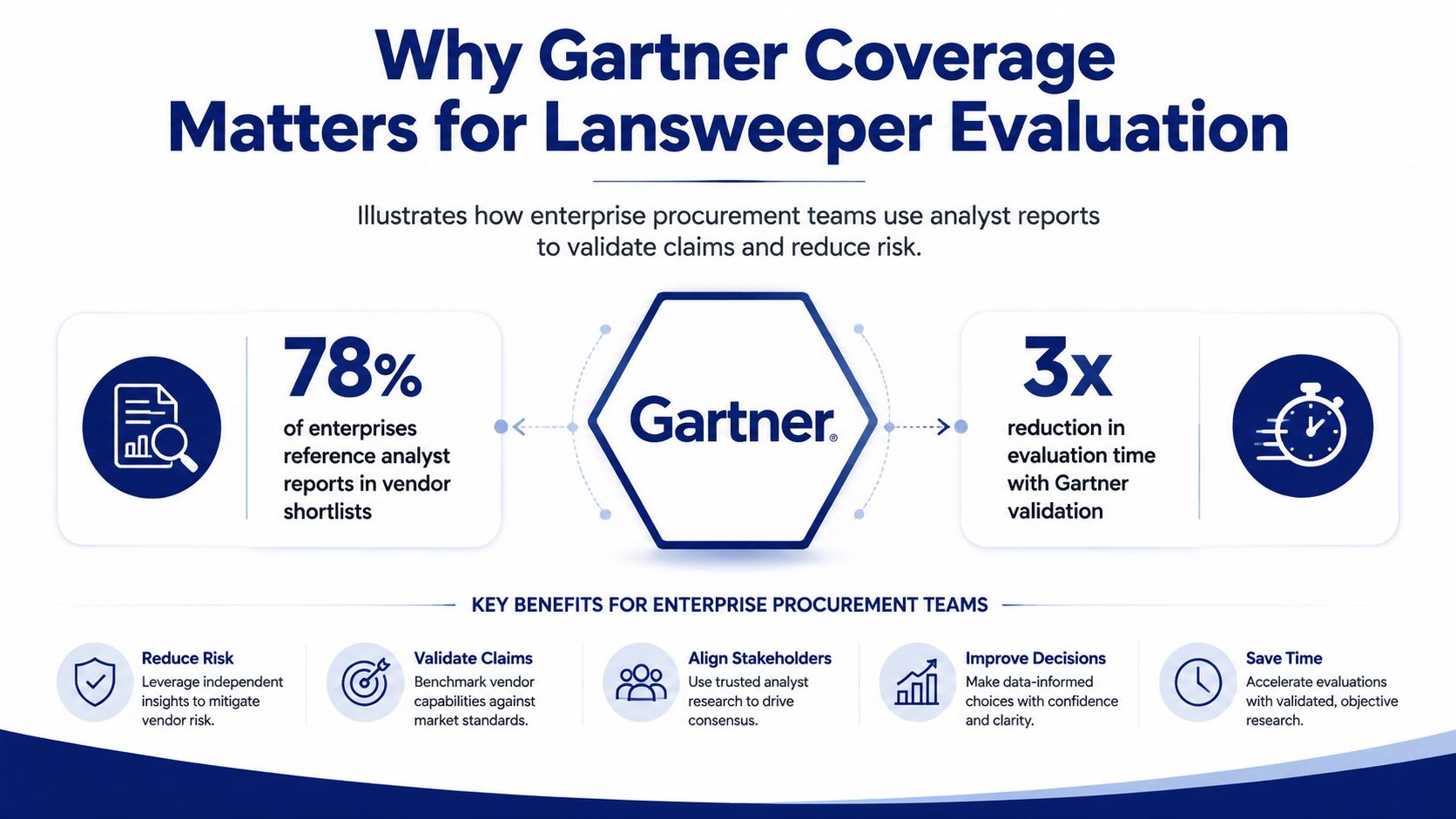
Gartner Peer Insights is useful because it gives buyers a vendor comparison and review ecosystem. Lansweeper's presence across multiple categories signals market visibility and product breadth, but it doesn't prove that the platform will discover every asset in your environment or deliver the integrations you need. Procurement teams should treat category presence as a shortlist signal, not a substitute for technical validation.
Peer reviews add a different type of evidence. They can reveal how customers experience deployment, administration, reporting, and support, while Gartner category descriptions help clarify the operational problem the vendor addresses. Neither source replaces a controlled proof of concept using your own networks, cloud accounts, software estate, and security controls.
Procurement rule: Use Gartner coverage to justify evaluation effort, then use your RFQ and trial to test the claims that affect cost, risk, and implementation.
Finance stakeholders also benefit from this framing. A platform that identifies unknown assets and improves software inventory quality can support renewal decisions, but the business case depends on how quickly your team can turn inventory data into action. For a useful contrast in analyst-led vendor evaluation, compare SysAid Gartner Magic Quadrant coverage, while keeping the evaluation focused on documented capabilities rather than analyst terminology alone.
Mapping Lansweeper Across Gartner Categories
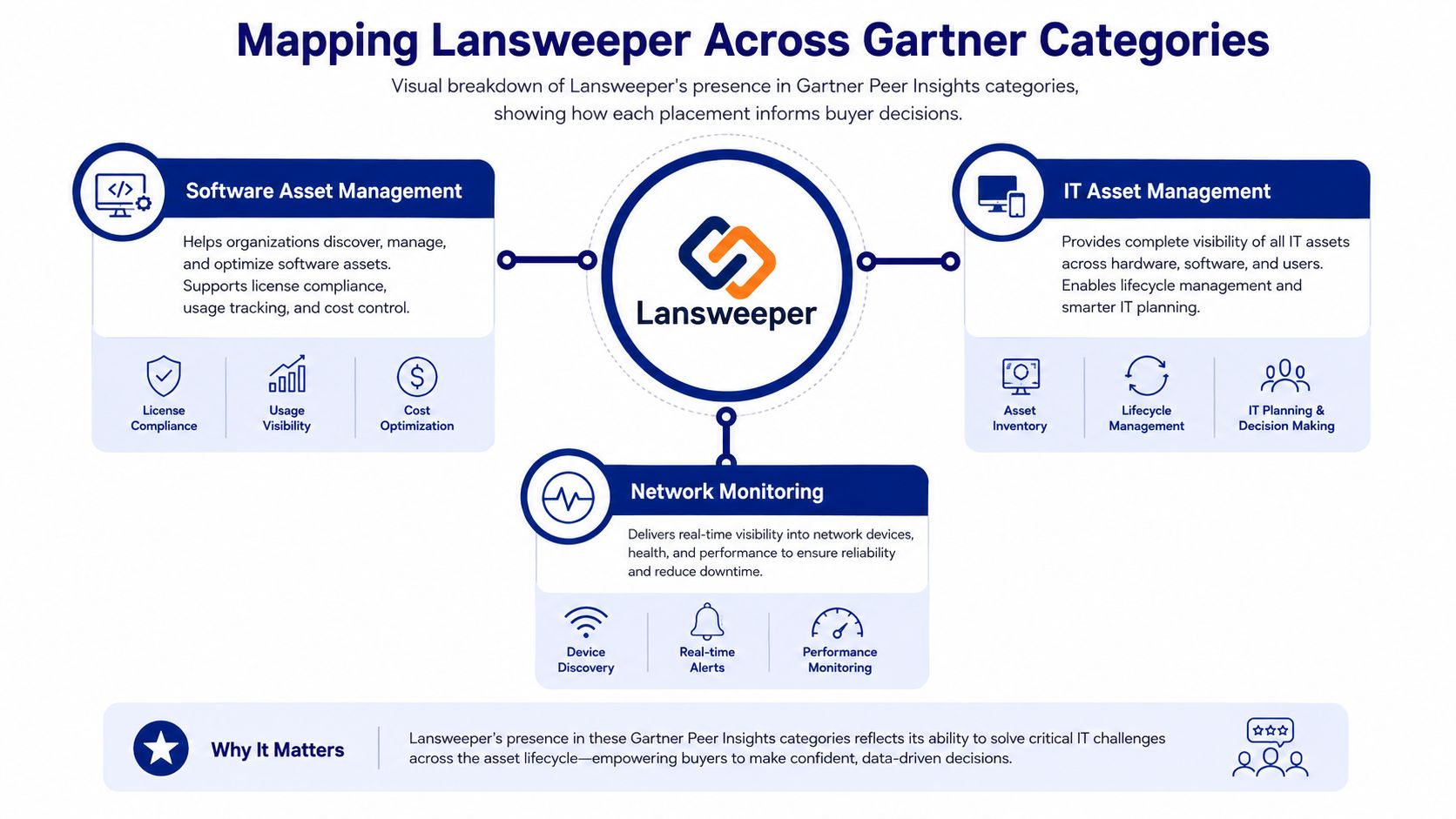
Lansweeper's Gartner category presence becomes useful when translated into separate procurement tests. Software Asset Management addresses license visibility, compliance, and spend control. Hardware Asset Management covers physical asset ownership and lifecycle management. Cyber Asset Attack Surface Management focuses on finding and understanding assets that could increase security exposure. Each category points to different RFQ requirements, so a shared product label should not replace capability-level evaluation.
Software Asset Management Tools
For a SAM buyer, the first test is discovery quality. The platform must identify installed software, versions, ownership, and usage context before your team can challenge renewal quantities or investigate compliance exposure. Gartner's category description highlights centralized asset data, unknown-asset identification, and less time spent on discovery, inventory management, software distribution, licensing, and updates, as documented on Lansweeper's Gartner market page.
The RFI should then test depth. Ask which publishers, licensing models, SaaS services, and entitlement records the platform supports. Require examples showing how installation data becomes a renewal recommendation, an exception report, or a compliance decision. Discovery is an input to optimization, not proof that optimization is available.
Hardware Asset Management
HAM requirements should cover ownership, location, lifecycle status, warranty data, and retirement workflows. Lansweeper's positioning across IT, OT, and cloud assets may suit organizations that need one inventory view for infrastructure extending beyond standard endpoints.
The procurement question is how well that scope holds up in practice. Ask how the system models nonstandard equipment, disconnected environments, and relationships between devices, applications, locations, and owners. A platform that spans software and hardware categories may support a unified inventory strategy, but the buyer must verify the data model and workflow coverage.
Cyber Asset Attack Surface Management
CAASM buyers should assess whether Lansweeper can find unknown or unmanaged assets, enrich records, and provide usable data to security systems. Category presence indicates relevance to security-led asset visibility. It does not establish the quality of integrations, vulnerability context, remediation workflows, or security operations handoffs. Those items belong in a proof of concept and should be tied to acceptance criteria.
Lansweeper was founded in 2004, and its continued visibility in Gartner categories through 2025 and 2026 is relevant to procurement because it indicates an established vendor with a longer period to develop, support, and adapt its platform than a newer entrant. That supports a durability assessment, not a product-fit conclusion. Buyers should still verify current roadmap alignment, support expectations, and technical performance through Gartner Peer Insights vendor coverage.
Strengths and Limitations from Gartner and User Reviews
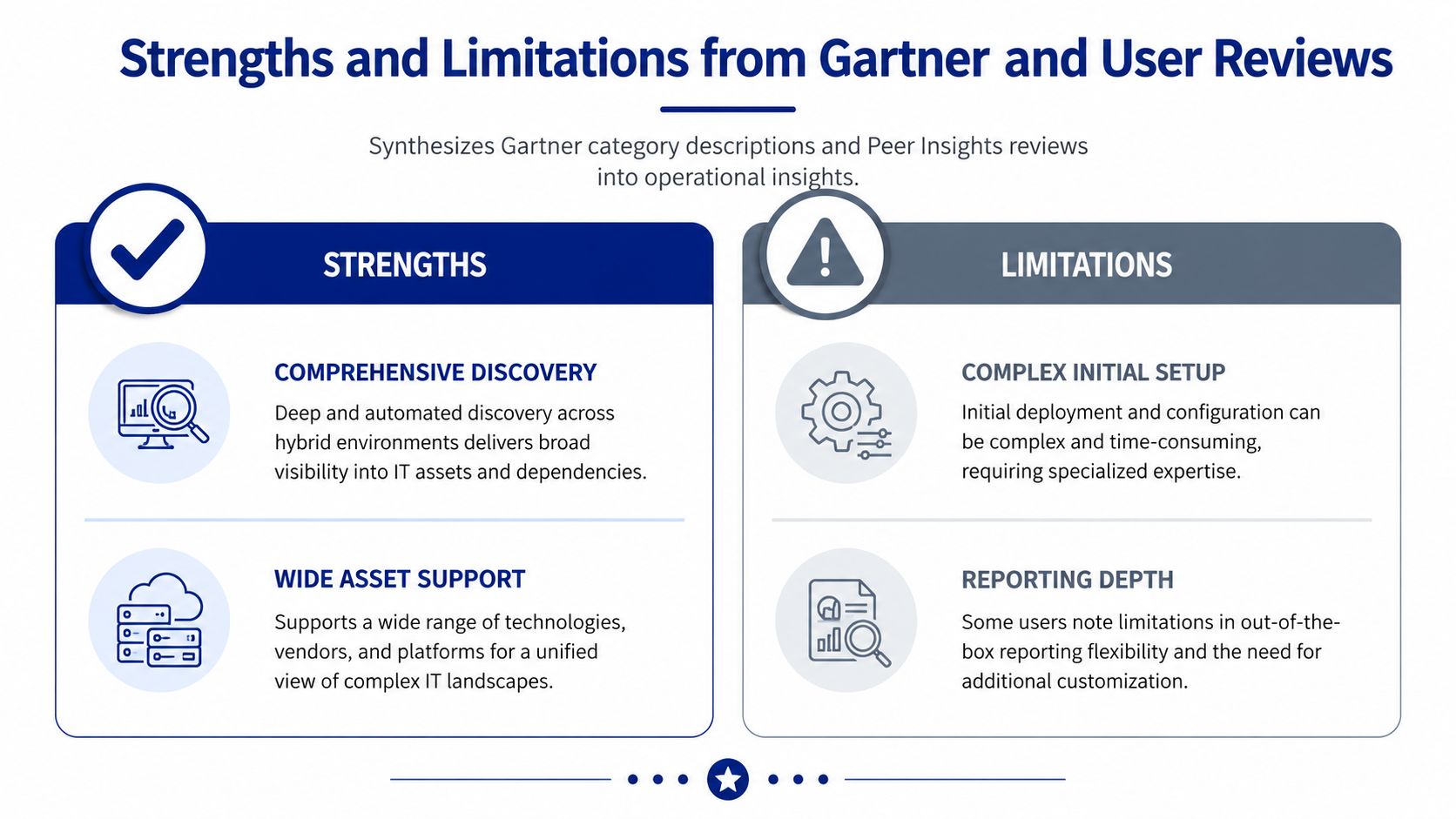
Gartner's category coverage points to four operational outcomes buyers should test: discovering unknown assets, centralizing asset data, reducing discovery effort, and supporting routine inventory and licensing work. These capabilities address a common ITAM weakness, incomplete or outdated records. They do not, by themselves, prove implementation speed, integration quality, or reporting value.
Lansweeper describes a discovery architecture that combines active and passive methods, agentless and agent-based approaches, and data aggregation across physical, virtual, cloud, IoT, and OT assets. That scope may suit estates spanning office networks, data centers, cloud environments, and operational technology. The procurement test is whether the platform produces consistent records across those environments and whether teams can maintain them without excessive manual work.
Strengths to validate
Hybrid visibility: Multiple discovery methods may reduce blind spots associated with relying on one scan technique.
Broad asset support: The platform is positioned across IT, OT, cloud, IoT, physical, and virtual assets.
Centralized inventory: A consolidated view may support patch status, vulnerability exposure, software licensing, warranty tracking, and updates to downstream systems.
Category flexibility: Its presence in SAM, HAM, and CAASM contexts lets different stakeholders assess a shared data foundation.
Limitations to expose before signing
The public review data does not include implementation timelines, integration complexity scores, or customer-reported satisfaction rates. These figures should be requested directly from the vendor during the RFI process. Buyers should also ask how results vary by environment size, asset type, deployment model, and required integrations.
Require a demonstration using your fields, permissions, naming standards, and audit requirements. Have a technical owner test integrations rather than accepting a connector list. Confirm the administrative workload for normalizing records, resolving exceptions, and maintaining governance. Broad discovery has limited procurement value if teams cannot trust, query, and transfer the resulting data into systems that run daily operations.
Essential RFQ and RFI Questions for Lansweeper Evaluation
A good RFQ turns broad product language into comparable answers. Ask every shortlisted vendor the same questions, require written assumptions, and separate included functionality from paid modules, services, or partner work.
Evaluation Category | Critical Questions | What to Look For |
|---|---|---|
Discovery coverage | Which physical, virtual, cloud, IoT, and OT assets can you discover? Which require agents, credentials, integrations, or network access? | A coverage matrix tied to your actual asset classes and network zones |
Data quality | How are duplicates, naming conflicts, stale records, and unknown devices handled? | Demonstrable normalization, ownership rules, timestamps, and exception workflows |
SAM support | How are installations, versions, entitlements, usage evidence, and renewals represented? | A clear path from discovery data to license and renewal decisions |
Integration | Which ITSM, CMDB, SIEM, SOAR, directory, and vulnerability tools are supported? | Live demonstrations, API documentation, synchronization direction, and error handling |
Implementation | What customer resources, access permissions, architecture decisions, and professional services are required? | Named roles, dependencies, milestones, and a realistic deployment plan |
Commercial model | What is the licensing metric, and which discovery sources, reports, integrations, or support tiers cost extra? | A written quote with quantities, assumptions, renewal terms, and change rules |
Support | How are product updates, detection changes, security issues, and escalations handled? | Defined support scope, response process, documentation, and update governance |
The question about commercial measurement deserves special attention. Asset-based pricing, user-based pricing, device-based pricing, and module-based pricing can produce very different long-term costs even when the initial quote appears comparable. Ask the vendor to model growth scenarios using your expected estate, not an abstract reference environment.
For a parallel procurement perspective on enterprise platform demonstrations, review Nuvolo demo evaluation. The same discipline applies here: require the vendor to perform your workflows, not just present prepared screens.
How Lansweeper Discovery Architecture Addresses Hybrid Environments
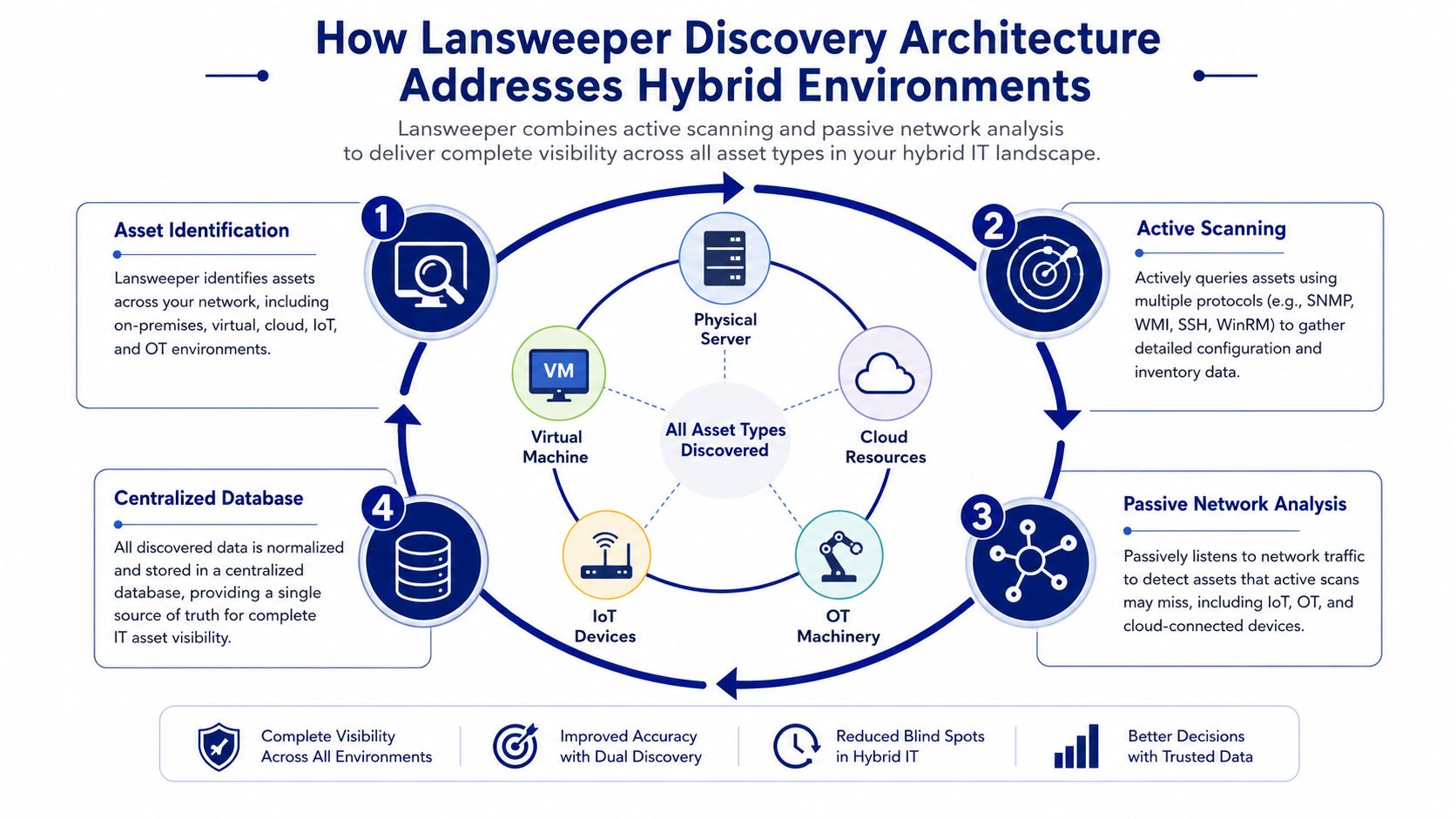
A hybrid estate cannot be assessed reliably through one scan type. Physical servers, virtual machines, cloud resources, IoT devices, and OT equipment expose different data and access constraints. Lansweeper's documented design uses active scanning for reachable endpoints, passive network analysis for devices that may avoid conventional queries, and agent-based collection where installed components are permitted. It also aggregates results across discovery sources, as described in its IT asset management use-case description.
Why multiple discovery modes matter
Active scanning can query reachable assets and collect technical attributes. Passive analysis can expose devices through network behavior, including equipment that does not respond to standard scans. Agent-based collection may provide endpoint details in managed or regulated environments where credential-based queries are restricted.
The procurement question is whether these inputs produce usable, reconciled records. Better coverage can support patch verification, vulnerability review, software licensing, warranty tracking, CMDB updates, and synchronization with ITSM, SIEM, or SOAR tools. Buyers should validate field-level accuracy and freshness, not judge the platform by its discovery-mode labels.
Questions for your architecture review
Use representative estate segments rather than a sanitized laboratory:
Restricted networks: Can the design operate where credentials, agents, or active queries are prohibited?
Cloud ownership: Which cloud accounts, subscriptions, and resource types require direct integration?
OT safety: What scan behavior is permitted for operational technology, and who approves the schedule?
Data freshness: How are scan intervals, passive observations, stale records, and conflicting values displayed?
Performance impact: What controls limit network traffic, endpoint load, and administrative work?
The strongest proof test compares discovered assets with an independently maintained scope list. Investigate each mismatch and require a documented explanation of what the platform found, missed, and why. The evaluation should also record how unresolved gaps will be assigned and monitored. Teams assessing fit can review Lansweeper implementation and platform options against their access model, network boundaries, and audit requirements.
AI Asset Management and Audit Readiness Gap
Traditional SAM starts with software inventory and licensing. AI governance adds a harder question: which assets are AI-capable or AI-active, and how are those assets governed? Lansweeper's AI asset management materials describe discovery and governance of AI systems and claim visibility across a global catalog of more than 5 million software titles, as stated in Lansweeper's AI asset management overview.
That claim is relevant, but it shouldn't be mistaken for a complete AI governance program. An inventory can identify software titles and technology assets. Governance also requires ownership, approved use, data classification, access controls, risk treatment, model or service relationships, and evidence that policies are followed. Procurement teams should ask which of those controls Lansweeper supports directly and which require connected platforms or internal processes.
A Lansweeper presentation citing Gartner states that 30% of organizations admit they don't know which IT assets they own, and that enterprise internal and external hardware and software asset audit requests were expected to rise by 100% by 2024, as described in the cited AI asset management source. These figures frame audit pressure, but the buying implication is more specific: incomplete inventory creates uncertainty before an auditor, security team, or finance owner can determine whether an AI service is approved, licensed, exposed, or redundant.
Use the Device42 compliance and audit resource as a comparison point when defining evidence requirements. Your RFI should request sample audit outputs, asset lineage, ownership fields, change history, and workflows for unknown AI-related software. If the platform identifies AI-capable assets but cannot connect them to accountable owners and control evidence, you'll need complementary governance tooling.
Comparing Lansweeper to Alternative Asset Management Platforms
Lansweeper belongs on a shortlist when discovery breadth is the primary control gap. Its stated combination of active, passive, agentless, and agent-based discovery is especially relevant to organizations managing distributed infrastructure, cloud resources, and operational technology. Buyers seeking a single inventory foundation across several asset domains may value that scope more than a narrowly specialized licensing product.
The alternatives become clearer when you define the problem precisely:
Specialized SAM platforms: Consider these when publisher licensing, entitlement reconciliation, contract interpretation, and audit defense are more important than broad infrastructure discovery.
ITSM platforms with embedded ITAM: These may fit when service workflows, incidents, changes, configuration relationships, and asset records already operate in one established ecosystem.
CAASM-focused tools: These are relevant when the security team needs attack-surface context, unmanaged asset identification, exposure prioritization, and security workflow integration.
Hardware-focused tools: These can suit organizations whose main requirement is custody, location, depreciation, refresh planning, and physical lifecycle control.
Discovery-first platforms: Lansweeper is most compelling here when the organization needs to improve foundational inventory data before expanding governance and optimization processes.
Don't compare vendors using feature labels alone. Compare the evidence each platform produces, the effort required to keep it current, the ownership model for exceptions, and the commercial consequences of adding users, assets, integrations, or modules. Nuvolo's platform overview can help broaden that comparison when an ITSM-centered operating model is under consideration.
The defensible decision is often not “which tool has the most features?” It's “which tool gives the accountable team the most reliable data for its highest-cost decisions?” That answer may differ between security, procurement, infrastructure, and finance.
Next Steps for Procurement Teams Evaluating Lansweeper
Lansweeper offers a 14-day free trial with unlimited access to all features and no credit card requirement, according to the company's product website. Treat the trial as a controlled evaluation, not a product tour.
Days one through fourteen
Define the boundary: Choose representative network, cloud, endpoint, and, where appropriate, OT segments.
Set evidence requirements: Agree on the asset fields, ownership records, software views, audit exports, and integration events that must work.
Test discovery modes: Record what active, passive, agentless, and agent-based methods identify, including exceptions and stale records.
Run a real workflow: Use one software renewal review, security inventory check, or CMDB synchronization scenario.
Capture effort: Document administrator time, access dependencies, remediation of duplicates, and report-building work.
After the trial, separate technical fit from commercial fit. Ask for a quote that states the licensing metric, included capabilities, support scope, implementation assumptions, and renewal treatment. Have finance review the model against the SAM savings case, while security and infrastructure owners validate the data they would consume.
A sound decision package should contain discovery results, unresolved coverage gaps, integration test outcomes, ownership assignments, implementation dependencies, and a documented reason to proceed or stop. That package gives you a strong position in negotiation and prevents Gartner visibility from becoming a substitute for evidence.
Stackingo can help structure enterprise licensing and RFQ comparisons across technology vendors, including Lansweeper, so procurement teams can evaluate requirements and quotes through a more standardized commercial process. Visit Stackingo to submit your Lansweeper requirements, compare available licensing options, and start a procurement conversation grounded in your environment and use cases.
