
Lansweeper Prtg
Meta Title: Lansweeper PRTG: When to Use Each Layer
Meta Description: Compare Lansweeper PRTG for discovery, inventory, monitoring, pricing, and integration. Learn where each fits and where the sync gap appears.
Title: Should you choose Lansweeper or PRTG, or standardize on both?
The popular advice on Lansweeper PRTG gets the frame wrong. These tools aren't clean substitutes, they sit in adjacent layers of the same estate, one discovering and normalizing assets, the other watching those assets in motion. If you buy them as alternatives, you'll likely end up re-buying the missing layer later.
Decision area | Lansweeper | PRTG |
|---|---|---|
Primary job | Asset discovery and inventory across IT, OT, IoT, and cloud | Infrastructure monitoring through sensors and measurements |
Data model | Unified asset records, ownership, lifecycle, software, and configuration data | Time-series telemetry, thresholds, and alert streams |
Scaling lens | Coverage, reconciliation, scan duration, and inventory completeness | Sensor count, polling interval, probe topology, and measurement load |
Best buying question | What do we own, where is it, and is it still active? | What is healthy, what is slow, and what needs an alert? |
Integration value | Feeds lifecycle context into monitoring | Uses sensor behavior to reflect inventory events |
Why Most Lansweeper vs PRTG Comparisons Start in the Wrong Place
The first mistake is treating Lansweeper vs PRTG as if both platforms answer the same question. They don't. Lansweeper is built to discover, classify, and normalize assets, while PRTG is built to monitor performance and availability through sensors.
The layered model matches how estates actually behave
A real environment is rarely “monitored” before it's “known.” Teams first need to find the device, identify it, reconcile duplicate sightings, and decide whether it still belongs in the estate. Only then does monitoring become meaningful, because a sensor tied to the wrong identity creates noise instead of clarity.
Lansweeper's own scale history shows why it belongs in the inventory layer. By June 2021, it said its software had discovered and monitored approximately 100 million connected devices for more than 25,000 customers worldwide from the company's 2021 investment announcement. That is not the profile of a narrow network utility, it's a broad asset intelligence platform.
PRTG sits in a different category. Its sizing is expressed in sensors, not endpoints, and its guidance centers on measurement load, polling intervals, and probe design in Paessler's technical requirements. That's why procurement teams usually make a false binary choice first, then discover they need both layers anyway.
Practical rule: buy the layer you're missing first, not the one that looks closest in a checklist.
Procurement teams should standardize on the first layer, not the final stack
If your estate lacks reliable asset discovery, PRTG won't fix that. It can monitor what it can reach, but it can't create a clean asset record on its own. If your estate already has inventory discipline, PRTG may be the right operational layer to add next.
That's why Stackingo's Lansweeper guide is useful as a procurement anchor for the discovery layer, because it frames the platform as an asset-intelligence decision rather than a monitoring one. The question is not “Which one wins?” The better question is, which layer do you want to standardize first, and how will the second layer inherit identity from it?
What Lansweeper and PRTG Are Built to Do
Lansweeper is the cyber-asset intelligence layer. It combines discovery methods, cloud connectors, and reconciliation logic to build a unified inventory across IT, OT, IoT, and cloud. Its job is to answer what exists, who owns it, what software is installed, and whether the asset still belongs in service.
Lansweeper is about identity, normalization, and lifecycle context
Lansweeper's acquisition of Fing's device-recognition technology matters because it extended recognition beyond conventional enterprise inventory. Lansweeper said it already monitored more than 80 million connected devices for over 25,000 customers, while Fing contributed a database of more than 600 million uniquely identified devices and approximately 10 million newly catalogued devices per month in the acquisition announcement. Stackingo's Lansweeper-Fing analysis frames that as an identity problem, and that is the right lens.
The platform also combines network discovery, agent-based tracking, and cloud connectors for AWS, Azure, and Google Cloud, then reconciles duplicate observations into a unified asset record in Lansweeper's discovery documentation. For procurement, the decision point is inventory completeness across messy estates, not polling speed.
PRTG is about measurement, thresholding, and alerting
PRTG is built around time-series monitoring. Its unit of commerce is the sensor, and each sensor represents one monitored aspect of a device, such as CPU, disk capacity, traffic, or a service check in Paessler's pricing and FAQ material. That makes it a monitoring platform first, and a hardware inventory tool second.
Its technical guidance makes the load model plain. A current dual-core system can monitor roughly 2,000 sensors, with about 150 KB of RAM per sensor and about 200 KB of disk storage per sensor per day at 60-second intervals according to Paessler's system requirements. The design is measurement-heavy by intent.
Practical rule: if the buying discussion is about alerts, intervals, and telemetry volume, you are in PRTG territory. If it is about unknown devices, duplicate records, and lifecycle state, you are in Lansweeper territory.
That is why the two products often sit in sequence, not competition. Lansweeper tells you what should exist. PRTG tells you what is happening right now. Treating them as substitutes leads to weak procurement logic and unrealistic implementation expectations.
Side-by-Side Capability Comparison
The cleanest way to read Lansweeper PRTG is to stop treating it as a substitute choice and compare the layers each product covers.
Capability area | Lansweeper | PRTG |
|---|---|---|
Discovery scope | Strong across IT, OT, IoT, cloud, software, and lifecycle data | Limited to monitored devices and sensor coverage |
Data normalization | Strong, because it reconciles duplicate observations into asset records | Weaker, because it stores monitored states more than asset identity |
Monitoring depth | Limited, since it isn't built around continuous telemetry | Strong, because it's built for performance and availability monitoring |
Deployment topology | Scan engines, agents, cloud connectors, and inventory workflows | Core server, probes, and sensor-based polling |
Integrations | Broad ecosystem for ITSM, CMDB, security, and analytics | Monitoring-centric integrations and alert workflows |
Reporting style | Inventory, ownership, software, lifecycle, and asset views | Threshold, uptime, performance, and sensor-driven reporting |
Best fit question | What do we have, where is it, and is it active? | What's healthy, what's slow, and what needs attention? |
Lansweeper is stronger when the estate is fragmented. That includes mixed hardware, remote endpoints, cloud resources, and environments where ownership data sits in different places. Its value comes from reconciliation, not polling frequency. For a deeper look at deployment specifics, see the Lansweeper 9 deployment details.
PRTG is stronger when the estate is already known and the operational question is performance. It handles sensor mix and polling depth well, but that depth is also its constraint. As sensor counts rise, licensing and system load become part of the decision, not an afterthought.
Where the comparison becomes misleading
Vendor comparisons often flatten “monitoring” into one bucket. That hides the difference between an inventory tool and a telemetry engine, which answer different procurement questions. One helps clean the estate. The other helps watch it.
A better shortlist asks which layer is missing, which layer is already governed, and which team owns the exception handling between them. That framing is more useful than asking which platform is better in the abstract.
How the Lansweeper PRTG Integration Works in Practice
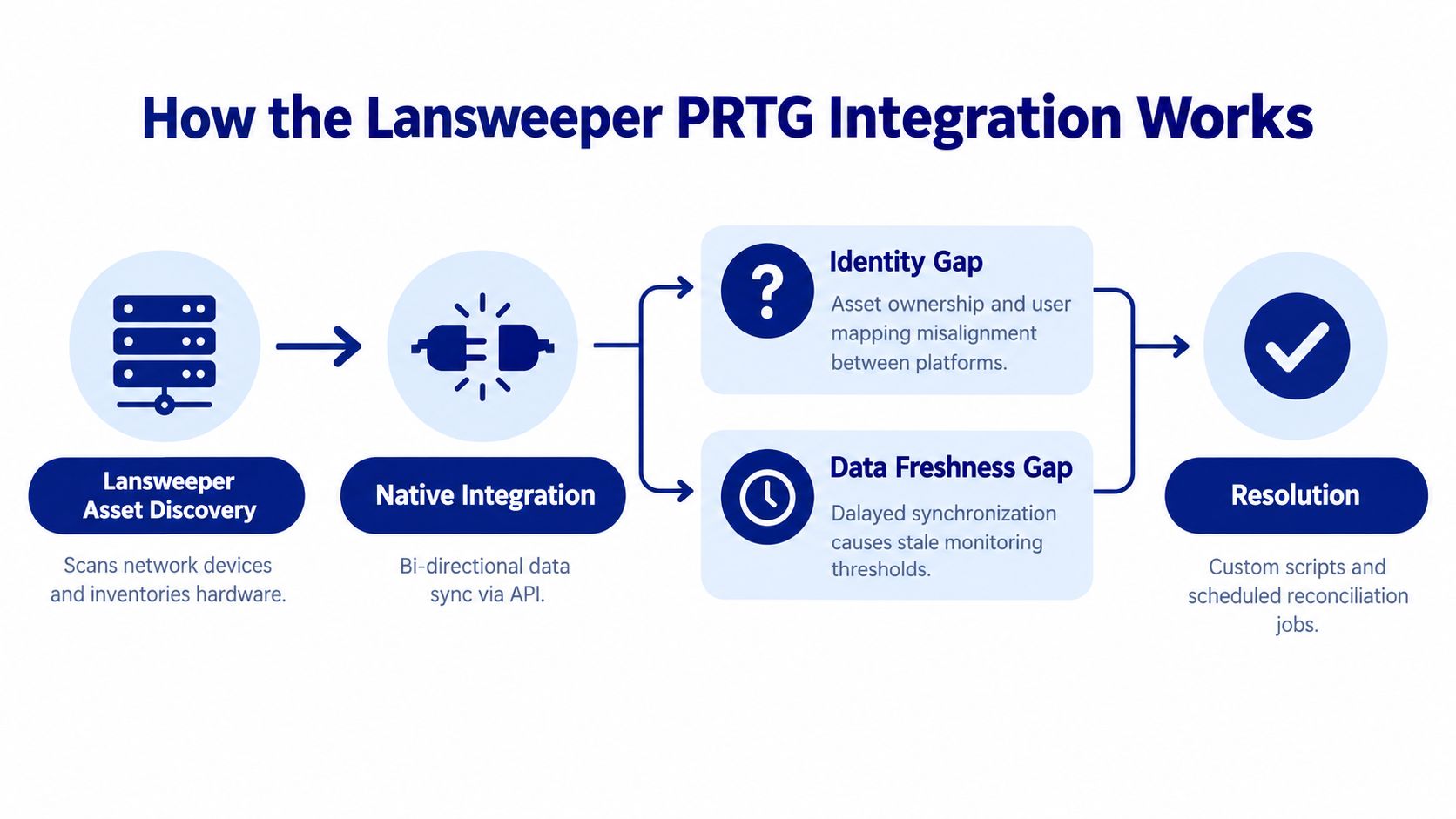
The integration works best as a data-governance workflow, not a feature add-on. Lansweeper contributes lifecycle and identity context, and PRTG uses that context to shape monitoring behavior. The promise is straightforward, but the operational gap is where many organizations run into trouble.
Identity matching is the first real problem
The mismatch is usually mundane. A device may carry different names, IP values, or serial-number availability in each system, so “the same asset” does not always line up cleanly. A practitioner account describes that kind of drift, including a server that went weeks without monitoring, and says API-based comparison workflows were used to catch mismatches in the practitioner write-up.
The right starting point is a canonical identifier strategy. Match on the most stable attributes first, then send uncertain records into an exception queue.
Lifecycle suppression needs guardrails
The second issue is sensor suppression. Lansweeper can signal that an asset is decommissioned or absent for too long, and PRTG can react by pausing monitoring. That sounds clean, but a “last seen” gap can also reflect a segmentation issue, an endpoint failure, or a missing credential.
A safer operating model keeps the human review step in place. Tag assets that look inactive, but do not suppress them yet. Route uncertain matches to an owner for validation. Suppress only confirmed retirements, and keep an audit trail for every sensor-state change.
Event and syslog handling between the two platforms needs the same discipline. For a useful reference point on that pattern, see event and syslog handling between the two platforms.
Practical rule: never let a stale record turn into silent blindness unless someone has explicitly approved the suppression.
Track the integration as a control system
The useful KPIs are operational, not cosmetic. Track unmatched assets, stale monitored devices, time-to-remediate, and coverage by asset criticality. If those numbers do not improve, the integration is only moving inconsistency from one system to another.
That is why buying the integration is not the same as solving the visibility problem. The exception queue, ownership model, and review cadence determine whether the joint deployment becomes a single source of truth or two inconsistent datasets connected by API.
Sizing and Pricing Models for Both Platforms
PRTG's pricing logic is the easiest place to misread the buying case. It is licensed by sensor, not by device, and Paessler's published tiers are PRTG 500, 1000, 2500, 5000, and 10000, covering up to 500, 1,000, 2,500, 5,000, and 10,000 sensors in Paessler's pricing pages. Device counts only approximate the bill, because one environment may consume a few sensors per host while another burns through them quickly.
A 5,000-device estate can price very differently
The same estate can land in very different cost bands. A server estate watched with Ping and SNMP behaves differently from one layered with xFlow, VMware, WMI, Syslog, or Trap Receiver sensors. Paessler's system guidance also says Ping and SNMP create less load than xFlow, VMware, WMI, Syslog, or Trap Receiver sensors, and it recommends one-minute intervals up to about 2,000 sensors and five-minute intervals above that in the system requirements guide.
The procurement question is therefore not “How many devices do we own?” It is “How many monitored aspects will each asset consume?”
A practical read looks like this:
Light monitoring: fewer sensors per asset, lower tier pressure.
Deep monitoring: more sensors per asset, faster tier escalation.
Distributed topology: multiple probes can add complexity even if the device count looks modest.
Lansweeper scales differently
Lansweeper scales around assets and discovery coverage, not sensor count. Its procurement logic tracks inventory breadth, normalization, and reconciliation depth more than telemetry volume. That usually makes budgeting clearer on the discovery side, because the cost driver is the scope of scan coverage rather than the number of metrics attached to each endpoint.
For current Lansweeper price points, see our Lansweeper pricing breakdown.
Procurement note: do not compare a device count on one side to a sensor count on the other and call them equivalent. That can underprice PRTG in deep-monitoring estates and make Lansweeper look artificially expensive in discovery-heavy ones.
Use Stackingo as the commercial comparison layer
If you are standardizing the buying motion, Stackingo can serve as one commercial route for Lansweeper alongside adjacent ITSM, CMDB, and observability tools. Procurement usually spans multiple vendors, even when the evaluation starts with one product.
Enterprise Use Cases That Map to Each Platform
The fit changes with the estate. Retail, manufacturing, education, and MSP work each surface different control points, so the better tool depends on what is failing first.
Multi-site retail and lean IT
Retail teams usually need a reliable inventory picture across many locations. Lansweeper often comes first because the core problem is drift in hardware, software, and ownership records, not continuous telemetry on every register and printer. PRTG matters later, once store uptime and network health start driving support volume.
Regulated financial services
Financial services usually need auditable asset records, software visibility, and tighter ownership discipline. Lansweeper fits the compliance-facing layer, while PRTG sits behind it for uptime and threshold monitoring. The pairing makes sense when audit evidence and service health both matter.
Manufacturing and OT exposure
Manufacturing puts Lansweeper's device-recognition depth to work, especially since the company tied its current IT, OT, IoT, and cloud classification approach to the Fing acquisition as noted earlier. PRTG still has a role, mainly where operational health needs continuous monitoring. The first purchase is usually inventory and classification, not sensors.
Cloud-first SaaS companies
Cloud-first teams often know their application estate well, but they still struggle with endpoint ownership, contractor devices, and shadow infrastructure. PRTG works when the operational requirement is uptime and service response. Lansweeper becomes the stronger first layer when the issue is knowing what assets and software are present.
Education, research, and MSPs
Education and research often operate on tight budgets and mixed device ownership. MSPs need both discovery and monitoring across client estates, but not always in the same ratio. In those cases, the primary buy depends on whether the immediate pain is unknown assets or noisy operations.
If the estate looks like a sprawling facility with mixed endpoints, the image below is the closest mental model for where Lansweeper usually earns its keep first.

Procurement Checklist for Enterprise Buyers
A clean buying process starts by naming the outcome. If you want asset visibility, start with Lansweeper. If you want performance monitoring, start with PRTG. If you want both, define the ownership model before procurement, not after deployment.
Validate the estate before you validate the SKU
Use a pilot that mirrors the actual environment, not a tidy lab. Identity matching should be tested on messy data, because that's where the integration either holds or falls apart. Lifecycle suppression should be tested against critical assets, not just retired endpoints, because the risk of silent suppression is highest where the business impact is worst.
Ask the right demo questions
Identity reconciliation: How does the platform match records when names, IPs, or serial data differ?
Lifecycle handling: What happens when an asset is missing, retired, or only intermittently reachable?
Sensor intensity: How many monitored aspects will each asset consume?
Integration scope: Which ITSM, CMDB, cloud, and security systems need to be fed?
Governance: Who owns the exception queue, and who approves remediation?
Check the commercial model over three years
PRTG's SKU logic is sensor-based, so forecast growth in monitored aspects, not just endpoint count. Lansweeper's value case is easier to evaluate when you tie it to discovery coverage and normalization across the full estate. If the environment is hybrid or multi-vendor, the procurement motion should stay cross-functional, because the integration gap is usually an operational issue, not a software one.
Decision filter: if the team can't explain how mismatches will be resolved, the deployment isn't ready, even if the license is.
For teams that want a single commercial front for this kind of purchase, Stackingo can help structure the RFQ, compare multi-vendor quotes, and keep the buying motion aligned to the actual use case rather than to a single product pitch.
If you're evaluating Lansweeper PRTG for an enterprise stack, use Stackingo to compare the discovery layer, the monitoring layer, and the commercial terms in one place. Visit Stackingo to structure the RFQ, compare options across vendors, and keep the decision tied to the estate you run.


