
Lansweeper Fing
Updated: Oct 10
Lansweeper and Fing solve related problems, but they aren't interchangeable. Fing is strongest when you need fast device discovery and identification, while Lansweeper is designed to turn discovery data into centralized, repeatable asset intelligence. The practical decision is whether a device fingerprint is only a useful hint or a record you can rely on for inventory, compliance, and operational workflows.
Why IT Discovery Choices Matter Now
A CIO can have a network that appears well managed while still lacking a defensible answer to basic questions. Which devices are connected? Who owns them? What software do they run? Which unmanaged sensor, camera, access point, or industrial controller should security investigate first?
The problem becomes visible when a new device appears in a scan and the team has to reconcile it with spreadsheets, procurement records, service desk tickets, and security tooling. A basic ping tool may confirm that something is reachable. It won't necessarily explain what the device is, whether it belongs in the CMDB, or whether its identification is reliable enough to drive a remediation decision.
That distinction makes Lansweeper and Fing strategic architecture choices rather than interchangeable scanner selections. Lansweeper was founded in Belgium in 2004 and has grown into a global IT asset intelligence vendor. Its platform discovers and inventories technology assets, installed software, and users across organizations, while its reported footprint exceeds 25,000 customers and 80 million connected devices according to Lansweeper's company overview.
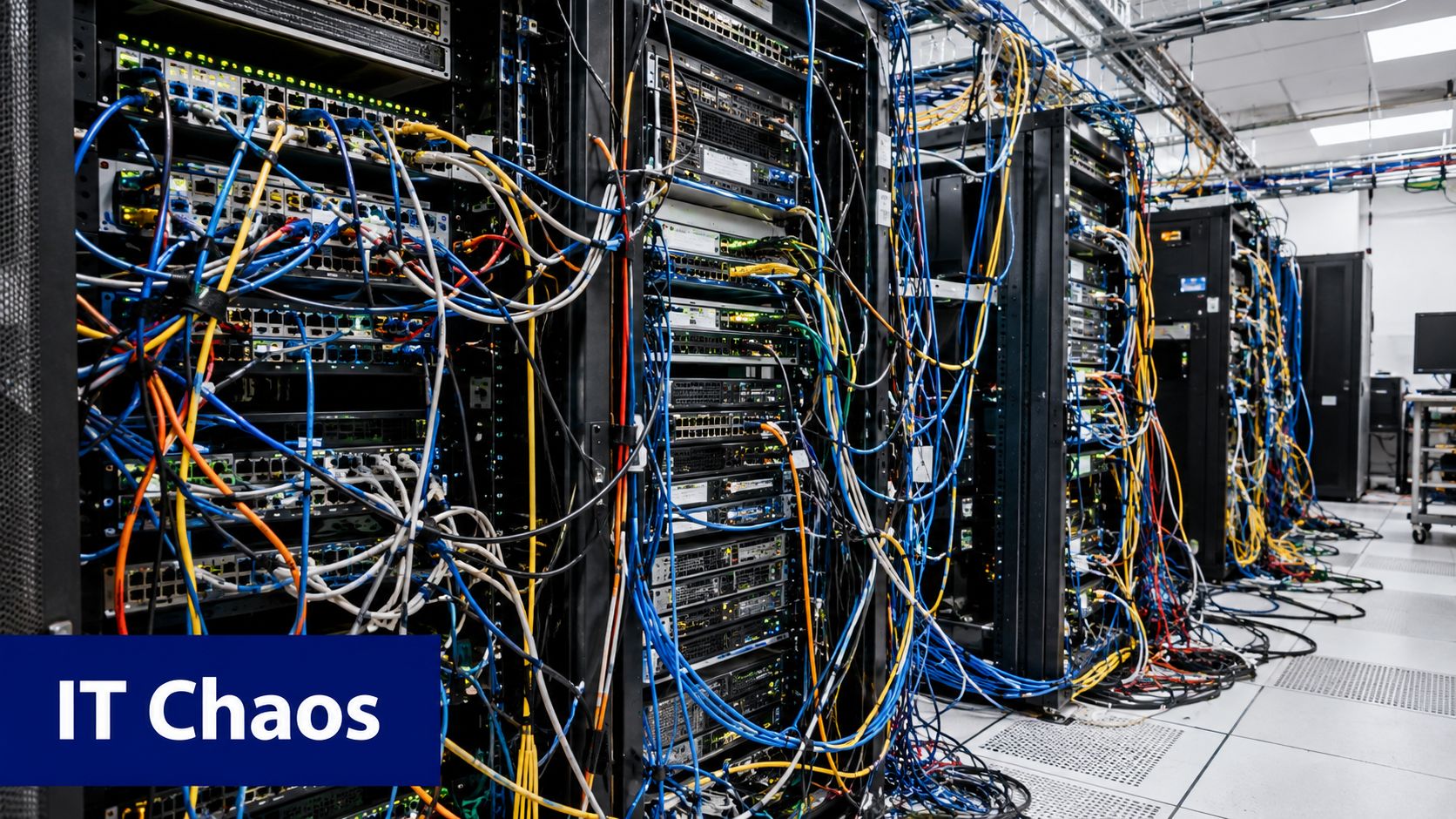
Why a reachable device isn't an accountable asset
Fing's value is immediate visibility. It can help you identify devices on a local network, monitor their appearance or disappearance, and diagnose connectivity problems quickly. That makes it useful for technicians, smaller environments, and targeted investigations.
Lansweeper addresses the next operational questions:
Ownership: Can the organization associate the device with a user, location, or business service?
Lifecycle: Can teams track the asset beyond its first appearance on the network?
Reporting: Can security, audit, and infrastructure teams consume the same normalized inventory?
Confidence: Is the identification signal strong enough for an operational decision?
A device discovery result is therefore an observation, not automatically an inventory record. Treating every observed label as authoritative creates a quiet governance risk, especially in hybrid environments containing unmanaged, IoT, and OT equipment.
Architectural rule: Use fast discovery to reduce uncertainty. Use governed inventory to make decisions.
Lansweeper vs Fing Architecture Comparison
The simplest way to understand Lansweeper Fing is to separate the discovery layer from the inventory layer. Fing is positioned for fast, mobile-friendly device discovery and diagnostics. Lansweeper is positioned for mid-sized and large organizations that need full asset inventory, centralized reporting, and repeatable discovery operations as independent comparisons describe.
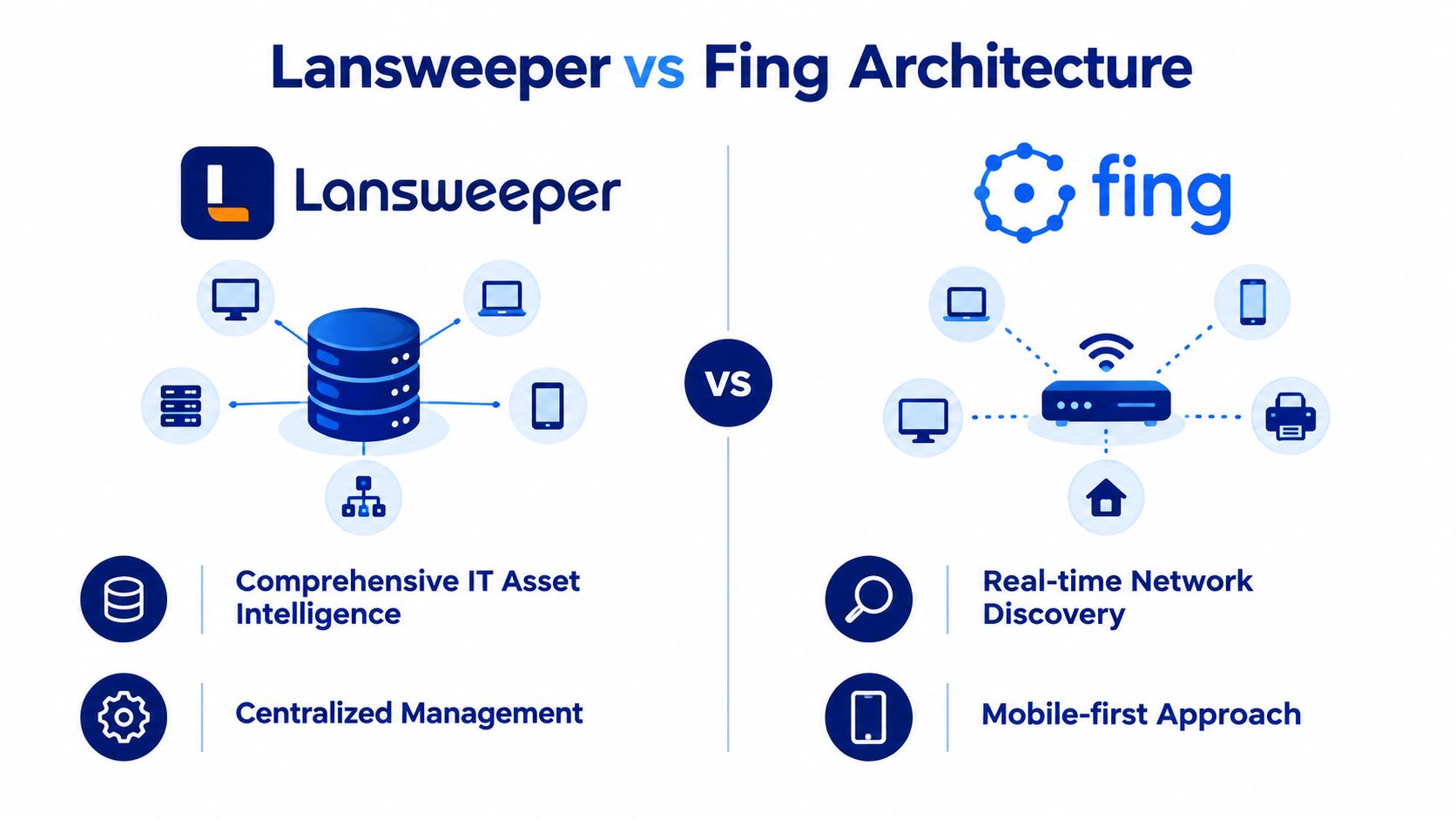
How do their operating models differ?
Fing starts with the network encounter. It scans, identifies, and alerts. Its strength is the speed at which a technician can answer, “What is on this network right now?” The workflow is direct and useful when the immediate objective is local visibility or rapid diagnosis.
Lansweeper starts with the estate. Its discovery data feeds centralized asset intelligence, dashboards, and scheduled reporting. That model supports organizations where the question isn't only whether a host exists, but how its data should be reused across infrastructure, service management, security, and audit processes.
Feature | Lansweeper | Fing |
|---|---|---|
Primary role | Centralized IT asset intelligence and inventory | Fast network discovery and device identification |
Typical operating style | Repeatable, organization-wide discovery and reporting | Mobile-friendly diagnostics and local visibility |
Data outcome | Correlated asset records, dashboards, and scheduled reports | Device recognition, monitoring, and alerts |
Best fit | Mid-sized and large organizations with complex estates | Technicians and teams needing quick network insight |
Operational question | What assets exist, how are they related, and how should teams manage them? | What devices are visible and what might they be? |
Independent expert rankings make a similar distinction. Fing is described as a network scanning tool focused on quick host discovery, device visibility, and alerts when devices appear or disappear. Lansweeper is described as an agentless IT asset management platform that correlates discovery data into dashboards and scheduled reporting in an independent software comparison.
Which architecture fits your operating tempo?
Choose Fing when the team needs a lightweight way to investigate a network segment, validate device presence, or support always-on local monitoring. It can be the right front-line instrument when speed matters more than centralized governance.
Choose Lansweeper when multiple teams need a shared, durable view of the estate. Its value increases when you must connect discovery to asset ownership, software inventory, reporting, service operations, or compliance evidence.
The two tools can coexist, but their outputs need explicit status labels. A Fing-derived identification should enter an inventory workflow as observed or provisional unless the evidence meets the confidence threshold required by your process. Lansweeper's broader engine is required when the organization must transform that observation into an accountable, audit-ready record.
For technical teams evaluating network scanning in more depth, this Lansweeper IP scanner analysis provides a related view of discovery architecture.
Understanding Device Recognition and Fingerprinting
An unmanaged sensor appears on a segmented network with no usable credentials. The first question is not whether a tool can name it, but whether that name is reliable enough for the next action. Device recognition combines observable network attributes with a device knowledge base, so the output is an inference rather than a verified asset record. Fing identifies signals used by Lansweeper-powered technology, including MAC address, DHCP fingerprint, User-Agent, UPnP, Bonjour, NetBIOS, and SNMP information as documented by Fing.
Those signals have different evidentiary value. A MAC address can indicate a manufacturer, while DHCP, SNMP, or protocol data may provide stronger clues about an operating system or device type. Hostnames and vendor rules can help, yet they may be generic, incomplete, or misleading in segmented enterprise networks. The practical boundary is clear: recognition can support investigation, while audit-ready inventory requires evidence that survives review and links to an accountable record.
What does a recognition score mean?
Lansweeper documents a non-linear recognition ranking. Any score above zero is usable, but the operational meaning varies by range. A score of 90 or higher is described as highly accurate, 40 or higher as very reliable protocol information, 20 or higher as usually DHCP best-effort, and 1 to 20 as potentially weak evidence based on NetBIOS or hostname and MAC-vendor rules in Lansweeper's device recognition ranking guide.
That ranking supports explicit acceptance rules:
High-confidence recognition: Suitable for automated enrichment when a wrong label has limited business impact.
Protocol-backed recognition: Appropriate for many operational workflows, with local validation.
Best-effort DHCP recognition: Useful for triage and prioritization, not automatically authoritative.
Weak rule-based recognition: A lead that requires confirmation.
No result: Evidence is unavailable. It does not prove that the device is absent.
A recognized device is not automatically a verified device. The confidence score should remain attached to the record when the result informs vulnerability prioritization, rogue-device response, or compliance reporting. Fing-level recognition is sufficient when the objective is rapid visibility or investigation. Lansweeper's full engine is required when the organization must reconcile observations, enrich ownership and software context, and produce an accountable configuration item.
How does Fing extend credential-free discovery?
Lansweeper's acquisition of Fing was intended to extend discovery with credential-free device recognition and improve asset radar effectiveness in Lansweeper's acquisition announcement. This is particularly relevant for unmanaged IoT and OT equipment, where credentials are not consistently available.
Lansweeper's embedded technology description says Device Recognition is powered by Fing and combines a patented MAC clustering technique with artificial intelligence and machine learning. It describes a foundation of over 2 billion profiled devices, with a predictive model trained to generalize across an estimated 50 billion device types in Lansweeper's OEM technology description.
These figures describe the technology's data foundation, not the accuracy of every result in a specific environment. Network segmentation, suppressed protocols, stale fingerprints, virtualization, and unusual vendor behavior can reduce the evidence available to the recognition engine.
Teams designing a CMDB with Lansweeper should store both the proposed identity and its supporting evidence. A provisional classification can speed investigation, while an acceptance rule prevents it from becoming a definitive configuration item without sufficient confidence.
Scalability, Integrations, and Security Considerations
An enterprise team may identify a device quickly yet still lack an audit-ready asset record. The difference lies in the pipeline: collection, recognition, normalization, storage, reporting, and operational action must connect without losing evidence. Lansweeper's OEM technology page identifies several Device Recognition delivery models, including cloud APIs, multi-platform SDKs, offline databases, and on-premises setups.
How should you test architectural fit?
Begin with networks where credentials are sparse, including IoT, OT, guest, remote, and segmented environments. Request test results for three cases: a recognized device, a low-confidence result, and a device with no available recognition. Fing may provide sufficient identification when the objective is raw device awareness inside a network product. Lansweeper's full engine becomes more appropriate when the result must support shared inventory, reconciliation, ownership, scheduled reporting, or audit review.
Evaluate the operational handoff:
Collection: Which protocols and network attributes can the platform observe?
Recognition: Does the output include confidence or ranking information?
Normalization: Can separate observations resolve to one asset record?
Integration: Can ITSM, SIEM, vulnerability, and reporting systems consume the data?
Governance: Can administrators distinguish observed, enriched, verified, and retired assets?
An API or SDK-oriented recognition layer suits a product team embedding identification into a network experience. A centralized inventory platform suits organizations that need multiple operational groups to work from consistent asset records.
What security controls deserve attention?
Credential-free discovery reduces deployment friction, but it does not remove security responsibility. Network metadata can expose infrastructure details, user context, and device behavior. Review access control, data retention, encryption, tenant separation, administrative logging, and the locations where recognition data is processed.
A device label is not a security verdict. A low-confidence camera classification may warrant investigation, while a high-confidence workstation identity does not demonstrate software compliance. Pair recognition confidence with authenticated inventory when risk or audit requirements demand stronger evidence.
The Lansweeper full-platform overview provides additional context for separating discovery coverage from broader asset operations.
Optimizing Your IT Procurement and Licensing
A technically correct selection can still produce a poor procurement result if licensing, deployment scope, and renewal ownership remain unclear. The commercial team needs the same precision as the architecture team. Define the assets, environments, integrations, confidence requirements, and reporting obligations before comparing quotes.
What should the RFQ contain?
Include more than a product name. Ask vendors or partners to price the operating model you intend to run:
Discovery scope: Include managed, unmanaged, IoT, OT, cloud, and remote environments where relevant.
Deployment model: State whether cloud, on-premises, offline, SDK, or hybrid delivery is required.
Data use: Identify whether recognition feeds a CMDB, service desk, security workflow, or audit report.
Commercial basis: Request clear treatment of subscriptions, modules, support, implementation, and renewal terms.
Validation: Require a proof process for low-confidence and unrecognized devices.
Stackingo operates as a multi-vendor enterprise IT licensing platform. It aggregates software and hardware licenses into an RFQ-led purchasing experience, allowing buyers to capture requirements once and compare structured options across participating OEMs. That model is relevant when your Lansweeper decision involves more than a standalone subscription, especially where procurement must coordinate licensing, integrations, and commercial governance.

How can procurement avoid buying the wrong layer?
Don't license a centralized asset platform merely because Fing can identify a device quickly. Conversely, don't deploy a lightweight discovery tool and expect it to provide lifecycle governance, audit evidence, and organization-wide reporting without the surrounding architecture.
Use the Lansweeper pricing discussion as a starting point for commercial questions, not as a substitute for a requirements-based quote. The right comparison is total operating fit, including data validation, integration work, administration, and the cost of acting on inaccurate inventory.
Final Verdict and Recommendation for Enterprise Buyers
An enterprise team can identify a device within minutes and still lack an inventory record that supports an audit, ownership decision, or lifecycle action. The right Lansweeper Fing choice depends on where that operational threshold sits for your environment.
Fing fits fast network visibility. Use it when a technician must identify devices, monitor a local environment, or investigate an unfamiliar connection without first establishing a centralized inventory process. Its mobile-friendly, diagnostic orientation is useful at the edge of operations, where speed and reach matter more than long-term governance.
Lansweeper fits situations where discovery must become durable asset intelligence. It is the stronger option for centralized reporting, repeatable inventory operations, broader asset workflows, and a shared record used by infrastructure, service management, security, and audit teams.
Which tool should different organizations choose?
Select Fing first when:
The problem is immediate visibility: The team needs to establish which devices are present on a network.
The team is small or mobile: Technicians need rapid diagnostics without a large management workflow.
The output is investigative: A device label helps determine the next action, but does not automatically become an audit record.
Select Lansweeper first when:
The estate is distributed: Multiple networks, locations, environments, and asset classes must feed one operating view.
The output drives governance: Inventory supports service workflows, compliance evidence, risk decisions, or lifecycle management.
The business needs repeatability: Scheduled reporting and centralized data matter more than one-off scans.
Use both when:
Fing provides rapid recognition at the discovery edge.
Lansweeper receives, correlates, validates, and governs the resulting asset data.
The process preserves confidence levels instead of converting every identification into a definitive label.
This combined design separates observation from operational authority. Fing can improve the speed and breadth of observation, while Lansweeper determines whether the observation can participate in an enterprise operating model. The boundary sits past the scan, at the point where a guessed or inferred identity becomes a decision about risk, ownership, compliance, or spend.
Following Lansweeper's documented ranking model, introduced earlier in this article, scores above 90 indicate highly accurate identification, scores above 40 indicate very reliable protocol information, scores above 20 generally represent best-effort DHCP evidence, and scores from 1 to 20 provide weak evidence that requires caution. These thresholds should inform, rather than replace, an internal acceptance policy. A security workflow may require authenticated confirmation, while a technician's triage queue can reasonably accept a weaker signal.
For enterprise buyers, the recommendation is direct. Use Fing where speed and credential-free visibility solve the immediate problem. Use Lansweeper when the organization must defend, reuse, and operationalize its inventory. Procure the selected architecture through a requirements-led commercial process, with licensing and integration assumptions visible before approval.
Stackingo helps enterprise teams structure RFQs for software licensing, compare multi-vendor options, and source Lansweeper subscriptions through one purchasing process. Visit Stackingo to turn Lansweeper and Fing requirements into a clearer commercial evaluation and next step.