
Software Licence Compliance: What Buyers Must Control
Unlicensed software installed on personal computers worldwide carried a commercial value of US$46.3 billion in 2017, according to the Business Software Alliance's Global Software Survey, with 37% of all installations unlicensed, down two points from 39% in 2015. Read as an enforcement story, that number suggests a world of deliberate copying. Read as a purchasing story, it looks more familiar: quotes written in different units, editions picked to fit a budget rather than a workload, and entitlement records that never get compared with what is running.
Most compliance gaps open at the purchase decision, long before an auditor arrives. The audit only prices them.
What Software Licence Compliance Means for Your Business
In 2025, 37% of organizations identified software-licence compliance as their top software-licensing challenge, according to the Azul-ITAM Forum survey of 500 IT asset and software asset management professionals. That's a striking share for a discipline with decades of tooling behind it.
Software licence compliance is the agreement between three records: what you bought (entitlements), what's installed or in use (discovery data), and how the contract counts consumption (the licence metric). Break any one of the three and you have exposure, whether or not anyone meant to underpay.
The work of holding those three in line still falls to people at a desk.

Say a company holds 200 named-user licences for a CRM platform, but 260 staff reach the product through a handful of shared accounts. Nobody downloaded anything from a warez site. The install count might even reconcile. The gap is still 60 users, and a named-user contract prices it as 60 users.
This is why ISO/IEC 19770-1 frames the discipline as an ongoing control system rather than an audit ritual. As SmartSuite's summary of ISO/IEC 19770-1 sets out, the standard requires organisations to control duplication and distribution, retain audit trails for authorisations and asset changes, manage both underlicensing and overlicensing, and reconcile asset data with financial systems.
Discovery supplies the middle record. A tool such as Lansweeper gives you installs, versions and last-used dates across the estate. It can't tell you which metric your contract counts, and that's the part buyers most often skip.
A three-question self-test
Name the metric. For each major product, can you say whether you're licensed by named user, concurrent user, processor, core, instance or consumption unit?
Produce the proof of purchase. Can you pull the quote, order and invoice that match the entitlement currently in force, including territory and term?
Show that the count fits. Can you demonstrate that deployed and active counts sit inside the entitled count, measured on that same metric?
If any of the three goes blank, the gap is in your records rather than in your software. Those gaps are what the next sections price.
Why Compliance Gaps Cost More Than Missed Invoices
Audits find organisations that bought legitimately. A 2022 survey of 283 IT professionals found that 69% of respondents' enterprises had been through a software-vendor compliance audit in the preceding three years, as reported by Businesswire. Exposure climbed with size: 83% of mid-sized companies and 77% of organisations with at least 1,000 employees had been audited.
Where money changed hands, the amounts were not small. Among respondents whose organisations paid compliance-related fees, 29% paid between US$1,000 and US$99,000, 25% paid between US$100,000 and US$999,999, and 10% paid more than US$1 million.
Finding | Share of Respondents | Where It Usually Starts |
|---|---|---|
Use or activation of unlicensed features | 32% | Features enabled by default in new deployments |
Virtualization | 31% | Cluster growth and workload migrations |
Insufficient licence purchases | 25% | Headcount or device growth without a true-up |
Incorrect licence types | 23% | Wrong edition or metric chosen at purchase |
Three ways a clean purchase turns into a finding
A default setting switches on a premium module. The deployment is standard, the edition purchased is not, and nobody checks whether the module sits inside the grant until a usage report lands on a reviewer's desk.
A virtualisation cluster grows. Workloads move onto hosts during a refresh, cores multiply, and the host-level entitlement was sized against the estate as it existed two refresh cycles ago.
The edition doesn't cover the way the product is used. Multi-site access, contractor accounts or integration rights were outside the tier purchased, so users work around the limit instead of reporting it.
None of these requires bad faith. Each is an ordinary operational change meeting a record that never got updated.
The pattern behind the table: the finding is rarely a purchase that never happened. It's a record that stopped matching the estate after the purchase.
For CIOs and procurement leaders the lesson is structural. An effective control environment connects contracts, entitlements, invoices, deployments, users and renewal decisions, because gaps appear exactly where those six stop matching each other. Standardised records and comparable vendor information cut the odds that an audit uncovers something avoidable.
Audit Types and How Vendors Verify Usage
Five exercises get called audits. Each has a different owner, trigger and output, and the number the reviewer produces is only as good as the metric written into the purchase.
Vendor-initiated reviews usually arrive first. A renewal, a contract audit clause or an internal sales review starts the process, and the publisher's licence team typically runs it with an independent auditor alongside. IBM's audit-preparation guide is unusually direct about what that means: verification "typically takes the form of an audit conducted with the assistance of an independent auditor". Expect technical and contractual evidence, not an invoice check.
The split often starts at the quote. One vendor prices by user, another by core or device, and the entitlement file is never tied to the deployment it is meant to cover. The auditor then applies the contract metric to live usage. The shortfall looks like over-deployment. It is usually a purchase recorded in a form the usage report cannot test.
Audit Type | Who Runs It | Typical Trigger | Typical Outcome |
|---|---|---|---|
Vendor-initiated audit | Publisher or its appointed auditor | Renewal, contract audit clause or sales review | True-up invoice and back maintenance |
Third-party verification | Independent auditor engaged for the vendor | Scheduled licensing verification | Reconciled findings report |
Self-assessment | Your ITAM, SAM or procurement team | Pre-renewal or annual review | Internal remediation plan before vendor contact |
Renewal review | Vendor licence or sales team | Renewal or true-up quote | Quote for additional licences |
Due diligence | Acquirer or new owner | Merger, acquisition or divestiture | Price adjustment or indemnity |
A self-assessment run before a renewal strips most of the surprise out of a vendor-initiated audit. Pull last-used dates for every product in scope, because inactive and never-used installations are the cheapest finding to fix, and each inactive install is a licence you may be able to reallocate rather than replace.
What the auditor will ask for
The governing terms for each product, including the version in force when the deployment happened.
The licence metric, stated in the contract's own language.
The calculation logic, so the reviewer can see how the number was produced.
Deployment and user data, with dates.
Virtualisation architecture, including hosts, clusters and standby arrangements.
A record of past changes, such as migrations, upgrades and reorganisations.
That list is a recalculation test. If the metric, the calculation and the dated deployment data sit in separate systems, your team cannot reproduce the figure the auditor will publish.
Audit rights and procedures vary by agreement. Read the audit clause in each product's contract before a notice arrives, because the scope, notice period and evidence you are obliged to supply all come from that wording rather than from the publisher's general position.
Enforcement Actions and Legal Exposure
Enforcement starts where the purchase and the deployment never used the same metric. A quote counted one way, the install another, and nothing linked the entitlement to the machines or users that consumed it. The publisher can then price the gap from its own count.
That shortfall follows a set path. Where it stops depends on the record, not on the tone of the audit notice.
True-up invoice. The shortfall is billed at list or contract price, backdated to when the gap opened.
Back maintenance. Lapsed support or subscription periods are charged at the maintenance rate, on top of the licences.
Restructured contract. The renewal moves to a higher commitment, often multi-year.
Suspension or termination. Product rights can be withdrawn, so a finance problem becomes an availability problem.
Civil claim. The publisher sues for damages for proven infringement.
Criminal exposure. This follows evidence of deliberate infringement or a refusal to cooperate.
Ordinary buying gaps usually stop at step three. The last three follow intent, concealment or stonewalling. A file that states the metric, the quantity and which deployment it covers does more in that moment than an assurance that usage is under control.
The UK government's guidance on intellectual property crime and infringement states that a business may face civil court action and damages for proven infringement, while criminal proceedings can result in unlimited fines or imprisonment of up to 10 years.
What decides the outcome: the offence, the jurisdiction and the evidence. Published penalties are maximums, not automatic sentences.
Keep proof of lawful acquisition, current entitlements, permitted users or devices, renewal status and any restriction on copying or deployment. A missing invoice does not prove infringement. It does make the lawful position harder to show in a dispute, an investigation or a vendor audit, because the chain from quote to install was never written down.
Who Owns Compliance Across the Business
Compliance fails in the space between job titles. Every function assumes another one holds the record, and the record stops being held.
CIO. Sets the policy, the risk appetite and the approval threshold above which a new licence commitment needs sign-off.
Procurement. Owns the quote standard and captures the entitlement record at each purchase, including metric, quantity, territory, term and affiliate rights.
Finance. Reconciles invoices against entitlements and flags renewals that arrive without a matching record.
Legal. Reads the audit clause, transfer restrictions and affiliate definitions before signature.
ITAM or SAM. Runs discovery, reconciliation and audit preparation, and keeps the evidence file current.
Security and infrastructure. Confirms installation and virtualisation rights on hosts, clusters and standby systems.
Business owners. Approve user counts and report joiners, leavers and access changes as they happen.
A split responsibility model creates the gap directly. Only 34% of organizations manage SaaS licensing centrally through ITAM or procurement teams, according to Deloitte's 2025 global ITAM survey, while 23% were still establishing application-portfolio management and clearer approval workflows. Decentralised buying produces shadow IT, fragmented vendor relationships and poor consumption visibility, and no amount of central policy fixes it after the purchase order is raised.
Platforms help only when someone owns the output. Inventory tools such as SysAid asset management hold the device and software record, but a named person has to sign the reconciliation.
Set the cadence deliberately: reconcile quarterly, before every renewal, and at every merger, divestiture or major infrastructure change. Name the signatory for each reconciliation in the policy document, so the question "who checked this" has an answer.
How to Control Licences at the Point of Purchase
A per-core quote and a named-user quote can both look cheap until you try to add them. The lower number often counts a different unit, so the compliance gap is created when the purchase order is raised, not when an auditor arrives. Fixing that mismatch after software is installed means paying for what is already running and then unwinding it. The cheaper moment is while the quote is still a draft.
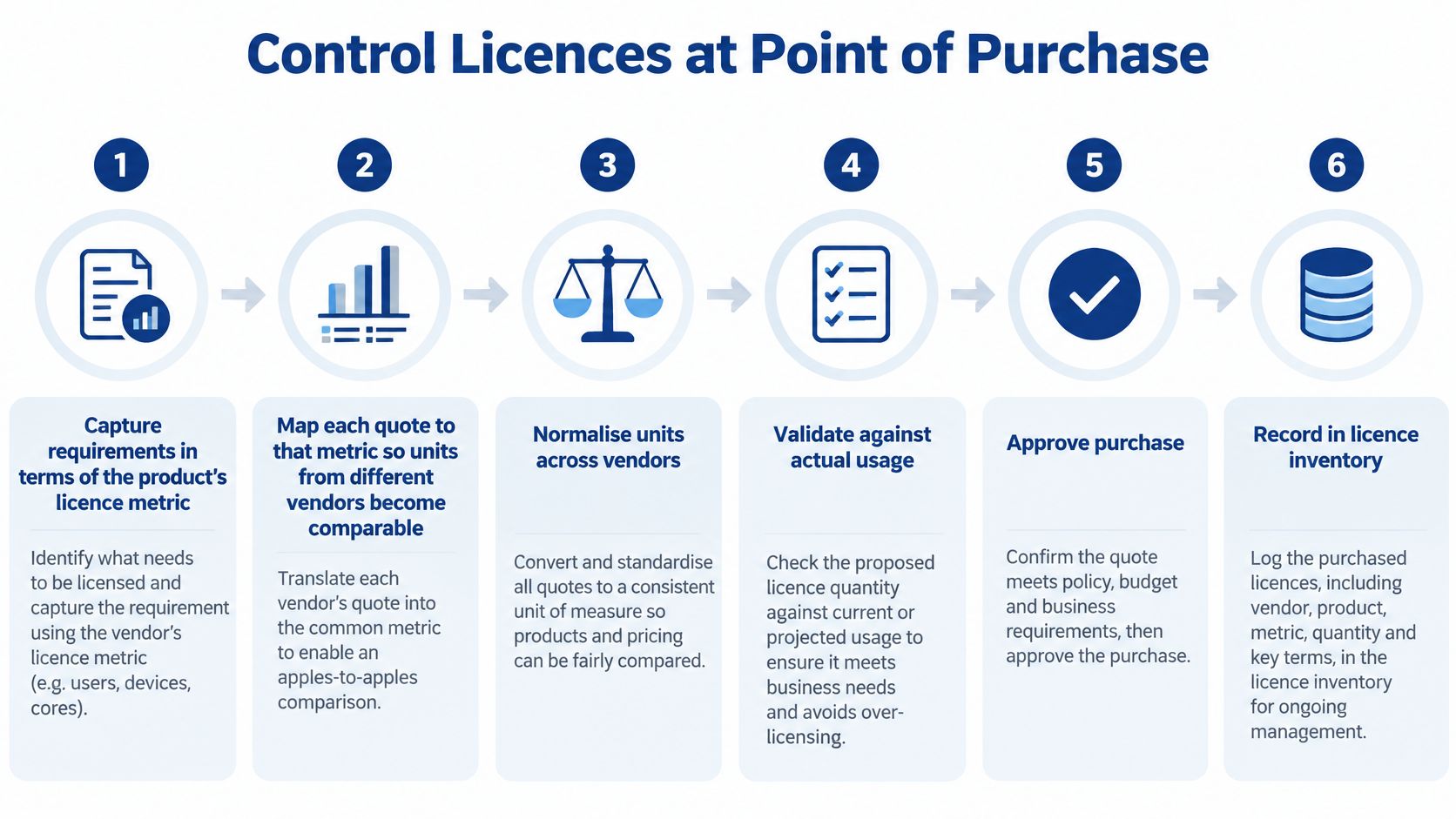
Write the requirement in the product's licence metric before anyone prices it. "200 named users across two territories" can be checked. "A CRM licence" cannot, and the contract will count the unit you left blank.
Capture requirements in the product's licence metric. State the count, the unit and the territory in the request itself.
Map every quote to that metric. Convert units so a per-core offer can be compared with a per-instance offer. Without that conversion, the comparison is confident and wrong.
Record the entitlement fields. SKU, edition, metric, quantity, territory, term, affiliate rights, deployment constraints and proof of purchase.
Route ambiguous language to legal before signature. Virtualisation wording, affiliate definitions and "unlimited" claims change what you are buying.
Release the purchase order only when the record matches the requirement. An incomplete entitlement record is a reason to stop, not a detail to tidy later.
Reconcile after deployment. Treat the purchase record as a hypothesis until discovery confirms what is installed. Pair entitlement data with an inventory source such as Lansweeper alongside Cleverbridge records so install counts and purchase history sit in one check.
Licence Metric | What It Counts | Common Gap |
|---|---|---|
Named user | One licence per named person | Shared logins or unassigned accounts |
Concurrent user | Peak simultaneous sessions | Peak load above the purchased pool |
Processor or core | Physical or virtual cores or processors | Virtualisation on unlicensed hosts |
Instance or virtual machine | Each running or cloned instance | Clones and standby copies without rights |
Consumption or transaction | Units used against a prepaid allowance | Usage beyond the prepaid allowance |
Subscription term | Active term and maintenance status | Lapsed maintenance or expired subscription |
Multi-vendor buying makes step two harder, and more useful. Each OEM quotes in its own commercial unit, so a price comparison that skips metric mapping produces the wrong decision with a tidy spreadsheet behind it. Stackingo is an enterprise IT licensing marketplace where buyers procure software licences from multiple leading OEMs through one commercial front. A licensing expert, not a chatbot, reviews the scope and returns a structured, comparable quote. The multi-vendor RFQ is free to add other vendors to the same request.
Standards already describe the record you want. ISO/IEC 19770-3 sets common terminology and a transport format for encapsulating entitlement data, including the metrics attached to it. A normalised entitlement object can be matched to a deployment. A shared drive of PDFs cannot. Where discovery already feeds a spend view, those structured fields are what connect the invoice to the install.
Backup copies need their own line. EU Directive 2009/24/EC lets a person who has the right to use a program make a backup copy where that copy is necessary for use, and stops a contract from blocking that act. It does not create extra production seats, test environments or distributed copies. Classify each replica as disaster recovery or as a deployment that needs its own entitlement.
ALVAO Asset Management tracks software entitlement against actual installs. Used at step six, that comparison replaces a spreadsheet guess with an install record you can challenge.
Reconcile Licences Before Your Next Renewal
Azul and ITAM Forum's survey found that 27% of enterprises reported spending more than US$500,000 annually resolving software-license non-compliance, 73% had experienced an Oracle Java audit within three years, and nearly 80% had migrated or planned to migrate to open-source Java alternatives. A renewal is the last point at which that spend is still a figure you set. After signature, the same shortfall is priced by the vendor.
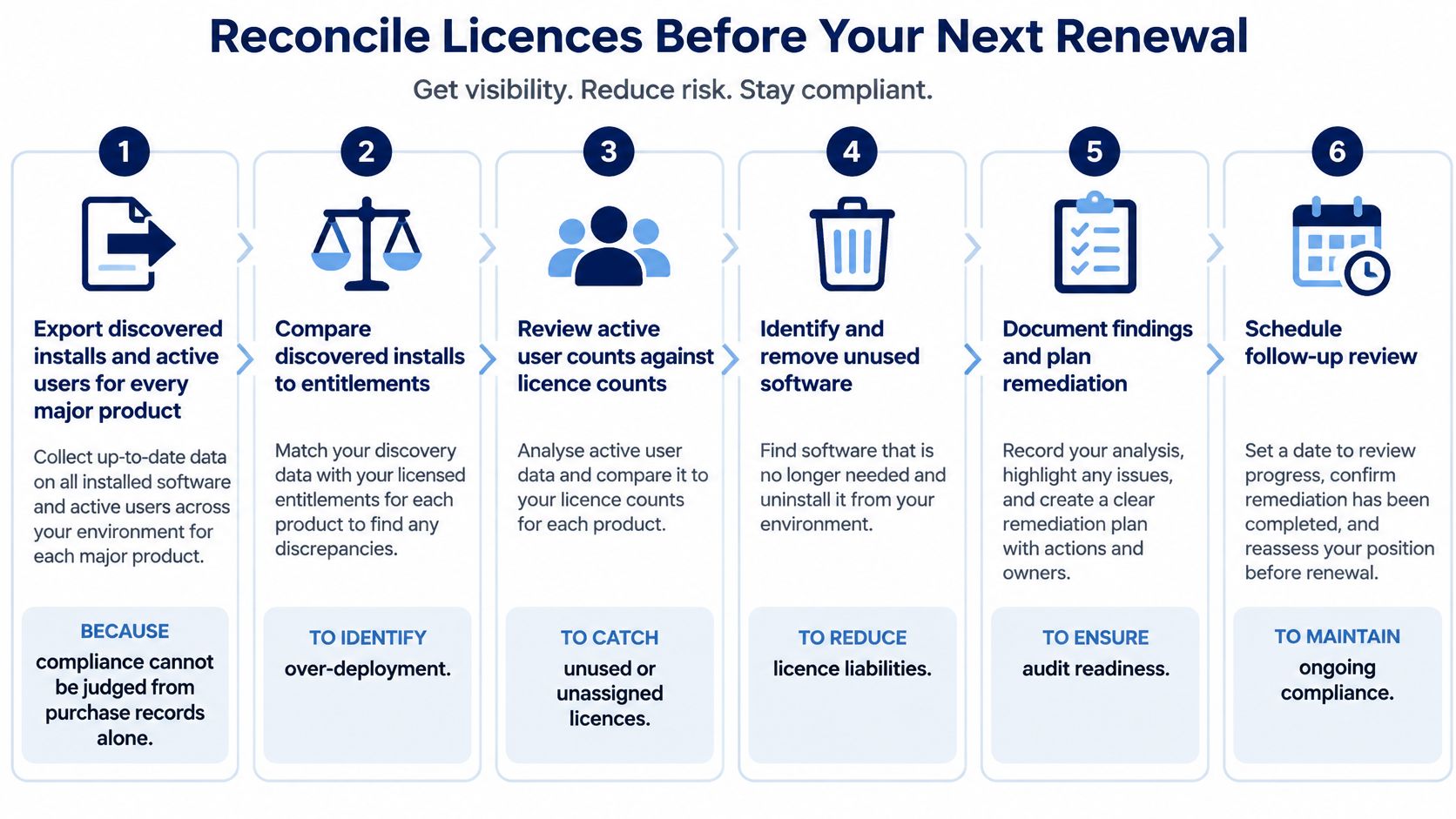
You are closing a term. The test is what the expiring contract will bill against what is running, on the metric that contract uses.
Date an export of discovered installs and active users for every product inside the renewal window. Purchase paperwork describes what was ordered. An auditor asks what is running on the export date.
Read that export against the metric on the contract about to renew. Users, cores and instances are separate bills. An install total does not say which one the renewal will charge.
State the movement per product and per metric since the entitlement already on file. One invoice line can stay flat while a single metric grows.
Assign each movement a disposition before the order is drafted. True-up on the new term, reallocation from inactive users, uninstall before the term starts, or an item held out for legal review. Reallocation is usually the lowest-cost disposition, and the one most often left off the order.
Cost every disposition across the full new term. Set true-up, contract restructuring, a smaller deployment and migration side by side on support, integration, training and administration, not on licence fees alone.
Write the chosen disposition, the date and the owner into the entitlement record. The reasoning has to survive the next reorganisation.
Book the following reconciliation, with a named signatory, before that later renewal date.
Migration carries switching costs, support obligations, security governance, compatibility testing and a new set of licence obligations to document. Price it as one scenario among those above.
Microsoft 365 is a useful rehearsal, because assigned licences and active accounts diverge constantly. Lansweeper's view of Office 365 seats against activity shows assigned seats against genuine use: the licence you hold, and the licence the renewal needs.
Blocking rule: a renewal or new purchase with an incomplete entitlement record waits, however urgent the vendor says the deadline is.
Stackingo turns multi-OEM licence buying into one structured RFQ. A licensing expert, not a chatbot, reviews your scope and returns a comparable quote with guaranteed discounts. If the entitlement record and the deployed estate have drifted apart, have that conversation before the renewal date. Start the request at Stackingo.


