
Lansweeper Cleverbridge: How the Billing Partnership Works
Updated: Oct 10
You've received a Lansweeper renewal email, but the invoice points to Cleverbridge, the license is managed in Lansweeper, and your finance team wants to know who owns the commercial relationship. The answer is straightforward: Lansweeper provides the IT asset management platform, while Cleverbridge may handle billing as merchant of record. That split affects invoices, tax treatment, payment changes, renewal notices, and license-key administration.
What Lansweeper and Cleverbridge Actually Do
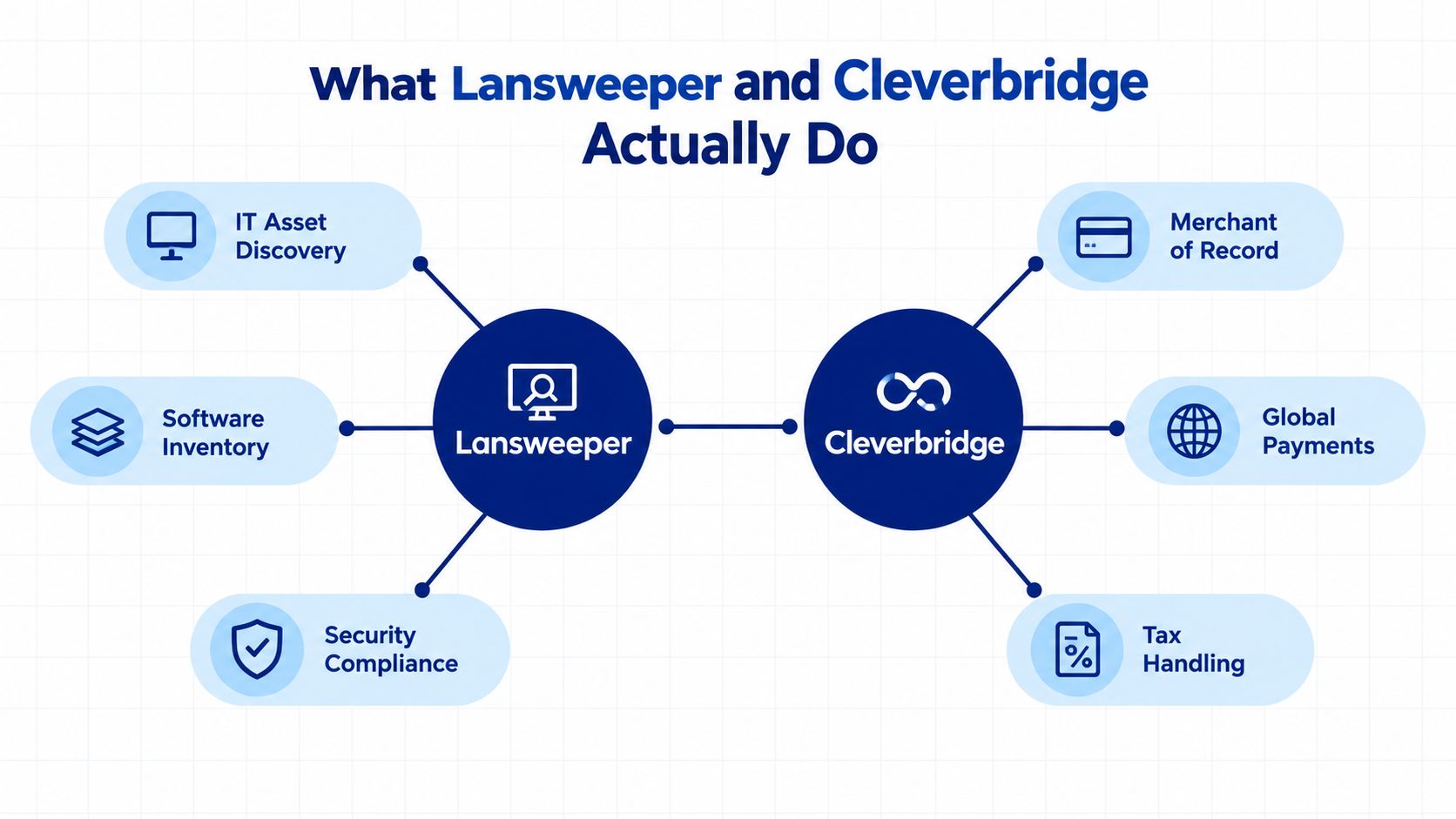
Lansweeper and Cleverbridge solve different problems. Lansweeper is the software platform used to discover and inventory technology assets, installed software, and users. It gives IT, security, and operations teams a structured view of their environment, while Cleverbridge provides the digital commerce layer that supports software purchasing and recurring billing.
Lansweeper was launched in 2004 as a platform for technology asset discovery and inventory. By June 2, 2021, the company had closed a €130 million minority investment from Insight Partners, remained profitable, and employed more than 150 people across offices in Europe and the United States, according to Lansweeper's investment announcement. Independent company data reported total external funding of about $159 million across two rounds and employee counts around 416 to 418 in 2026, illustrating the vendor's growth from a long-running software business into a larger enterprise platform.
Cleverbridge operates on the commercial side. Its merchant-of-record role can cover checkout, recurring payments, invoicing, tax handling, fraud prevention, and payment security. In practical terms, Lansweeper manages the product entitlement, while Cleverbridge may manage the transaction and billing record.
That distinction matters during procurement. Your administrators may work inside Lansweeper, but your accounts-payable team could receive documents from Cleverbridge. For a broader explanation of the platform itself, see this Lansweeper asset management overview.
Practical rule: Treat product ownership and billing ownership as separate workstreams from the first purchase order.
How the Partnership Started and Why It Lasted
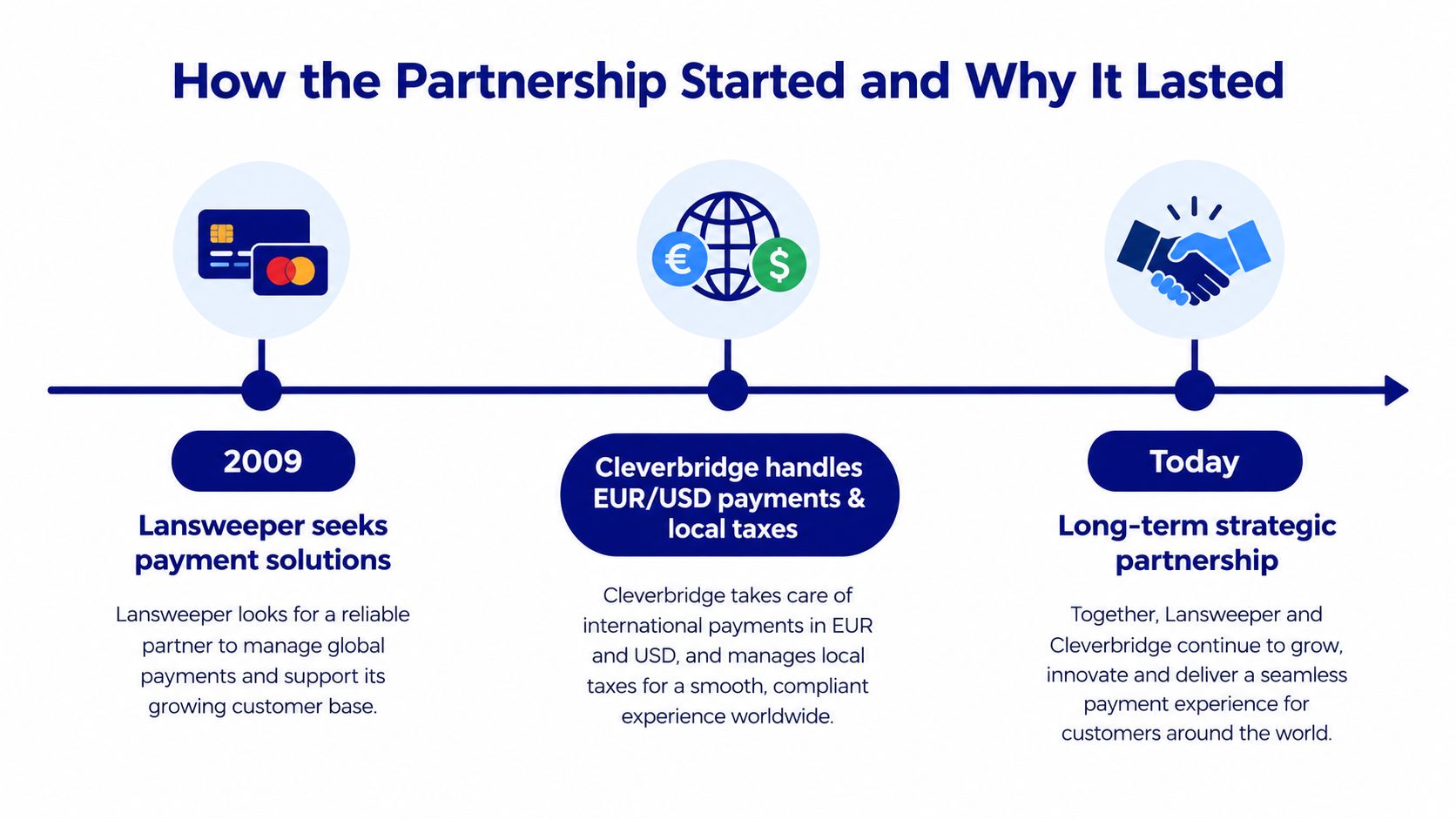
The Lansweeper Cleverbridge relationship dates back to 2009. Lansweeper relied on Cleverbridge's digital commerce capabilities while developing its international software business, and the relationship later supported a move from perpetual licensing toward subscriptions. A Cleverbridge case study on Lansweeper's subscription revenue describes the expansion of that partnership and its Quote-to-Cart workflow, including personalized, pre-populated checkout pages generated from Salesforce.
That history is more important than the payment screen itself. Lansweeper had an established commerce relationship before subscription billing became central to software procurement. Cleverbridge's role could support recurring transactions, customer checkout, and commercial workflows without requiring Lansweeper to recreate every international billing process internally.
Cleverbridge's own business history also matters. An industry profile reported that the company had been profitable every year since 2007 and was already serving customers including Dell, Corel, Acronis, and Avira by the time of publication, as described by Tech.eu's Cleverbridge profile. That gives buyers useful context. This isn't an improvised payment gateway attached to Lansweeper after the fact. It's a long-running commerce platform used to support software monetization.
The partnership also survived major changes in Lansweeper's corporate story. Lansweeper was acquired by Dovesco in 2018, then reached its Insight Partners financing milestone in 2021. The continued billing relationship suggests that Cleverbridge became part of the operating infrastructure rather than a temporary checkout vendor.
The Merchant-of-Record Split Inside the Lansweeper Portal
The most important point for procurement is this: your Lansweeper portal doesn't always tell you who owns the billing relationship. Lansweeper's Subscription Portal separates customers by billing route. If Cleverbridge handles the account, the portal directs billing and payment management into the Cleverbridge flow. Direct-billing customers remain in Lansweeper's own portal, as explained in the Lansweeper billing and payment documentation.
That creates two connected relationships. Lansweeper remains responsible for the platform, license entitlement, product access, and technical support. Cleverbridge handles the commercial administration where it is the merchant of record, including the payment record, billing documents, and relevant payment-management actions.
What changes between direct and Cleverbridge billing
Touchpoint | Direct from Lansweeper | Lansweeper via Cleverbridge |
|---|---|---|
Seller relationship | Lansweeper manages the commercial transaction | Cleverbridge manages the transaction as merchant of record |
Billing portal | Managed inside Lansweeper's portal | Customer is directed into the Cleverbridge billing flow |
Invoice ownership | Invoice comes through Lansweeper's billing route | Invoice and payment record come through Cleverbridge |
Product access | Managed by Lansweeper | Still managed by Lansweeper |
License key | Issued by Lansweeper | Issued by Lansweeper after the relevant renewal or purchase |
Billing questions | Lansweeper billing or sales contact | Cleverbridge billing path, with Lansweeper involved where needed |
Technical support | Lansweeper | Lansweeper |
The distinction becomes visible when a finance team changes a credit card, requests billing documentation, disputes a charge, or asks for tax details. Those actions should follow the merchant-of-record route, not automatically the product support route.
For enterprise teams mapping the platform into a wider configuration-management program, this Lansweeper full product guide provides useful product context. Keep its commercial boundary separate from the invoice workflow.
Renewal Mechanics Every Buyer Should Understand
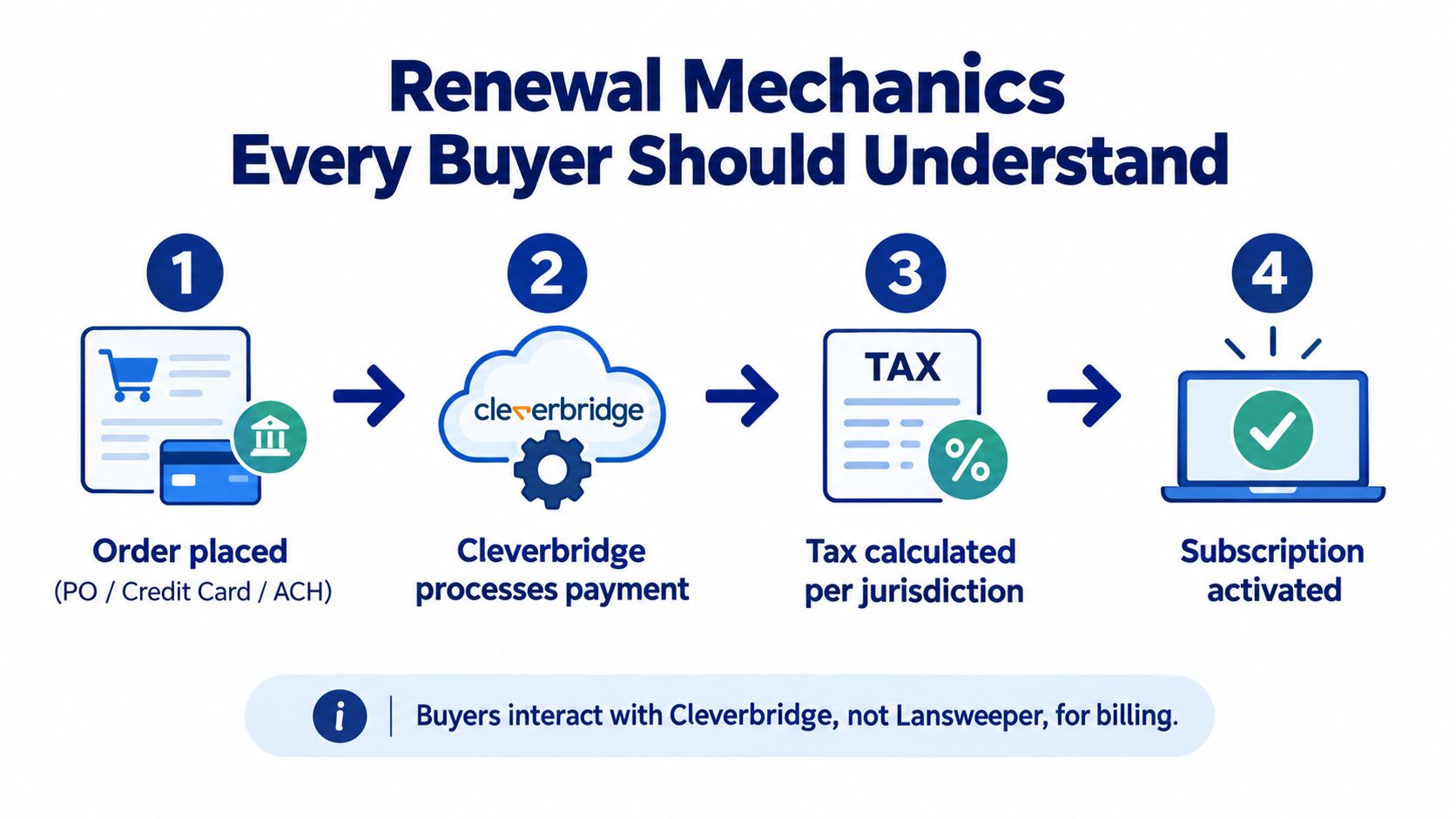
A Cleverbridge renewal follows a predictable sequence, but buyers often miss the point where action is required. Most Lansweeper subscriptions renew automatically on a 1-year or 3-year interval, and the billing contact receives an automated renewal email 14 days before expiry, according to Lansweeper's renewal guidance. Other Lansweeper documentation describes renewal notifications that may arrive 14 to 60 days before expiry, depending on the billing path, so you should verify the schedule attached to your account rather than rely on a generic calendar.
The renewal sequence
The subscription approaches its expiry date. The billing contact receives a renewal message with the relevant instructions. If auto-renewal has been canceled, the automated reminder won't arrive, and the buyer must contact Lansweeper to arrange renewal.
The buyer confirms the commercial route. Billing and payment management stay with Cleverbridge when Cleverbridge is the merchant of record. Direct-billing customers use Lansweeper's portal and billing process.
The renewal is processed. The renewed subscription creates a new license key. The new key must be applied to the installation to maintain the correct entitlement.
The buyer updates the deployment. The confirmation email includes the receipt and instructions for obtaining the newly generated key. The renewal documentation also confirms that the current and renewed subscriptions can't overlap through an early renewal, although buyers can approve renewal in advance.
The operational trap is simple. If you need to change the bill-to entity, replace a payment method, obtain a purchase-order form, or move from one procurement route to another, don't wait for the final reminder. Your renewal path may require separate coordination between finance, Lansweeper, and Cleverbridge.
You can use this Lansweeper pricing reference as a starting point for commercial planning, but treat renewal pricing as account-specific. Online-store pricing may apply to new subscriptions and not necessarily to renewals.
A renewal isn't complete when the invoice is paid. It's complete when the new license key is applied and the installation recognizes the renewed entitlement.
Buying Through Cleverbridge Versus Direct OEM Versus a Multi-OEM Marketplace
The right procurement route depends on whether Lansweeper is a standalone purchase or one item in a larger software portfolio. Cleverbridge is convenient for transactional buying, direct OEM procurement offers deeper commercial control, and a multi-OEM marketplace can reduce fragmentation across vendors.
Criterion | Direct OEM / Reseller | Cleverbridge Marketplace | Multi-OEM Marketplace, Stackingo |
|---|---|---|---|
Price flexibility | Usually strongest for negotiated enterprise terms | Limited at checkout | Quote-based, depending on partner and requirements |
Tax handling | Buyer and seller follow the agreed regional structure | Merchant of record manages the applicable commerce workflow | Marketplace or reseller structure manages the commercial route |
Renewal visibility | Depends on account team and contract owner | Automated, but tied to the billing record | Can be consolidated across participating vendors |
Contract consolidation | Often one vendor relationship per product | One Lansweeper product relationship | Multiple software vendors under one procurement front |
Vendor access | Direct escalation and sales relationship | Product support remains with Lansweeper, billing follows Cleverbridge | Marketplace coordinates procurement, with vendor access depending on the arrangement |
Best fit | Complex enterprise negotiation | Fast, low-friction subscription purchase | Portfolio-wide license consolidation |
Direct OEM procurement is the better route when you need negotiated terms, a custom agreement, a defined escalation path, or a broader enterprise deployment discussion. It also gives procurement a clearer opportunity to align licensing with legal, security, and supplier-management requirements.
Cleverbridge works well when the priority is fast online purchasing and straightforward recurring billing. The trade-off is that the checkout experience generally doesn't give you the same negotiating power as a structured enterprise sales process.
A multi-OEM marketplace such as Stackingo can consolidate Lansweeper with other software licensing decisions through a shared RFQ and commercial workflow. That approach is most useful when the same team is managing several IT asset, ITSM, software asset management, or enterprise-platform renewals. For buyers assessing how Lansweeper fits into a configuration-management database, this Lansweeper CMDB resource is a relevant planning reference.
My recommendation is direct. Use Cleverbridge for a contained, low-complexity purchase. Use direct OEM procurement for a strategic Lansweeper deployment. Use a multi-OEM marketplace when your real problem is supplier sprawl, not merely the next Lansweeper invoice.
Hidden Costs in Marketplace Billing That Buyers Rarely Track
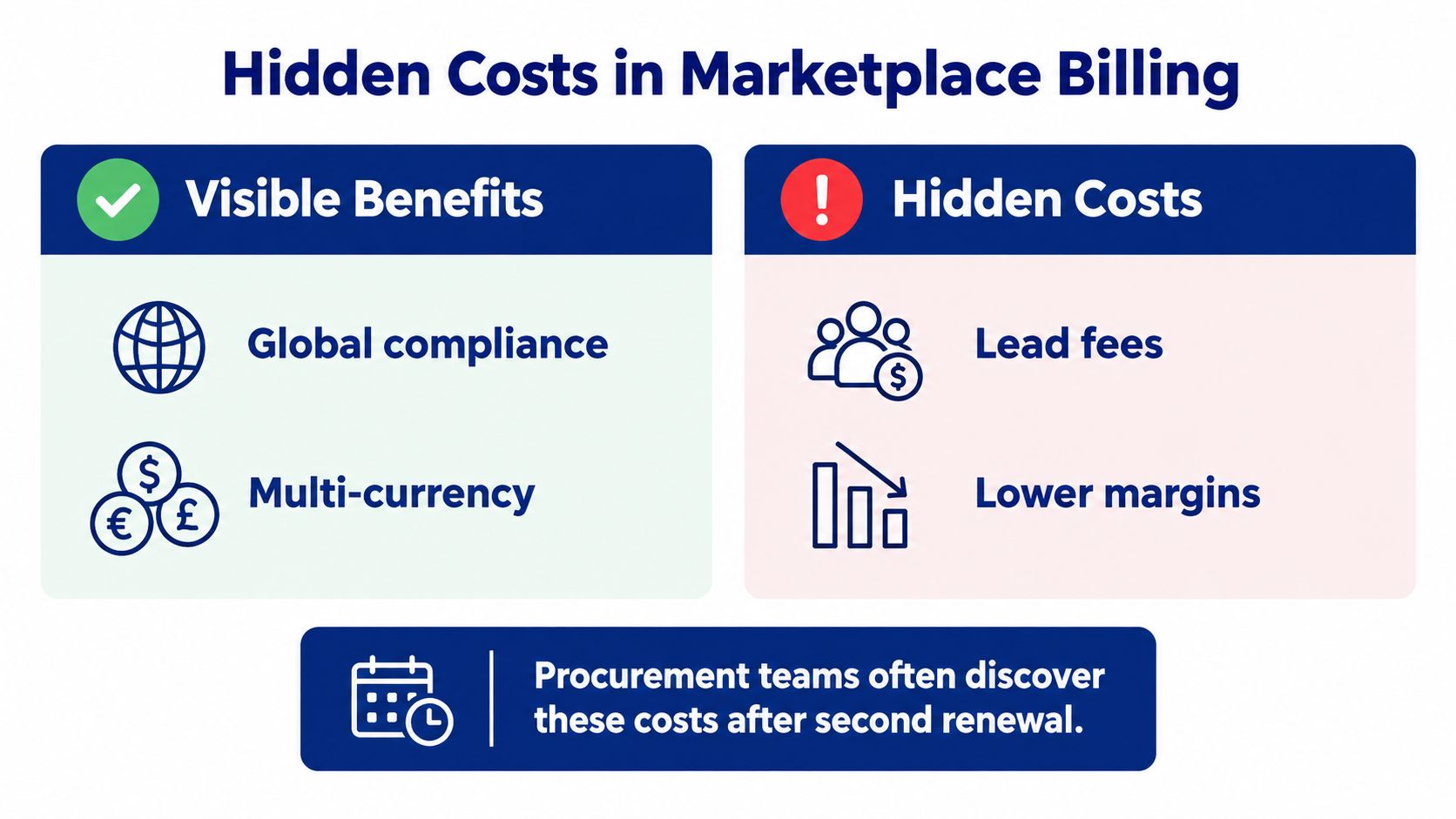
Merchant-of-record billing removes work, but it doesn't remove commercial complexity. The visible benefit is convenience. The less visible cost appears in renewal timing, invoice ownership, tax controls, and the effort required to reconcile records across systems.
Lead time becomes a procurement constraint
An automated renewal route can make the buyer passive. The account renews under the existing setup unless someone checks the term, payment method, bill-to entity, and cancellation status early enough. That matters when procurement needs to run a competitive quote, consolidate adjacent tools, or move the purchase into a broader software agreement.
Finance owns a different vendor record
When Cleverbridge is the merchant of record, accounts payable receives commercial documentation from Cleverbridge rather than directly from Lansweeper. That can affect vendor-master records, spend categorization, invoice matching, tax documentation, and renewal ownership.
Cleverbridge's role extends beyond checkout. Its current merchant-of-record positioning emphasizes global tax compliance, fraud prevention, and payment security. For a buyer, that can transfer operational responsibility away from the internal finance team, but it can also make the transaction less transparent to teams that expect the software publisher's name on every commercial document.
Tax convenience isn't always tax optimization
A merchant-of-record structure can simplify cross-border tax handling, but your tax team should still confirm how invoices support local accounting, exemptions, and input-tax treatment. Don't assume that a compliant invoice is automatically the most advantageous invoice for your organization.
The same review should cover currency conversion, payment-method costs, internal approval time, and the effort required to reconcile the Cleverbridge record with Lansweeper's entitlement data. The hidden cost isn't necessarily a fee printed on the invoice. It's the accumulated friction around ownership and control.
Finance checkpoint: Compare total procurement effort, invoice treatment, tax requirements, and renewal flexibility alongside the license price.
What to Do Before Your Next Lansweeper Renewal
Run the renewal review before the reminder arrives. Start with the entitlement record, not the invoice.
Procurement checklist
Reconcile licenses: Compare every Cleverbridge billing record with the active deployment and asset information inside Lansweeper. Identify unused entitlements, unexpected quantities, and ownership gaps.
Confirm the renewal route: Establish whether the next invoice will come from Cleverbridge or Lansweeper. That decision affects payment administration, tax review, invoice matching, and dispute handling.
Verify the term: Confirm whether the subscription follows a 1-year or 3-year interval and document the business reason for that term. A longer term may simplify administration, but it can also reduce flexibility if your deployment is changing.
Assign an owner: Give one procurement or vendor-management owner responsibility for the renewal date, billing contact, license-key application, and internal approvals.
Create a portfolio register: Add adjacent software obligations, including IT asset management, ITSM, CMDB, and software asset management tools. A renewal calendar should show commercial dependencies, not just dates.
Choose the procurement model: Keep Cleverbridge when speed and transactional simplicity matter. Move to direct OEM engagement when you need negotiation or custom terms. Consider a multi-OEM route when consolidated contracts, quotes, and renewal governance matter more than a single-vendor checkout.
The broader market context is useful when you're deciding whether Lansweeper belongs in a wider configuration-management strategy. Review this Lansweeper Gartner resource, then document the commercial decision separately from the technical evaluation.
Stackingo offers a multi-vendor licensing route for teams that want to compare Lansweeper with adjacent enterprise software through a structured RFQ, shared commercial ownership, and a more unified renewal record. Visit Stackingo before your next Lansweeper renewal to map the requirement, compare procurement options, and decide whether Cleverbridge, direct OEM buying, or portfolio consolidation fits your operating model.