
Lansweeper CMDB Explained for Enterprise IT Buyers
The most popular advice about Lansweeper CMDB is incomplete. Lansweeper can provide exceptionally strong asset discovery and CMDB enrichment, but it isn't automatically a complete service-governance platform. It identifies what exists, gathers detailed configuration data, and can synchronize that information into systems such as ServiceNow. Your dedicated CMDB still has to govern ownership, business services, change risk, and operational context.
What Lansweeper CMDB Is and Is Not
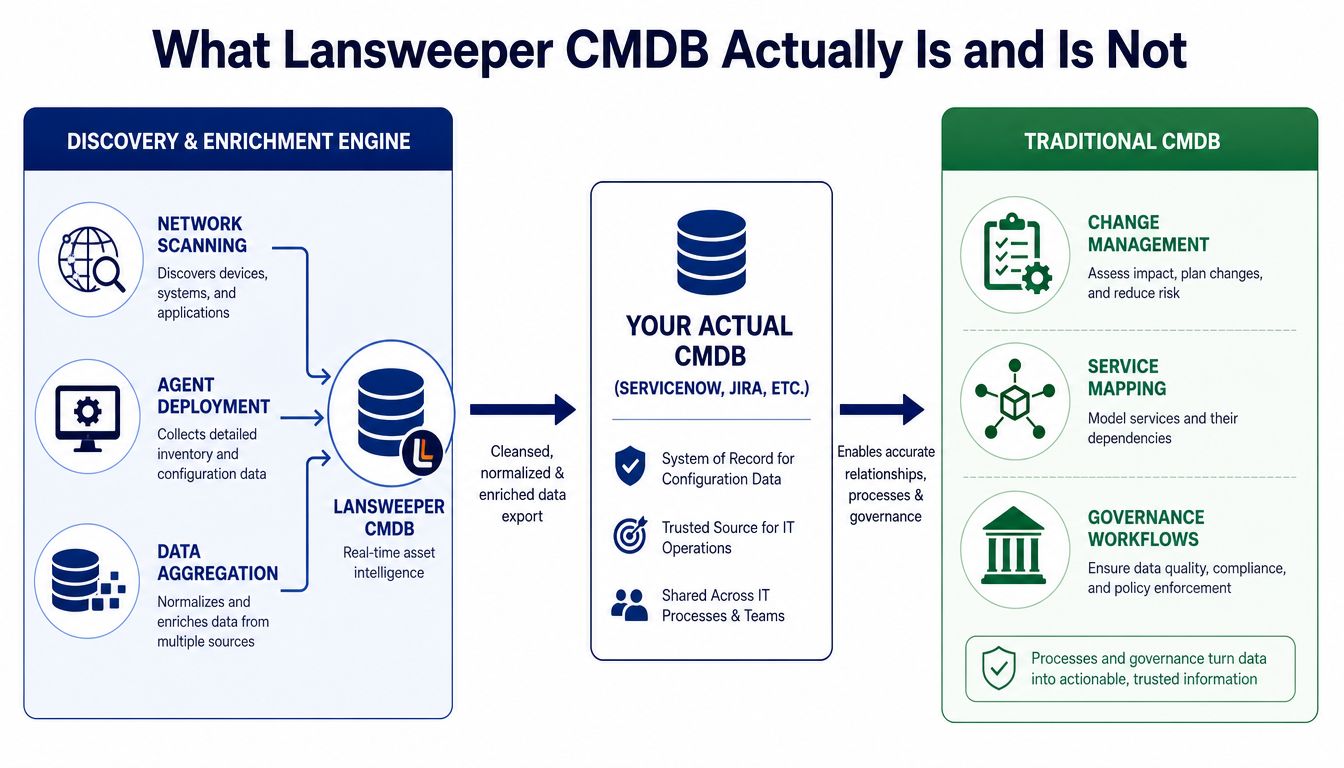
Lansweeper CMDB is best treated as a discovery and enrichment engine for enterprise environments. It continuously identifies servers, laptops, desktops, virtual machines, operating systems, software, and IoT assets. That technical inventory can feed IT service management and asset-control processes, as described in Lansweeper's CMDB automation overview. An inventory can be current and detailed without constituting a complete configuration management practice.
In an architecture review, Lansweeper should answer four practical questions:
What exists: Which devices, operating systems, applications, and virtual machines are present?
What changed: Which asset attributes changed during the latest audit?
What is aging: Which hardware and operating systems need lifecycle attention?
What connects: Which assets relate to other assets or users based on available discovery data?
A dedicated CMDB adds the governance layer. It links configuration items to business services, accountable owners, approved changes, policies, and downstream impact. Lansweeper's own CMDB guide describes relationships such as applications mapped to servers, databases connected to business processes, and network components related to one another. Discovery supplies much of the evidence. Service governance still requires people to validate ownership, service boundaries, change authority, and business impact.
Where the platform delivers immediate value
Lansweeper's strongest contribution is the freshness and breadth of technical asset data. It can collect hardware and operating-system lifecycle details, including model, manufacturer, operating system, and asset counts, then present lifecycle summaries through dashboards and asset views. Infrastructure teams can use that evidence for refresh planning, vulnerability prioritization, and initial CMDB population.
The platform also supports governance workflows. Lansweeper documentation says its audit trail stores user-identifiable activity for up to 12 months, including who changed assets, logged in, or modified settings. The Lansweeper product page on Stackingo presents Lansweeper as a CMDB and ITSM data feeder, a useful framing for enterprise buyers evaluating its role alongside ServiceNow or another dedicated CMDB.
The boundary is operational ownership. Lansweeper can reconcile discovered technical records, but teams must still resolve exceptions, approve authoritative values, assign service owners, and maintain business relationships manually or through their governance platform.
Practical rule: Use Lansweeper as the authoritative technical discovery source, then let the operating model establish who owns each service, approves changes, and accepts business risk.
How Lansweeper Discovers Assets and Builds Relationships
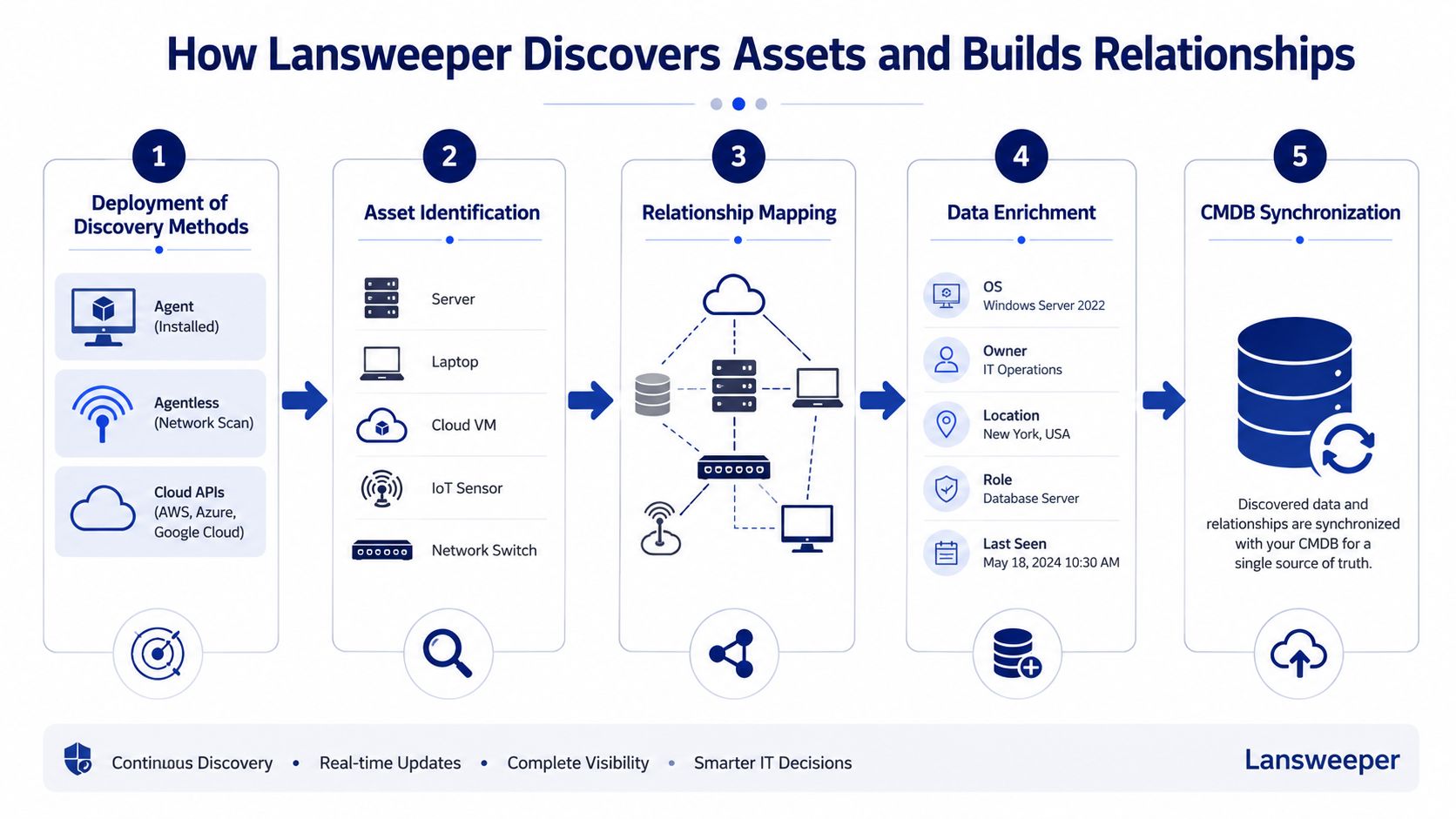
Lansweeper builds its inventory by combining discovery methods, credentials, network information, and integrations. Its discovery engine identifies servers, cloud instances, IoT devices, mobile endpoints, and network components across hybrid environments. The resulting data can include technical attributes as well as relationships, but the quality of those relationships depends on access, credentials, network visibility, and the rules used to interpret the environment.
Credential-based scanning is important because unauthenticated visibility rarely provides enough detail for configuration management. Where appropriate credentials are available, Lansweeper can collect operating-system, hardware, software, and lifecycle information. Cloud and network discovery extend the picture beyond traditional endpoints, helping teams avoid the common failure mode where on-premises devices are documented while cloud resources remain outside the operational record.
Relationships are useful, but they need interpretation
Lansweeper can link assets to other assets or users. A server may be associated with another server used for backup, while a laptop may be linked to the person who uses it. Administrators can create relations from an asset overview page and optionally assign start and end dates, as described in Lansweeper's asset relationship documentation.
Automatic relation discovery uses network information collected during inventory. SNMP relations are discovered automatically when SNMP credentials are configured. Lansweeper also states that when more than 4 devices connect to a switch port, the port is treated as an uplink by default, a practical rule that can influence the resulting network map. Its relation-discovery documentation is useful when validating whether an observed connection represents a genuine dependency or a network topology convention.
That distinction matters before synchronization. A discovered connection can show technical adjacency, but it doesn't necessarily prove a business dependency. A switch relationship, backup association, or user link still needs review when it becomes part of incident impact analysis or an approved change model.
For teams comparing adjacent ITSM options, this SysAid and RDS discussion provides useful context on how discovery and service management capabilities can sit together without assuming they perform identical functions.
Integrating Lansweeper with ServiceNow and Other ITSM Platforms
The strongest enterprise pattern is usually layered. Lansweeper discovers and refreshes technical facts, while ServiceNow or another ITSM platform applies CI classes, service models, ownership rules, change workflows, and operational governance.
A practical integration sequence looks like this:
Define the source of truth. Decide which Lansweeper fields should control hardware, operating-system, software, and network attributes, and which fields belong to ServiceNow or another ITSM platform.
Select the scope. Lansweeper's integration documentation allows users to choose the assets and attributes to import into a CMDB.
Map the model. Map Lansweeper assets to the appropriate CMDB tables and CI classes rather than sending every discovered object into a generic record type.
Set reconciliation rules. Decide how duplicate assets, retired devices, renamed hosts, and conflicting ownership data will be handled.
Validate every audit cycle. Each Lansweeper audit can update CI attributes and relationship links, but teams still need exception handling for records that require business context.
The ServiceNow integration advertises mapping more than 30 asset types and 80 CI-to-CI relationships directly into the CMDB. Lansweeper's CI synchronization explanation connects that mapping to incident triage, dependency mapping, and service-impact analysis.
Lansweeper ServiceNow Integration Capabilities
Capability | Details |
|---|---|
Asset ingestion | Imports selected Lansweeper assets and configuration items into a CMDB |
Attribute selection | Lets teams choose which discovered attributes should be included |
CI mapping | Maps Lansweeper assets into ServiceNow CMDB tables and CI classes |
Relationship synchronization | Maps more than 30 asset types and 80 CI-to-CI relationships |
Ongoing refresh | Automatically updates CIs with each Lansweeper audit |
Governance boundary | Leaves service ownership, policy decisions, and change approval to the ITSM operating model |
The integration won't repair a weak CMDB model by itself. If your organization hasn't defined service ownership or reconciliation policies, automation can move inconsistent assumptions faster. Use the ServiceNow resources on Stackingo alongside a clear data-governance design.
Asset Intelligence Versus Full CMDB Completeness
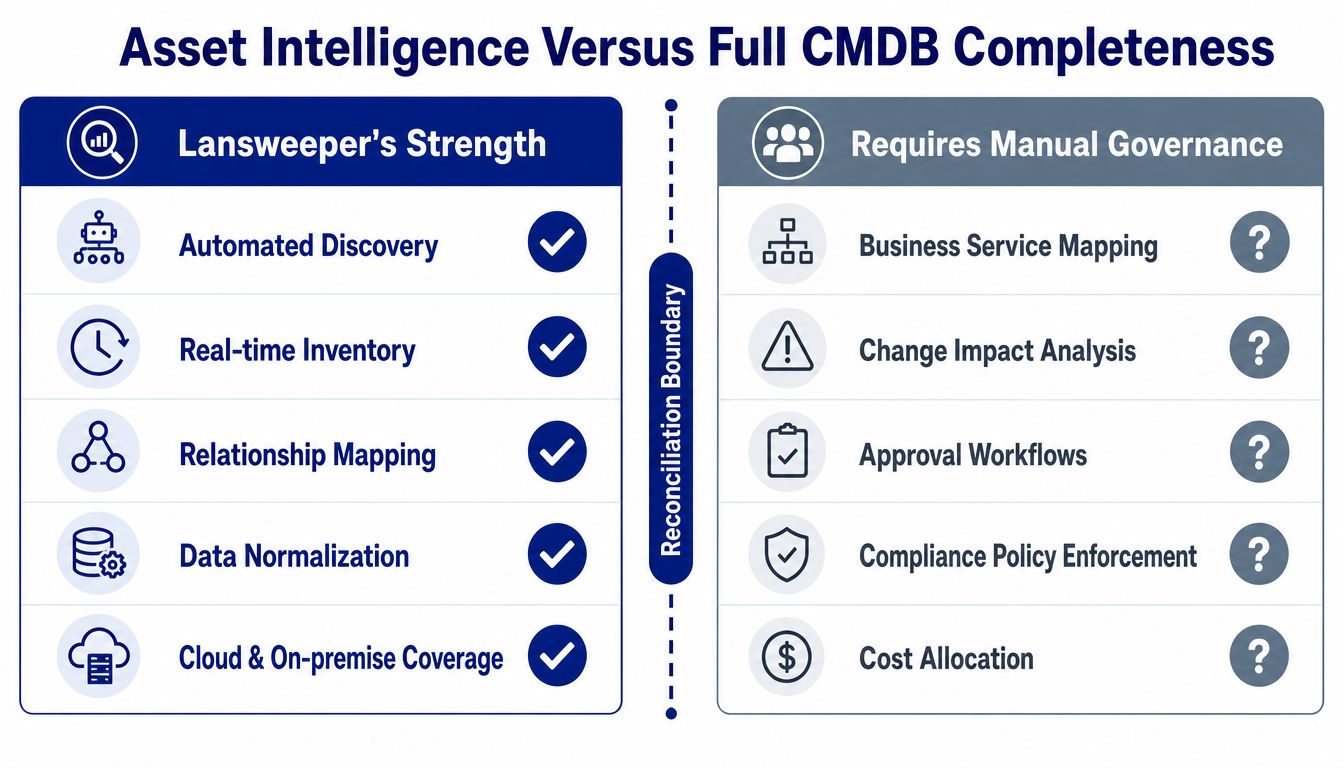
A vulnerability scanner can tell you what is running. A CMDB must also help you determine who is responsible, which business service is affected, and what the blast radius could be if someone changes or disables that configuration item. Lansweeper is strong on the first category and contributes valuable evidence to the second, but discovery alone doesn't create full operational readiness.
That boundary becomes visible during incidents. Lansweeper may identify the operating system, installed software, hardware model, network placement, and related assets. A dedicated CMDB still needs to connect that CI to an application service, business owner, support group, maintenance window, approval path, and risk policy.
The reconciliation boundary
Lansweeper's asset intelligence | Governance that still needs ownership |
|---|---|
Automated technical discovery | Business service mapping |
Current inventory attributes | Change impact analysis |
Hardware and software lifecycle data | Approval workflows |
Network and asset relationships | Compliance policy enforcement |
Hybrid environment visibility | Cost allocation and accountability |
The same distinction applies to AI-agent safety. An automation agent can use discovered data to identify a target system, but it shouldn't infer authorization, business criticality, or acceptable change risk from technical inventory alone. Those decisions require governed relationships and policy-aware context.
Independent coverage cited in the brief describes Lansweeper as strong at fast discovery and asset inventory while noting limits in service-level depth and continued reliance on third-party CMDBs for deeper operational context. That is the right procurement lens. Read the SysAid CMDB comparison material when assessing whether your service model needs a dedicated governance layer.
Architecture decision: Buy Lansweeper for reliable technical intelligence. Add CMDB governance when your operating model depends on service dependencies, accountable ownership, or controlled change impact.
Real Enterprise Use Cases for Lansweeper CMDB Enrichment
Lansweeper delivers the most value when its discovered data improves a defined operational workflow. During incident triage, an up-to-date asset record gives the service desk context about the affected endpoint, operating system, installed software, and related infrastructure. Responders can then separate an isolated device fault from a wider infrastructure problem before escalating it.
Lifecycle management is another practical fit. Lansweeper retrieves hardware and operating-system details, including model, manufacturer, OS, and asset counts, then presents lifecycle summaries through dashboards and asset views. Infrastructure teams can identify aging platforms, coordinate refresh planning, and connect technical exposure with replacement priorities. The platform does not set the budget. It gives the decision-maker a more dependable inventory for that decision.
Auditability changes the operating conversation
Compliance teams can use Lansweeper's activity evidence to examine configuration changes, access events, and administrative actions during an investigation. The platform's CMDB enrichment materials describe the product's support for lifecycle and governance processes, extending its role beyond basic inventory collection.
The evidence helps establish what happened in the platform and who performed the action. Compliance owners still need to determine whether the activity was authorized, which service was affected, and whether the event requires remediation or formal reporting. An audit trail supplies evidence for control testing and investigations, while policy and service ownership provide the decision framework.
A workable operating model assigns responsibilities clearly:
Discovery owners maintain credentials, scanning coverage, and collection schedules.
CMDB owners define CI classes, reconciliation rules, and relationship standards.
Service owners validate business dependencies and criticality.
Change managers use the resulting context to assess impact and approvals.
The operational gain is a stronger technical foundation for governed processes. Lansweeper can reduce the effort required to establish accurate asset context, but teams must still validate business relationships, assign ownership, and maintain the rules that turn inventory into trusted CMDB data.
Deployment Scale and Global Adoption Patterns
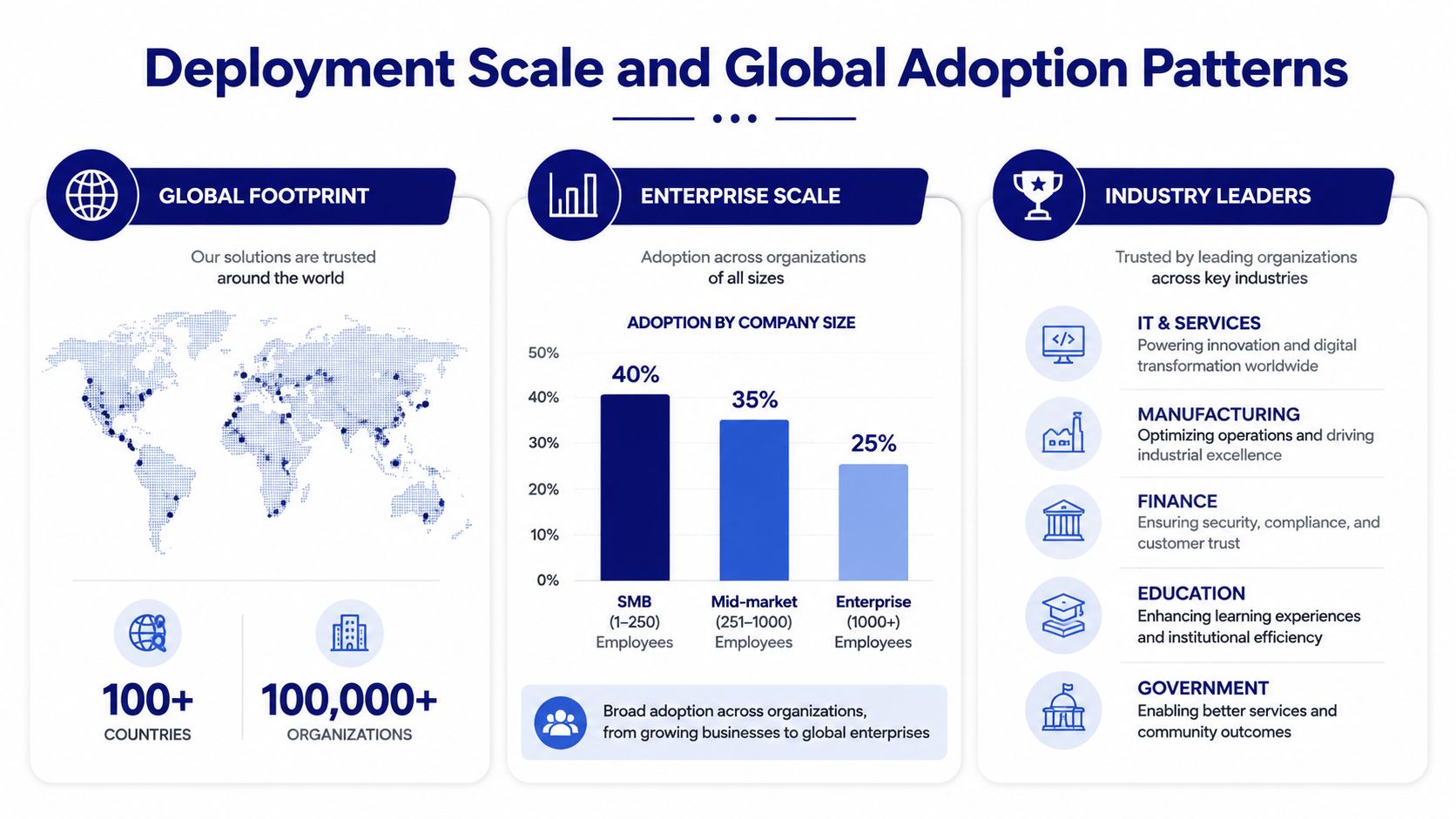
Lansweeper has an international installed base, but adoption alone does not prove that it can serve as a governed enterprise CMDB. Independent market data cited in 2025 indicates that more than 1,858 companies had started using Lansweeper as an IT asset management tool worldwide. The largest concentration was in the United States, with 949 customers, followed by the United Kingdom at 147 and Canada at 99. The source material is referenced earlier in this article.
A separate 2025 view places the United States at 61.23% of known IT asset management customers, the United Kingdom at 9.48%, and Canada at 6.39%. The distribution points to strong adoption in English-speaking enterprise markets, where IT asset management and CMDB practices are established. It does not show how consistently each organization reconciles CIs, validates service relationships, or assigns ownership after discovery.
What adoption means for procurement
An installed base can support a vendor-maturity discussion, but architecture validation must determine fit. Before procurement, assess:
Coverage: Can discovery reach your cloud, network, endpoint, and IoT environments?
Security: Can credential handling and access controls meet internal requirements?
Integration: Can your ITSM platform consume the asset classes and relationships you need?
Governance: Which team resolves reconciliation exceptions and validates service relationships?
Commercial fit: Are licensing, implementation, integration, and ongoing administration costs visible together?
Regional scale also creates an operating-model question. If your estate spans countries or hosting environments, confirm that internal teams can maintain discovery coverage and ownership data consistently. Lansweeper can provide broad asset intelligence, while completeness still depends on reconciliation rules, validation, and manual governance. Adoption demonstrates market relevance, not automatic suitability.
When to Use Lansweeper Alone Versus Layering a Dedicated CMDB
Use Lansweeper alone when your primary requirement is technical asset intelligence. It can be a sensible fit for teams that need discovery, software and hardware inventory, lifecycle visibility, audit activity, and basic asset relationships without building a tightly governed service model.
Layer a dedicated CMDB when your organization relies on formal change control, service-impact analysis, business-service dependency mapping, or policy-aware automation. Large hybrid estates usually reach this boundary when technical relationships become insufficient for answering operational questions such as which customer-facing service depends on a particular database or which owner must approve a change.
A practical decision framework
Choose a standalone approach when:
Inventory is the main outcome: You need dependable records more than governed service models.
Ownership is simple: Asset accountability can be managed through existing operational processes.
Change risk is limited: Your teams don't need detailed blast-radius analysis for routine changes.
Choose a layered architecture when:
Services cross domains: Applications depend on cloud resources, network components, databases, and external platforms.
Change approval is formal: Teams need evidence of affected CIs before approving work.
Automation has consequences: AI agents or orchestration tools must respect ownership and policy.
Auditability matters: You need traceable relationships between technical changes, services, and accountable teams.
A layered design doesn't mean duplicating every record. Define Lansweeper as the technical discovery source, map only the required attributes and relationships, and keep business ownership and service context in the dedicated CMDB. Review exception queues rather than forcing every discovered relationship into an approved dependency model.
For broader service-management architecture, Device42 ITSM options can be part of the comparison, especially when dependency mapping and service governance need to sit alongside discovery. Stackingo provides a marketplace-first route for comparing multi-vendor enterprise software and structuring quote requests across the stack, rather than treating each licensing conversation as an isolated purchase.
Frequently Asked Questions About Lansweeper CMDB
Is Lansweeper a true CMDB?
Lansweeper CMDB is most accurately described as a discovery-led enrichment capability. It provides detailed technical asset and relationship data and can publish that information into dedicated CMDB platforms, while deeper service governance remains dependent on the receiving ITSM architecture and operating model.
Can Lansweeper integrate with ServiceNow CMDB?
Yes. Lansweeper can import selected assets and attributes into a CMDB, map assets into ServiceNow tables and CI classes, and refresh CI data through ongoing audits. Its ServiceNow integration advertises mappings for more than 30 asset types and 80 CI-to-CI relationships, documented in Lansweeper's integration guidance.
Does Lansweeper map asset relationships automatically?
It can discover relationships from network inventory, and SNMP relationships are discovered automatically when SNMP credentials are configured. Teams should still validate whether a technical connection represents a governed business dependency before using it for change-impact decisions.
What does Lansweeper add to a CMDB?
It adds current technical attributes, lifecycle information, asset coverage, and discovered relationships. That enrichment can reduce stale records and configuration drift, but teams still need governance for ownership, business services, approval workflows, and policy enforcement.
When should an enterprise add a dedicated CMDB?
Add one when your organization needs governed service dependencies, formal change-impact analysis, accountable ownership, or policy-aware automation. If discovery is the main requirement and service governance is handled elsewhere, Lansweeper may provide the required foundation without replacing your broader ITSM model.
Stackingo helps enterprise teams compare Lansweeper with dedicated CMDB and ITSM options, structure multi-vendor requirements, and request comparable software licensing quotes through one commercial process. Visit Stackingo to evaluate the discovery, governance, and procurement layers your environment needs.
