
Fing Lansweeper
Updated: Oct 10
Your network team needs a fast answer to one question: what's connected right now? Your IT operations team needs a different answer: what is the asset, who owns it, what software does it run, and how should it feed the CMDB or service desk? Fing and Lansweeper address different layers of that problem, but they aren't competitors anymore. Lansweeper acquired Fing in 2020, so the practical decision is whether you need Fing, Lansweeper, or both within one vendor relationship.
Why IT Leaders Are Comparing Fing and Lansweeper Right Now
Hybrid estates create a visibility problem that a single network sweep rarely solves. Devices sit across offices, remote locations, cloud environments, operational technology networks, and unmanaged edge segments. Procurement teams, meanwhile, need a defensible choice that reduces tool overlap without creating new blind spots.
The Fing Lansweeper question should therefore be treated as a fit decision, not a feature race. Fing is associated with fast, lightweight network discovery and device recognition. Lansweeper is positioned as a broader technology asset intelligence platform, designed to discover and inventory technology assets, installed software, and users. Lansweeper was founded in Belgium in 2004, and its company history records growth to more than 150 employees across Europe and the United States by June 2021 after Dovesco acquired the business in 2018 and Insight Partners invested €130 million to accelerate growth. See the broader Lansweeper asset discovery overview for the platform context.
The procurement decision is simpler than the feature list
Start with the operating question:
Do you need immediate local visibility? Fing is relevant when a technician needs to identify devices on a network quickly, particularly where installing credentials or endpoint software isn't practical.
Do you need a normalized asset ledger? Lansweeper is the stronger default when inventory must include hardware, software, users, cloud resources, and network context.
Do you need both discovery speeds? Use Fing-style recognition as an edge signal and Lansweeper as the central inventory and workflow system.
Lansweeper announced its acquisition of Fing on 14 October 2020, describing Fing as a network scanning and device recognition app that extended Lansweeper's network discovery capabilities (Lansweeper's acquisition announcement). That changes how you should evaluate the products. You're not selecting between unrelated vendors. You're selecting a discovery layer, an inventory layer, or a combined procurement path under one ownership structure.
Practical rule: Buy for the system of record you need, then add fast edge discovery only where the central scanner can't see reliably.
How Fing and Lansweeper Actually Fit Together
Fing began as a lightweight network utility for identifying devices from phones and desktops. Its value is speed and accessibility. A network engineer or field technician can use it to inspect a local environment without first building a large credentialed scanning architecture.
Lansweeper developed in a different direction. Its discovery platform supports agentless network discovery, IT agent discovery, and cloud discovery across IT, OT, cloud, and networked devices. Its documentation also identifies enriched device fingerprints, open ports, and Mac-user data within the discovery payload (Lansweeper Discovery documentation).
The acquisition means Fing and Lansweeper now belong to the same vendor portfolio. The useful interpretation is layered:
Fing provides rapid, user-driven network reconnaissance where a technician needs an immediate view of the local segment.
Lansweeper provides structured technology asset intelligence for enterprise inventory, reporting, relationship analysis, and downstream operational workflows.
Together, they can combine edge visibility with a centralized asset dataset, provided the integration and licensing terms match your deployment.
Why the shared ownership matters
A separate network scanner often creates another inventory to reconcile. Fing's role is more useful when its findings enrich or validate the Lansweeper record rather than becoming a parallel spreadsheet replacement.
A Lansweeper community post from February 2021 described the Fing integration as being in alpha and explained that Fing could improve asset recognition without credentials, strengthening asset radar effectiveness and asset-type recognition (Lansweeper community discussion). Treat that historical status carefully. It establishes the intended mechanism, but your RFQ should confirm the current integration state, supported editions, data flow, and entitlement rules.
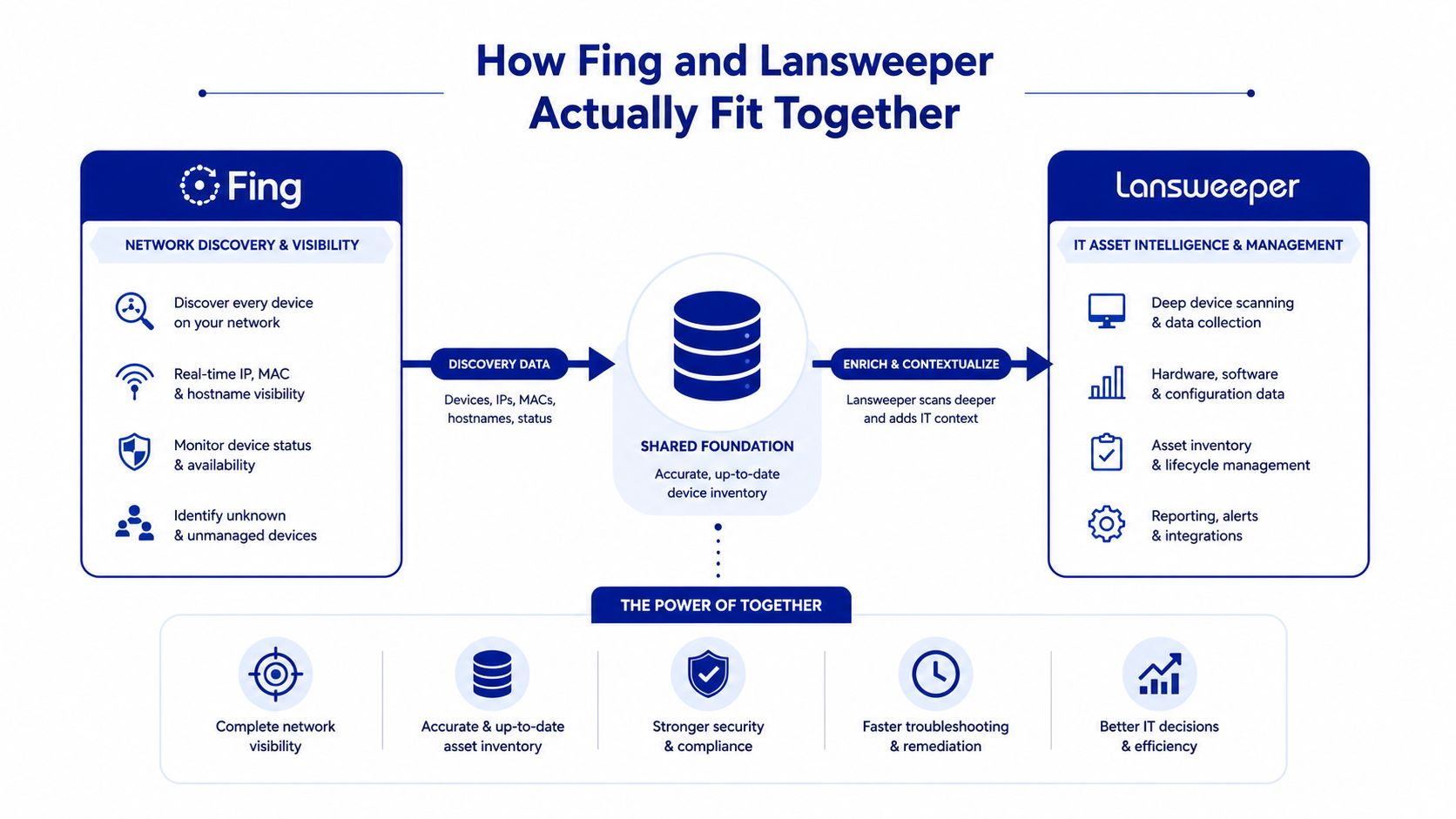
For a CIO, the conclusion is direct: Fing is best understood as a visibility accelerator, while Lansweeper is the primary inventory platform. If you already operate Lansweeper, assess Fing as an edge discovery component. If you only need occasional subnet checks, Fing may be sufficient. If the business needs audit-ready records and ITSM-connected asset intelligence, start with Lansweeper.
Discovery, Inventory, and Asset Reconciliation Compared
A device appearing on a scan does not make it an inventory record. Fing and Lansweeper separate at that point. Fing is built for rapid, agentless local discovery and device recognition. Lansweeper turns findings from network scans, IT agents, cloud discovery, and other sources into a queryable asset inventory.
That division matters because reconciliation depends on identity and context. Lansweeper records can include hardware and software details, device fingerprints, open ports, users, and related environment data. A Capterra review of Lansweeper's discovery and inventory capabilities also describes broad discovery coverage while noting the operational trade-off between wide agentless reach and the faster updates that selective agents can provide.
Use Fing to answer a local question: which devices are communicating on this network? Use Lansweeper to answer the operational question: how does each device relate to the environment, and which record should represent it?
The ownership model should be explicit:
Fing: a rapid discovery feed for unmanaged, unfamiliar, or locally connected devices.
Lansweeper: the normalized inventory, with broader asset context and records that teams can query.
Combined model: Fing identifies or enriches devices, while Lansweeper supports reporting, analysis, reconciliation, and operational handoff.
A CMDB-focused view of Lansweeper reinforces the practical distinction. A CMDB needs stable identity, ownership, relationships, and a repeatable update process. A list of active devices is only an input.
Capability | Fing | Lansweeper |
|---|---|---|
Local network discovery | Strong fit for fast, user-driven scans | Supported through agentless network discovery |
Credential requirements | Useful where credential-free recognition is needed | Supports agent and agentless discovery methods |
Asset context | Device recognition and local network visibility | Hardware, software, user, fingerprint, port, cloud, and network context |
Inventory depth | Best treated as a discovery signal | Better suited to the central technology asset inventory |
Asset reconciliation | Limited as a standalone inventory function | Better fit for consolidating records across discovery sources |
Cloud visibility | Not the primary enterprise inventory role | Cloud discovery is part of the documented platform model |
ITSM and CMDB use | Usually requires a downstream platform | Supports broader asset intelligence and operational workflows |
The procurement decision follows the data model. Do not make Fing responsible for full IT asset intelligence. Do not deploy Lansweeper for every quick field scan. Treat Fing as an edge discovery input and Lansweeper as the system of record when the business requires reconciled, reportable asset data. If the two products are evaluated together, specify ownership, matching rules, update flow, and the operational record that receives each finding.
Scalability, Security, and Integration Architecture
Treat Fing and Lansweeper as one procurement path before treating them as competing products. Lansweeper acquired Fing in 2020, so the architectural question is where Fing's lightweight network recognition belongs within a broader Lansweeper deployment. Fing can support fast, local visibility. Lansweeper is the stronger candidate for central governance across segmented networks, remote endpoints, cloud accounts, OT environments, and sites with inconsistent credentials.
Lansweeper documents discovery across IT, OT, cloud, and networked devices, including agentless network discovery, IT agent discovery, and cloud discovery. Fing remains useful at the edge, especially when a technician needs device recognition before credentials, classification, or a full inventory workflow is available.
Choose the discovery method by operating condition
Agentless scanning limits endpoint deployment and can cover broad network ranges. Agents provide fresher information when devices change often or operate outside the corporate network. The Lansweeper and Gartner perspective also frames this as an architectural trade-off, not a choice that should be applied uniformly. Use broad agentless discovery, then add agents where mobility, freshness, or network reach requires them.
Put security and integration requirements into the evaluation record. Require vendors to confirm:
Identity controls: SAML or SSO support, role separation, and administrator controls.
Auditability: Audit log availability, retention, export options, and review permissions.
Data governance: Hosting model, data residency, encryption, and applicable certifications.
Operational connectors: ServiceNow, Jira Service Management, Ivanti, Microsoft Intune, Active Directory, Okta, and SIEM integrations.
Segmentation: Separate credentials, sites, tenants, and reporting domains for distributed operations.
Data ownership: Export formats, API access, retention after termination, and exit support.
Commercial maturity supports Lansweeper's position as an enterprise platform. Preqin reports €52,641,082 in fiscal-year 2023 revenue and describes Lansweeper as a subscription-based technology asset intelligence platform (Preqin's Lansweeper profile). That information does not validate your design. It does justify evaluating Lansweeper as an established enterprise vendor rather than as a small scanning utility.
Dimension | Fing via Lansweeper | Lansweeper |
|---|---|---|
Primary architecture role | Lightweight discovery and device recognition layer | Central asset intelligence and discovery platform |
Deployment burden | Low for local, technician-led scans | Higher planning effort across credentials, agents, sites, and cloud sources |
Freshness model | Fast local visibility | Broad coverage with agent and agentless trade-offs |
OT and IoT relevance | Useful for edge recognition where supported | Designed for broad IT, OT, cloud, and network inventory |
Enterprise governance | Depends on Lansweeper integration and edition | Requires validation of SSO, roles, logs, residency, and certifications |
Integration strategy | Feed or enrich downstream records | Central source for ITSM, CMDB, reporting, and security workflows |
Scale planning | Validate local scan scope and concurrency | Validate asset volume, sites, scan windows, credentials, and API limits |
Run a proof of concept against difficult subnets, remote endpoints, and representative cloud or OT segments. Confirm scan scope, concurrency, credential boundaries, API behavior, and data handoff before selecting an edition or setting deployment standards.
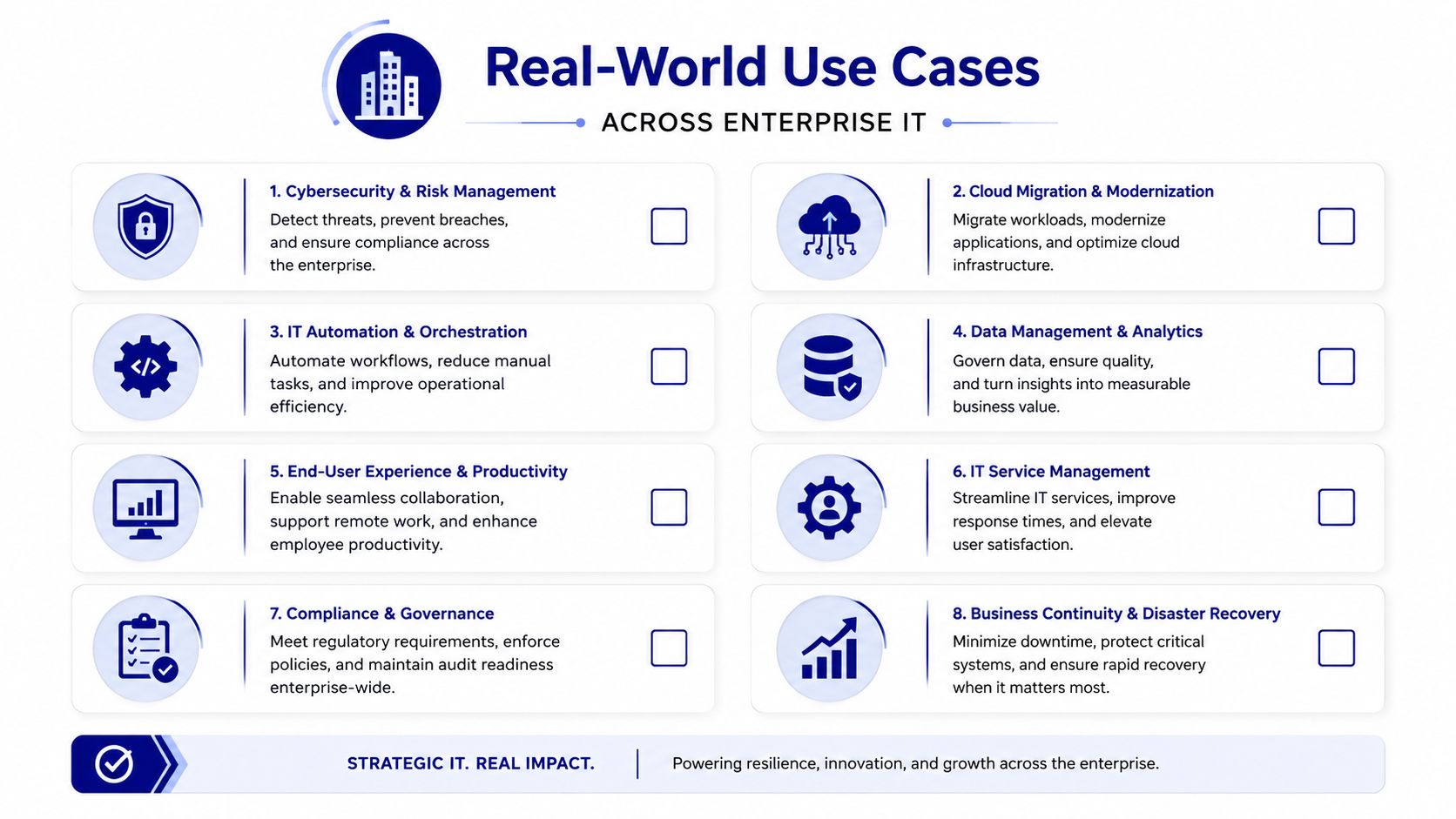
Real-World Use Cases Across Enterprise IT
The right choice changes by operating profile. A mid-market IT team, a multinational enterprise, and an MSP don't have the same discovery problem, even when they use similar words such as inventory, visibility, and CMDB.
Mid-market visibility
A mid-market firm with several offices and a mix of wired, wireless, and remote endpoints should normally make Lansweeper the primary inventory system. Use Fing where technicians need quick local identification during site visits, onboarding, or troubleshooting.
The main risk is assuming that a successful local scan proves complete enterprise coverage. Test remote laptops, guest networks, unmanaged devices, and credential boundaries before approving the design.
Global IT, OT, and cloud consolidation
A global enterprise should use Lansweeper as the asset ledger and evaluate Fing at edge locations where rapid network sweeps add information that credentialed discovery may miss. The central team should define ownership, reconciliation rules, reporting scope, and scan windows before rollout.
Watch for three failure modes:
Credential sprawl: Too many service accounts create governance and rotation problems.
Alert fatigue: Raw discovery findings overwhelm teams unless ownership and severity rules exist.
Segment blindness: OT and isolated networks remain invisible unless the deployment explicitly reaches them.
MSP and multi-tenant operations
An MSP should prioritize strong tenant separation, site-level administration, client-specific reporting, and predictable export behavior. Lansweeper should serve as the primary asset ledger, while Fing can support rapid onboarding diagnostics when a technician needs immediate network context.
Escalate evaluation if you find any of these conditions:
Unmanaged OT assets: Discovery cannot reach industrial or segmented environments.
Contractor blind spots: Remote contractor laptops never receive an agent or equivalent discovery coverage.
Duplicate records: The same asset appears separately across sites, domains, or discovery sources.
Weak separation: Client data, credentials, or reports can cross tenant boundaries.
No exit path: The vendor cannot explain how you'll export inventory and relationships.
The Lansweeper ticketing workflow is relevant when discovery data must improve incident and service workflows. Don't buy that capability without testing whether asset context arrives in the ticket in a form technicians can use.
Licensing, Pricing, and Procurement Implications
Treat Fing and Lansweeper as one procurement path first. Lansweeper acquired Fing in 2020, so the commercial question is not just which competitor costs less. It is whether you need Lansweeper as the asset system, Fing-derived discovery for local visibility, or both under one vendor relationship.
Lansweeper uses asset- and edition-based licensing rather than a simple seat model. Its current pricing page shows a Free plan and paid plans billed annually. Displayed pricing lists Starter at 199, 239, or 219 per month, depending on locale or version display, and Pro at 339, 399, or 359 per month, also depending on the displayed locale (Lansweeper pricing page). Use those figures for initial planning, then require a written quote.
Independent listings add another reference point. TrustRadius describes three Lansweeper pricing plans starting at $2,868. Capterra lists Free at $0 for 100 assets, Starter at $239 per month for 2,000 assets, and Pro at $439 per month for 2,000 assets with vulnerability and lifecycle insights (TrustRadius pricing information). These listings are useful for comparison, not contractual pricing.
Build the business case around total operating cost, not the license line alone. Model:
Discovery capacity: Purchased asset quantity, expected growth, and treatment of newly discovered assets.
Edition features: Vulnerability, lifecycle, API, reporting, and workflow capabilities.
Deployment work: Scanning infrastructure, credentials, agents, segmentation, and integrations.
Support: Included scope, escalation terms, and premium services.
Renewal exposure: Annual billing, true-up rules, tier changes, and post-promotion pricing.
Model | What to verify before approval |
|---|---|
Free | Discovery limits and whether evaluation data can support production decisions |
Starter | Asset ceiling, installation limits, support, and included integrations |
Pro | Whether vulnerability and lifecycle features replace existing tools or overlap with them |
Enterprise or custom | Written entitlements, API terms, support commitments, and renewal protections |
The acquisition may simplify vendor management, but it does not answer entitlement questions. Put Fing-derived functionality, technician access, site coverage, device limits, and any separate licensing in the order form. A demo statement is not a procurement commitment.
Which Tool Fits Your Stack and How Stackingo Helps
My default recommendation is simple: make Lansweeper the primary platform when you need a trusted inventory, and use Fing selectively where fast local discovery adds unique coverage.
A small IT team with a narrow network visibility requirement may start with Fing-style scanning. A team building a durable asset ledger should start with Lansweeper. A distributed enterprise should test Lansweeper Cloud or the appropriate enterprise deployment model, then place lightweight discovery at edge sites only where it improves coverage.
Buyer profile | Recommended tier | Fing role | Key integrations | Why it fits |
|---|---|---|---|---|
Small team needing local network awareness | Free or entry-level evaluation path | Primary field discovery utility | Export, identity, and ticketing validation | Low deployment friction |
Mid-market IT team building one inventory | Starter or Pro, subject to quote | Technician-led edge discovery | ITSM, CMDB, directory, endpoint tools | Centralizes hardware, software, and user context |
Distributed IT, OT, and cloud estate | Enterprise or cloud option, subject to architecture review | Edge and difficult-segment discovery layer | CMDB, SIEM, SSO, cloud, endpoint, and ITSM connectors | Combines broad inventory with targeted local visibility |
MSP with isolated clients | Site and tenant model validated in contract | Client onboarding and local diagnostics | Per-client reporting, ticketing, identity, export | Supports separation and repeatable operational delivery |
Use Stackingo as one procurement route when you need to compare Lansweeper licensing, optional Fing-related requirements, and adjacent tools in one RFQ process. Stackingo's marketplace model aggregates software licensing options and standardizes requirements, quantities, and scenarios so buyers can compare vendor responses through one commercial front.
The right RFQ should show at least a three-year view, even if the vendor bills annually. Include current assets, expected growth, additional sites, cloud expansion, technician usage, support, integrations, and exit requirements. That approach exposes whether a low initial quote remains economical after the estate expands.
Procurement and Migration Questions Answered
Are Fing and Lansweeper competitors?
No. Lansweeper acquired Fing in 2020, so they are now part of one vendor portfolio. Fing is best treated as a fast discovery layer, while Lansweeper is the stronger central inventory and asset intelligence platform.
Does Fing's consumer origin weaken Lansweeper's enterprise position?
Not by itself. The relevant question is how the Fing engine is integrated, governed, supported, and licensed inside your deployment. Test credential-free recognition, data enrichment, access controls, and export behavior against your own network.
Can existing Lansweeper customers add Fing for field technicians?
Don't assume that it's included at no additional cost. The provided product history confirms the acquisition and intended integration direction, but your contract should explicitly state technician entitlements, device limits, support coverage, and feature availability.
Can a competing-tool customer run Fing during migration?
Yes, a side-by-side discovery test is a sensible migration method. Compare discovered asset identities, duplicates, unmanaged devices, remote coverage, and reconciliation quality before setting the cutover scope.
What should the RFQ require?
Request discovery protocols, agent and agentless coverage, OT and cloud support, SAML SSO, ITSM and CMDB connectors, audit-log retention, asset-count rules, API access, support terms, and exit clauses. Ask for a three-year asset projection because Lansweeper licensing scales by asset count and tier.
Stackingo can consolidate Lansweeper licensing requirements, Fing-related discovery needs, and adjacent ITSM, CMDB, SIEM, or endpoint purchases into one structured RFQ. Visit Stackingo to compare commercial options and build a defensible procurement record before you commit to a discovery architecture.