
Lansweeper Spring4Shell Playbook for Enterprise IT Teams
Meta Title: Lansweeper Spring4Shell Playbook for IT Risk LeadersMeta Description: Use this Lansweeper Spring4Shell playbook to validate exposure, assign application owners, coordinate vendor fixes, and prove remediation across your enterprise.
You open Lansweeper after a Spring4Shell advisory and find Spring components across business-critical applications. Your Lansweeper Spring4Shell response should start by validating runtime and exposure, not declaring every finding exploitable. Then assign an owner, choose a remediation track, and require evidence before closure.
What an IT Director Faces the Morning After a Spring4Shell Advisory
The CIO wants an exposure statement. Application owners want to know whether they must interrupt service. Procurement needs to know which vendors owe you an answer. A software inventory export won't satisfy any of them unless your team translates it into decisions.
Start with a defensible distinction: a discovered component is a finding, not proof of a working exploit path. Your initial briefing should separate confirmed exposure, unresolved deployment questions, and findings where the known exploitation conditions aren't present.
That distinction doesn't justify delaying investigation. It gives responders a way to direct emergency effort without treating uncertainty as either safety or compromise.
Which decisions must the response support?
Give each workstream a concrete question:
Evidence: What does the inventory establish, and which runtime details remain unknown?
Accountability: Who can change the application, approve downtime, or obtain a vendor-supported fix?
Closure: What evidence will demonstrate that the deployed application, not merely its build file, has changed?
Assign technical validation to application and infrastructure teams. Security should set prioritization and evidence standards. Procurement should handle vendor commitments where your administrators don't control the affected software.
Practical rule: Unknown packaging, runtime, or ownership is an investigation task. It isn't a clean result.
The urgency is real, but the language matters. Early reporting described approximately 37,000 exploitation attempts during the first weekend after disclosure, and Trend Micro observed attackers deploying Mirai against vulnerable servers in Singapore, according to Spiceworks' Spring4Shell impact assessment. Those observations justify prompt action, not an assumption that every matching library was compromised.
Your executive update should therefore report decisions and blockers rather than a single alarming total. Show which applications require emergency changes, which need additional validation, which depend on vendors, and which have approved temporary controls. Keep the raw discovery count available, but don't make it the headline measure of risk reduction.
The Technical Conditions That Make CVE-2022-22965 Exploitable
Spring4Shell refers primarily to CVE-2022-22965, involving Spring MVC and Spring WebFlux data binding. It received a critical CVSS score of 9.8, and successful exploitation could allow remote code execution; Rapid7's technical analysis also identifies request mapping and bindable Plain Old Java Object parameters as relevant application-level conditions.
The familiar exploitation path requires a combination of runtime, packaging, container, dependency, and framework conditions. JDK 9 or later, Apache Tomcat, a traditional WAR deployment, and spring-webmvc or spring-webflux are the principal checks described in CERT-EU's Spring Framework advisory.
Which versions and deployment details matter?
Spring4Shell version and runtime impact matrix
Framework branch | Affected versions | Fixed version | Runtime trigger |
|---|---|---|---|
Spring Framework 5.3 | 5.3.0 through 5.3.17 | 5.3.18 | Assess the combined runtime, container, dependency, and packaging conditions |
Spring Framework 5.2 | 5.2.0 through 5.2.19 | 5.2.20 | Apply the same architecture checks |
Older unsupported releases | Included in the affected set | Move to a supported, fixed release | Don't assume age removes exposure |
Spring Boot | Inspect the bundled Framework dependency | Identified fixes include 2.6.6 and 2.5.12 | Distinguish executable JAR from traditional WAR deployment |
The Framework remediation thresholds and corresponding Boot releases above are documented in Trend Micro's exploitation and remediation analysis. These are historical minimum fixes for this vulnerability, not a recommendation to deploy an obsolete release instead of a currently supported version.
Internet exposure is a prioritization factor, not a prerequisite that makes an otherwise vulnerable internal application safe. An internal service still needs assessment against the access paths available within your environment.
A deployment that doesn't match the documented exploitation path needs an evidence-backed classification, not an unqualified declaration that Spring is safe.
Check the advisory identifier as well as the product name. Red Hat's architecture-specific guidance distinguishes this issue from the separate Spring Cloud CVE-2022-22963. Combining them into a generic Spring emergency creates ambiguous tickets and can send teams toward the wrong mitigation.
The practical result should be an architecture judgment: affected component confirmed, known exploit conditions confirmed or absent, and remaining uncertainty explicitly recorded.
Turning Lansweeper Findings into Triage-Ready Asset Records
Build the triage record around the application instance, not just the server. A host can carry multiple applications, and a component found on disk might belong to an inactive deployment, a vendor installation package, or the running service. Your report must preserve those distinctions.
Use Lansweeper inventory as the starting point and enrich it with deployment evidence. Don't assume that built-in software inventory or an agentless scan automatically exposes every nested Java dependency, packaging choice, or application owner.
How should you build the discovery report?
Use the reporting facilities available in your Lansweeper deployment to select candidate software records containing Spring component names. Where your inventory captures file evidence, include relevant application archive paths and component metadata. Treat name matching as candidate discovery, not authoritative version parsing.
Save a reproducible report with these enrichment fields:
Component identity: Framework branch, patch level, component path, and evidence source.
Runtime context: JDK, servlet container, deployment format, and active application instance.
Dependency context: Direct dependency or transitive inclusion, with build or vendor evidence.
Reachability: Public access, internal access restrictions, and who validated them.
Accountability: Application owner, service owner, vendor, support status, and ticket reference.
Evidence freshness: Observation time and whether the result came from inventory, runtime inspection, or supplier confirmation.
Implement missing values through custom fields where supported, or maintain a linked enrichment register. Don't invent SQL against an unverified schema: report objects and available fields should be checked against your actual deployment before automation.
Where do hidden dependencies enter the workflow?
Ask application owners for dependency manifests, build output, archive inspection, or a vendor software bill of materials. Record the path from the packaged product to the Spring component; otherwise, a vendor may answer about its platform while missing the module you found.
For cloud-hosted workloads, use the Lansweeper AWS inventory workflow as a related discovery reference, while validating application-level context separately. Host discovery alone doesn't establish whether the relevant Java process is running.
If you're comparing adjacent endpoint inventory options, Asset Management by SuperOps provides automated discovery, lifecycle tracking, and policy enforcement. Those functions address asset administration; they don't replace Spring dependency and runtime validation.
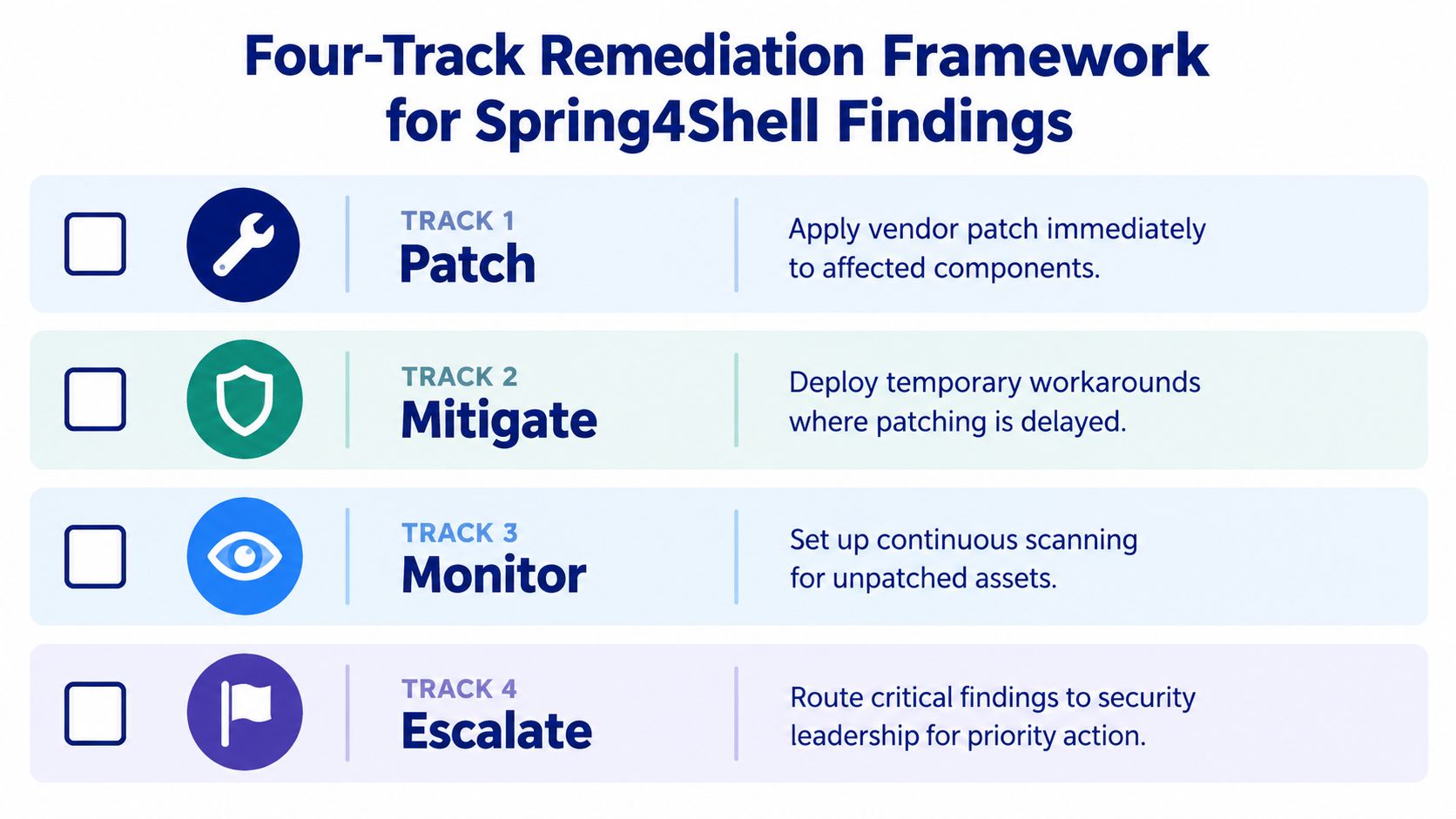
A Four-Track Remediation Framework for Spring4Shell Findings
Choose a treatment based on validated exposure, operational constraints, and change authority. A single patch queue hides the difference between an application your team can rebuild immediately and a vendor product you're contractually prohibited from modifying.
Keep treatment decision separate from workflow status. Monitoring and escalation support every treatment; neither is a substitute for deciding how to reduce or accept the risk.
Which treatment should each finding receive?
Patch now when the affected application has a confirmed exposure path and your team controls deployment. Give internet-reachable applications priority, while accounting for service criticality and internal attack paths. Use a supported application release rather than replacing a library inside a packaged product without vendor approval.
Isolate or restrict exposure when deployment cannot proceed immediately. Options include removing public reachability, narrowing network access, or applying an architecture-appropriate temporary mitigation. Treat WAF rules as supporting controls, not proof that the underlying vulnerability has disappeared.
Obtain a vendor remediation commitment when the vulnerable component belongs to a supplier-managed product. Require the affected product build, supported corrective release, delivery commitment, and interim operating guidance. A support ticket acknowledgment isn't a remediation plan.
Accept and monitor residual risk only through an authorized decision. Record the rationale, control limitations, review trigger, and expiration. The person accepting the risk should have authority over the business service, not only permission to close a scanner finding.
Microsoft's SpringShell response guidance states that upgrading removes the need for additional mitigation. That supports treating temporary controls as a bridge to a validated fix, not an indefinite alternative.
What must the decision record contain?
Treatment evidence: Why this track fits the application and its current exposure.
Accountable owner: The person responsible for action and the approver for exceptions.
Delivery control: Deadline, change reference, vendor case, and escalation trigger.
Exit criteria: Evidence required to remove restrictions or end an exception.
Write the track and references into the asset record and change system, using a shared identifier to prevent conflicting statuses. The Lansweeper Log4j response reference offers a related framework-vulnerability workflow, but don't transfer exploit prerequisites between unrelated vulnerabilities.
Running the Remediation Sprint Across Application Owners and Vendors
Consider a hypothetical packaged business application where inventory identifies an affected Spring component inside the vendor's WAR deployment. The application owner can schedule maintenance but can't independently rebuild the product. Security has enough evidence to require action, yet the actual fix depends on the supplier.
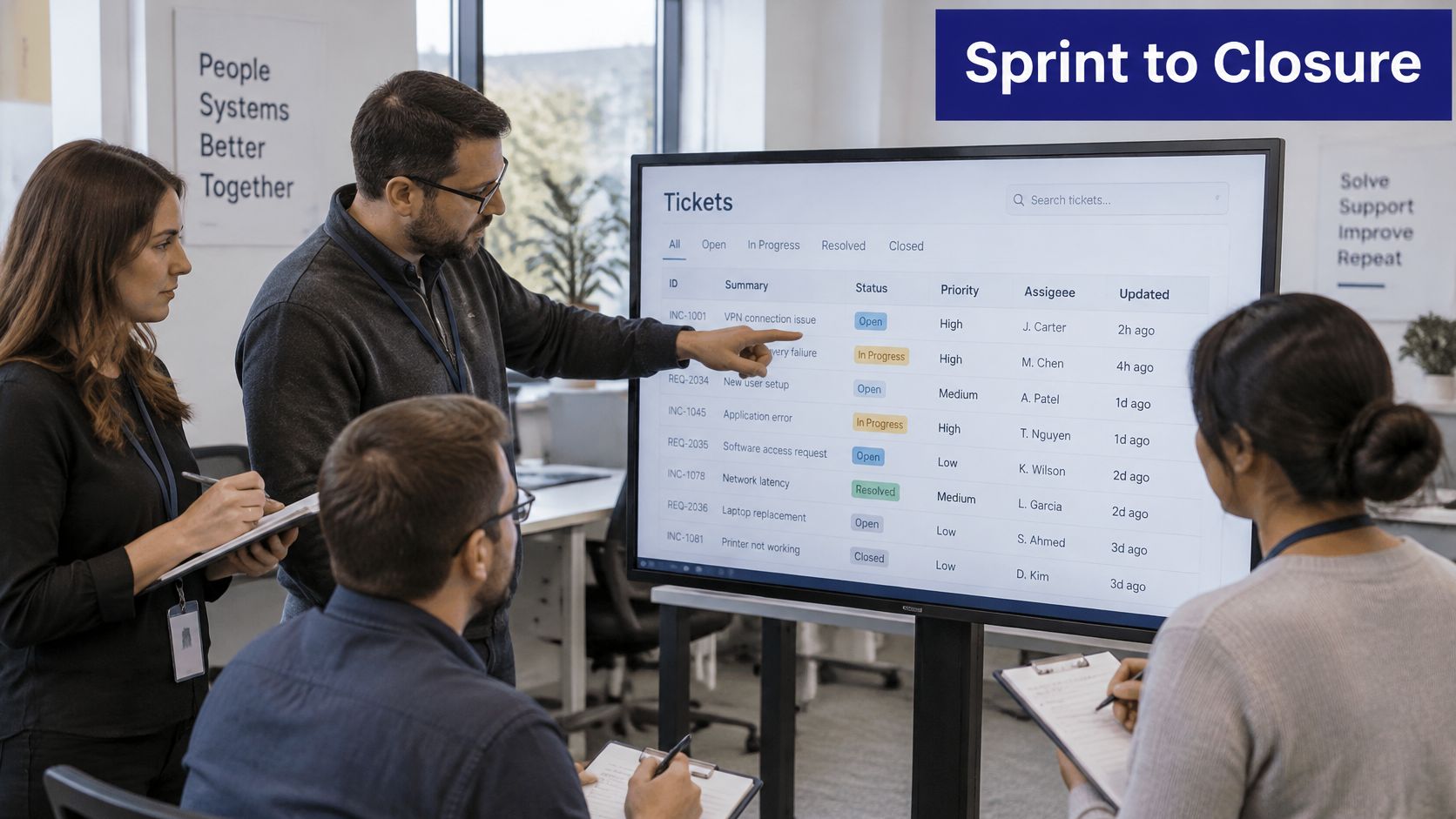
The first useful handoff isn't the CVE description. It's a ticket explaining the affected service, the observed component path, the runtime assessment, the recommended treatment, and the decision the owner must make.
What should the application owner receive?
The ticket should distinguish facts from questions. Attach the inventory evidence and runtime validation, then identify what remains unresolved, such as whether the supplier's recommended release replaces the bundled dependency.
Action requested: Approve a supported upgrade or an interim access restriction.
Business impact: Identify affected users, integrations, and maintenance constraints.
Supplier dependency: Name the vendor case and the evidence needed from support.
Closure requirement: Specify deployed-artifact validation and application testing.
Use the Lansweeper ticketing workflow as the operational handoff reference. Keep technical evidence accessible from the ticket rather than scattering it across email attachments.
The application owner then asks the supplier to confirm the exact product build, corrective release, supported upgrade route, and temporary controls. A reply that the product uses Spring isn't enough. Neither is a general statement that the supplier takes security seriously.
What happens when the vendor won't commit?
Procurement should escalate through the account team and applicable support arrangements. Ask for a written remediation position and record whether the vendor disputes applicability, lacks a release date, or requires a product upgrade.
Escalation test: If nobody can state what evidence will resolve the supplier dependency, the case is waiting, not progressing.
Keep the finding marked vendor-managed, awaiting patch, with a named internal owner and an active treatment decision. Don't let vendor responsibility become a reason to remove the application from reporting.
When the supported release arrives, the application owner schedules deployment and attaches the vendor release evidence to the change. Security validates the result, while procurement retains the unresolved support or lifecycle issues for the renewal discussion. This is a workflow example, not a claim about a measured customer outcome or a guaranteed remediation duration.
Validating Remediation and Setting Up Post-Incident Monitoring
Close the finding only when the deployed application satisfies the agreed exit criteria. A completed change ticket proves that someone performed work; it doesn't establish which dependency the running service loaded.
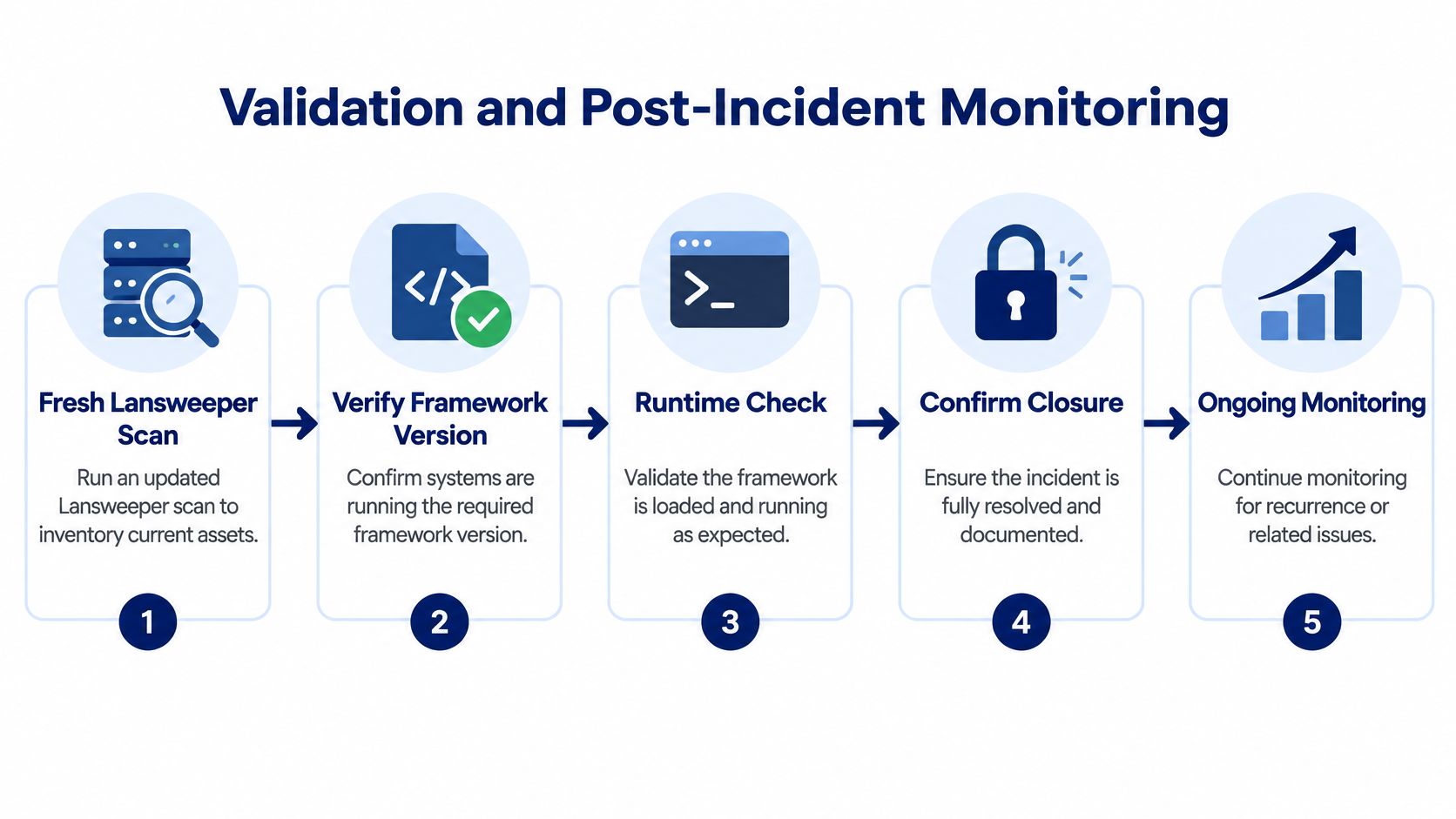
Require fresh discovery evidence, runtime confirmation, and application testing. If inventory cannot inspect the deployed dependency directly, obtain application-level evidence rather than treating an unchanged scanner result as either definitive failure or a harmless false positive.
What evidence supports closure?
Fresh inventory: Rescan the affected assets and retain the new observation with the prior finding.
Deployed component: Verify the Framework dependency in the actual running application.
Runtime consistency: Confirm the expected JDK, container, packaging, and deployment location.
Functional assurance: Run authorized smoke tests through relevant request-handling and data-binding paths.
Control disposition: Document whether temporary restrictions remain necessary.
A smoke test checks application behavior. It isn't, by itself, proof that an exploit cannot work. Use controlled security validation only with authorization and appropriate safeguards.
What should monitoring distinguish?
Unit 42 reported 43,092 detection-signature triggers during the seven days following its early March 31, 2022 release, while its April 7 assessment had not confirmed successful web-shell installation outside controlled testing, according to its Spring4Shell assessment. That telemetry illustrates why alert volume and verified compromise require separate reporting.
Have the security team correlate suspicious requests with application errors, unexpected files in deployed web locations, and unusual child processes from the Java or servlet-container process. On Windows and Linux hosts, investigate unexpected shell execution and download activity in the context of legitimate application behavior.
Use a proposed operating cadence of change-triggered validation, frequent review of unresolved findings, and quarterly estate-wide reassessment. Where your Lansweeper deployment supports vulnerability insights or integrations, test whether a regression creates the intended ticket instead of assuming the automation works.
A Lansweeper Power BI reporting approach can support separate views for open exposure, overdue actions, and evidence quality. Don't combine those measures into a closure percentage that conceals unresolved runtime questions.
Turning the Spring4Shell Response into a Repeatable Asset Governance Loop
The reusable outcome is a relationship between application, dependency, owner, supplier, treatment, and evidence. Preserve that relationship after the emergency ends so the next framework advisory doesn't require rebuilding your ownership map.
Use software and license records to inform a vendor-risk register, then make renewal review a checkpoint for unresolved security commitments. Procurement should ask whether the supported product build incorporates the promised correction and whether continued support depends on a migration.
How should governance survive the incident?
Connect service ownership and commercial accountability through a Lansweeper CMDB workflow. Keep evidence references attached to application records, not only to incident tickets that disappear from routine operational views.
Change approval: Require dependency evidence when applications are rebuilt or moved.
Renewal review: Reconcile open supplier commitments with the product version you operate.
Exception retirement: Remove temporary approvals and restrictions through documented decisions.
Reporting continuity: Preserve unresolved ownership and deployment questions as visible work.
Can a Lansweeper Spring4Shell finding prove exploitability?
No. It identifies a candidate for investigation; the runtime and application evidence determine whether the relevant exploitation conditions are present.
Should a Lansweeper Spring4Shell finding close after patch installation?
Not automatically. Confirm the deployed dependency, retain fresh evidence, and complete the application checks required by the change.
How should Lansweeper Spring4Shell findings affect renewals?
Carry unresolved vendor dependencies into the renewal review. Ask for product-specific correction evidence and a supported path forward rather than accepting a general security assurance.
The practical next step is to rerun the discovery report and review every unresolved application against its treatment record. Schedule the renewal review with procurement, then confirm that each finding has an accountable owner, a track, a deadline, and a defined evidence requirement.
Stackingo offers an RFQ-led purchasing route for multi-vendor enterprise licensing, helping your team compare requirements and quotes through a unified commercial front. Visit Stackingo with your Lansweeper licensing requirements, renewal dates, and unresolved vendor dependencies to structure a procurement review alongside your remediation program.


