
Reddit Lansweeper What Buyers Should Trust
Reddit Lansweeper users treat the product as worth it for asset discovery and fast fact-finding, not as a monitoring or helpdesk replacement, and hard-to-forecast renewals are the main reason teams leave. That verdict challenges the common advice to buy it as an all-in-one operations platform.
Admins praise the inventory. Finance questions the next invoice. Those two judgments can both be true, and treating either one as the whole answer leads buyers astray. A thread can tell you what broke, what an admin liked, and what one renewal looked like. It can't set your capacity plan, your contract cap, or your coverage for devices that never touch your network.
Buy it for a defined inventory job only after you've tested your topology and priced growth in writing.
What Reddit Lansweeper Users Say About Value
Discovery quality is the strongest case Reddit users make for Lansweeper. The product helps admins answer what a device is, what software it runs, and who last used it. That value can justify a purchase, but it does not settle whether the tool fits monitoring, helpdesk, or finance's renewal forecasts.
A Reddit discussion in r/sysadmin about whether Lansweeper is worth it describes it mainly as an asset-management and inventory platform, rather than a full monitoring product. Users praise its searchable collection of hardware specifications, installed software, operating systems, logged-in users, IP and MAC addresses, connected monitors, and network details. One commenter also points to custom reports, identifying a device's last logged-in user, and remote command execution or software deployment.
Treat the latter capabilities as pilot questions, not the reason to buy. The core value is a quick, centralized view of devices and their reported details.
Theme | What Reddit reports | Buyer implication |
|---|---|---|
Discovery and fact-finding | Hardware, software, OS, last user, IP and MAC, monitors, and custom reports are praised | Shortlist it when inventory is the primary job |
Monitoring | Users describe it as an inventory platform, not a full monitoring suite | Choose a separate tool for NOC monitoring |
Windows agentless scans | Users report missed active PCs when WMI, VPN, firewall, ping rules, or TCP 135 block the path | Pilot discovery in each trust zone |
Scale | A scale discussion describes about 30,000 assets across seven scan servers and says 100,000 assets may require smaller scan windows | Size scan capacity against topology and scheduling needs |
Renewals | Users report sharply higher renewal quotes, including cases that prompted a switch | Require scenario-based quotes and written exit terms |
Three jobs, three different answers
Inventory and audit are the clearest fit. Continuous monitoring is not. Helpdesk sits between those jobs, where buyers should check whether the workflow covers their actual needs before paying for it.
In a Reddit discussion about the Lansweeper helpdesk, users describe the product as adequate for basic use while criticizing knowledge-base search, limited SLA and KPI calculations, and manual association of users or assets with tickets. The same thread reports a base-product minimum of approximately $2,000, about $120 per additional helpdesk agent, and a free first administrative helpdesk user. These are figures from that discussion, not current pricing. Request a quote for the required configuration and term.
Forum-reported percentages and prices are user experiences, not controlled benchmarks or list prices.
Maturity doesn't settle fit
Lansweeper launched in Belgium in 2004. By June 2021, the company said its software discovered and monitored approximately 100 million connected devices across more than 25,000 customer organizations worldwide, according to its 2021 investment announcement. That establishes a mature vendor, not a fit for every monitoring or ticketing requirement.
For broader market context, read the Stackingo analysis of Lansweeper and Gartner coverage. The procurement case rests on a narrower question: can Lansweeper reliably deliver the discovery your team needs at a price finance can forecast? Keep ticketing and SLA requirements in the ITSM system built to handle them.
Scan Failures Teams Keep Hitting
Agentless discovery works only when your scan server can reach the management path. Block that path and a healthy, active PC doesn't appear. That's not a discovery bug. It's the architecture doing exactly what your network allows.
Reddit technical discussions on agentless scans missing Windows devices identify agentless discovery covering Active Directory, SNMP, SSH, and network or port scanning. Windows coverage, though, depends on reachability. Users cite firewall and VPN requirements for WMI-based scans, and another troubleshooting discussion points to ping behavior and TCP port 135 as practical prerequisites for some Windows discovery paths. If remote management traffic is blocked, or settings omit non-ping-responsive hosts, an active endpoint may not be created or fully inventoried.
Start with the missed Windows PC
Test from the scan server itself, not from your admin workstation. Your laptop may have a route and a firewall exception the server doesn't. Allow the management traffic for that trust zone, include hosts that don't answer ping, and record which credential succeeded.
If that sounds like a specific error you've already seen, the Stackingo guide to RPC unavailable errors in Lansweeper covers that failure path. The general rule holds. Reachability first, product settings second.
Symptom | Likely cause | Fix to validate |
|---|---|---|
Windows PC never appears | WMI path blocked by firewall or VPN, or non-ping hosts excluded | Test from the scan server, include non-ping hosts, check TCP 135 |
Laptop inventory stays empty | No line of sight for agentless scanning | Compare LSAgent on roaming devices |
Branch or isolated subnet is blank | No routing or local scan server | Add scan infrastructure and confirm license impact |
Duplicate records after go-live | A manually entered asset later appears on the network | Set reconciliation before manual entry |
Large scans do not finish | Unrestricted parallel discovery across too much scope | Segment workload and shorten scan windows |
Stale-asset rate climbs | Scope grows faster than database hygiene | Track completion time, database growth, and stale rate |
Where agentless stops working
Roaming laptops are the clearest case. A device with no line of sight to a scan server won't be inventoried agentlessly, so compare results with LSAgent on that population instead of assuming one method covers both. Isolated subnets carry a commercial question as well as a technical one. Plan another scanning point, and ask in writing whether that server changes your license.
Duplicates are a process failure, not a scanning one. Manually entered equipment that later joins the network creates a second record unless you've defined reconciliation before go-live. Unfinished large scans and a rising stale-asset rate point the other way, toward workload segmentation rather than wider parallel discovery.
Run one check this week. Pick one trust zone, one known-good Windows PC, and one laptop off VPN. Write down the ports and credentials that succeeded for each. That short list tells you more about your rollout than any thread verdict.
How Teams Size Scan Servers
One organization inventories approximately 30,000 assets using seven scan servers, which implies roughly 4,286 assets per server if spread evenly, according to a Reddit discussion reviewing Lansweeper at scale. Use that as a worked example, not a capacity guarantee. The same discussion cautions that 100,000 assets may require workload segmentation and smaller scanning windows rather than unrestricted parallel discovery.
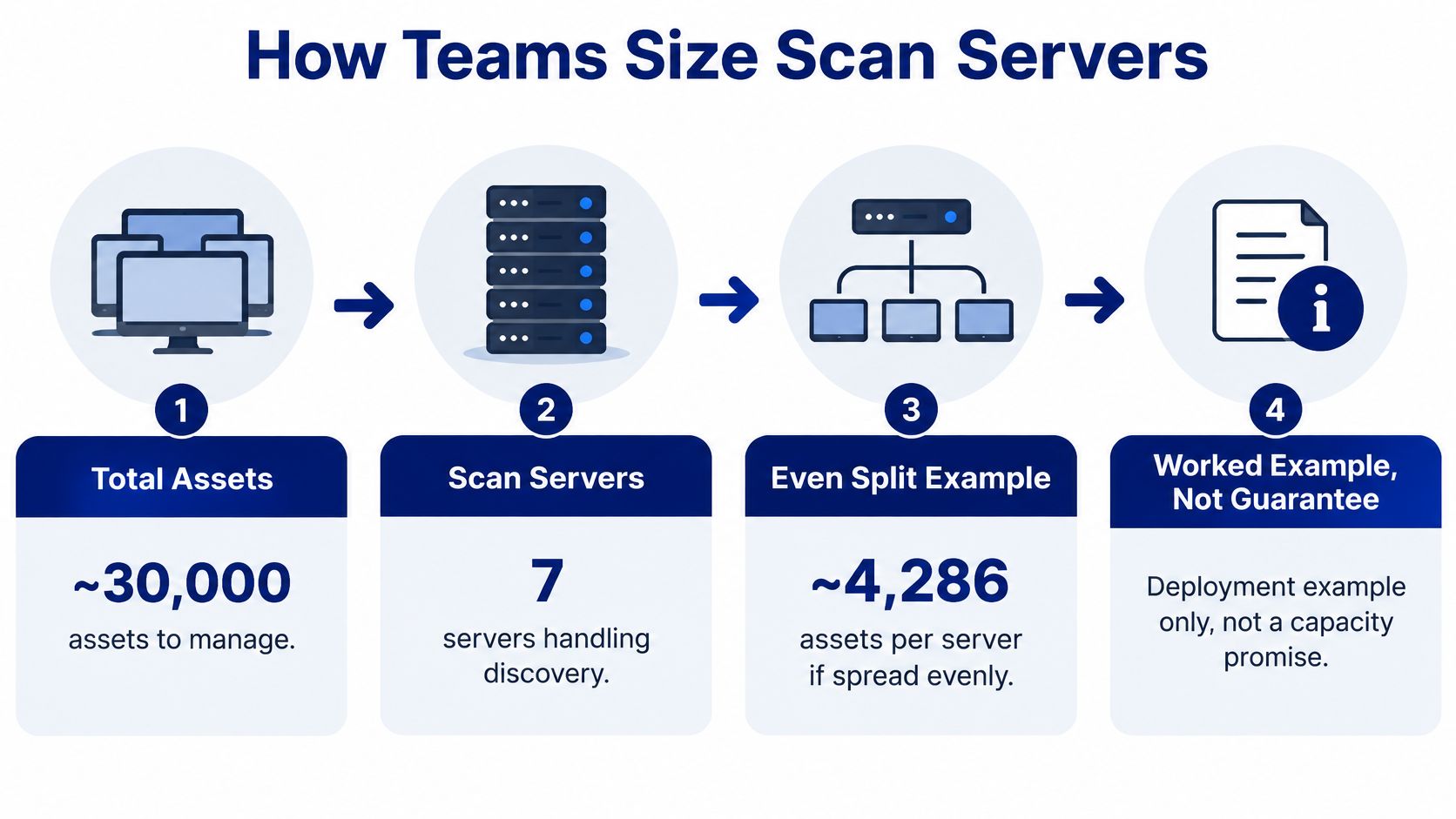
Entitlement is the wrong sizing input. Scan load follows topology, credential domains, latency, and how many subnets you can touch at once. A flat headquarters estate and a company with many isolated branches won't land on the same server count at the same asset total.
A validation sequence you can run
Map before you count. List sites, credential domains, and trust zones first.
Start narrow. Begin with one subnet and a limited directory scope.
Measure three things. Record scan completion time, database growth, and stale-asset rate.
Increase scope in steps. Stop adding targets when completion slips or stale records climb.
Split windows by site. Don't scan everything in parallel to save wall-clock time.
Price each extra server. Ask whether a remote scanning server carries a license cost, since practitioners raise that question and threads don't settle it.
Record your own ratio. Compare it with the 4,286 planning figure only as a sanity check.
Sizing rule: Buy scanning infrastructure for the topology you measured, then match the asset entitlement to the inventory you can refresh.
Your web console and database layout affect how that load feels in daily use, which the Stackingo overview of Lansweeper on IIS walks through. Vendor sizing guidance is a starting hypothesis. Your stepped pilot is the evidence, and it's what should go into the business case.
Why Renewals Surprise Finance
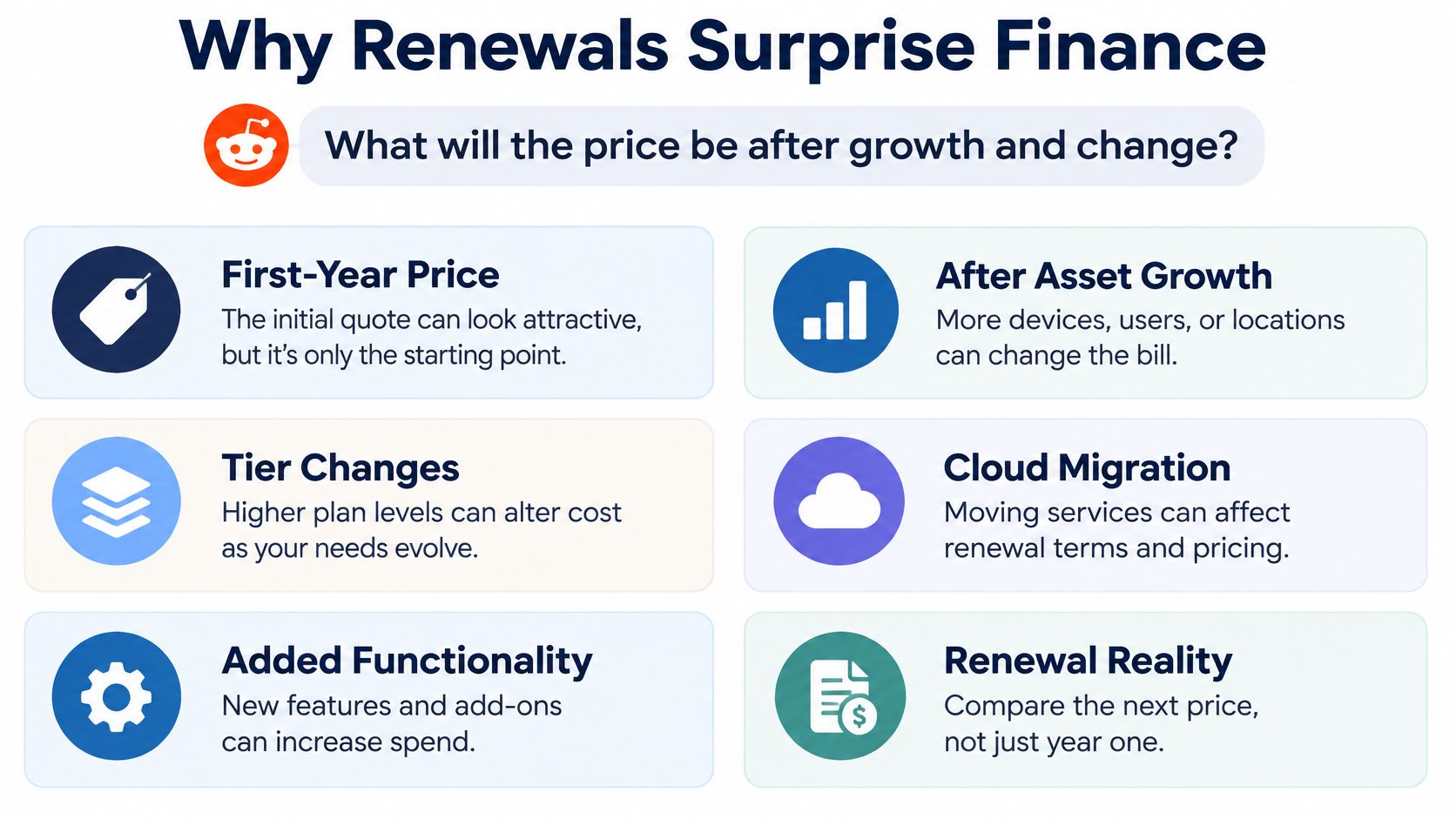
Discovery quality can justify Lansweeper, but a strong first-year result does not make renewal costs predictable. Asset growth, tier changes, cloud migration, or added functionality can all change the next invoice. Finance needs prices for those scenarios before signing.
A 2024 Reddit thread on leaving Lansweeper reports a 50% increase. A separate 2025 discussion mentions a reported 200% annual subscription increase and a move to another inventory product. These are individual reports, not a forecast for your renewal. They do show why buyers should request scenario-based pricing rather than assume the first quote will hold.
Scenario | What to get in writing | Failure to catch |
|---|---|---|
Year-one entitlement | Quoted price per 2,000 assets per month and minimum tier | Ignoring tier cliffs |
Inventory 50 percent higher | Price at 1.5 times current count, with the tier that count triggers | Assuming linear growth |
Tier or packaging change | Price at the new tier with features and notice period | Missing the renewal notice window |
Cloud or helpdesk expansion | Helpdesk per agent and remote scan-server charges quoted separately | Helpdesk money merged into the asset subscription |
Price four futures, not one
Start with the year-one entitlement and minimum tier. Then request prices for an inventory 50 percent higher, a tier or packaging change, and cloud or helpdesk expansion. A few hundred additional assets may trigger a higher tier, so ask for the applicable threshold and price. Get the renewal notice period in writing, and keep per-agent helpdesk costs separate from the asset subscription.
For a comparable benchmark, Stackingo lists a reseller price of $203.15 per 2,000 assets per month against a $239 list price. Confirm discount and service terms in the Lansweeper and Cleverbridge billing explanation and in the RFQ. Use the quote to compare commercial terms side by side, then re-quote when your asset count, tier, or requirements change.
For an exit comparison, Stackingo lists AssetExplorer at $67.65. Strong discovery can justify switching costs. Unmodeled commercial terms can still justify re-evaluation.
Assets the Network Never Sees
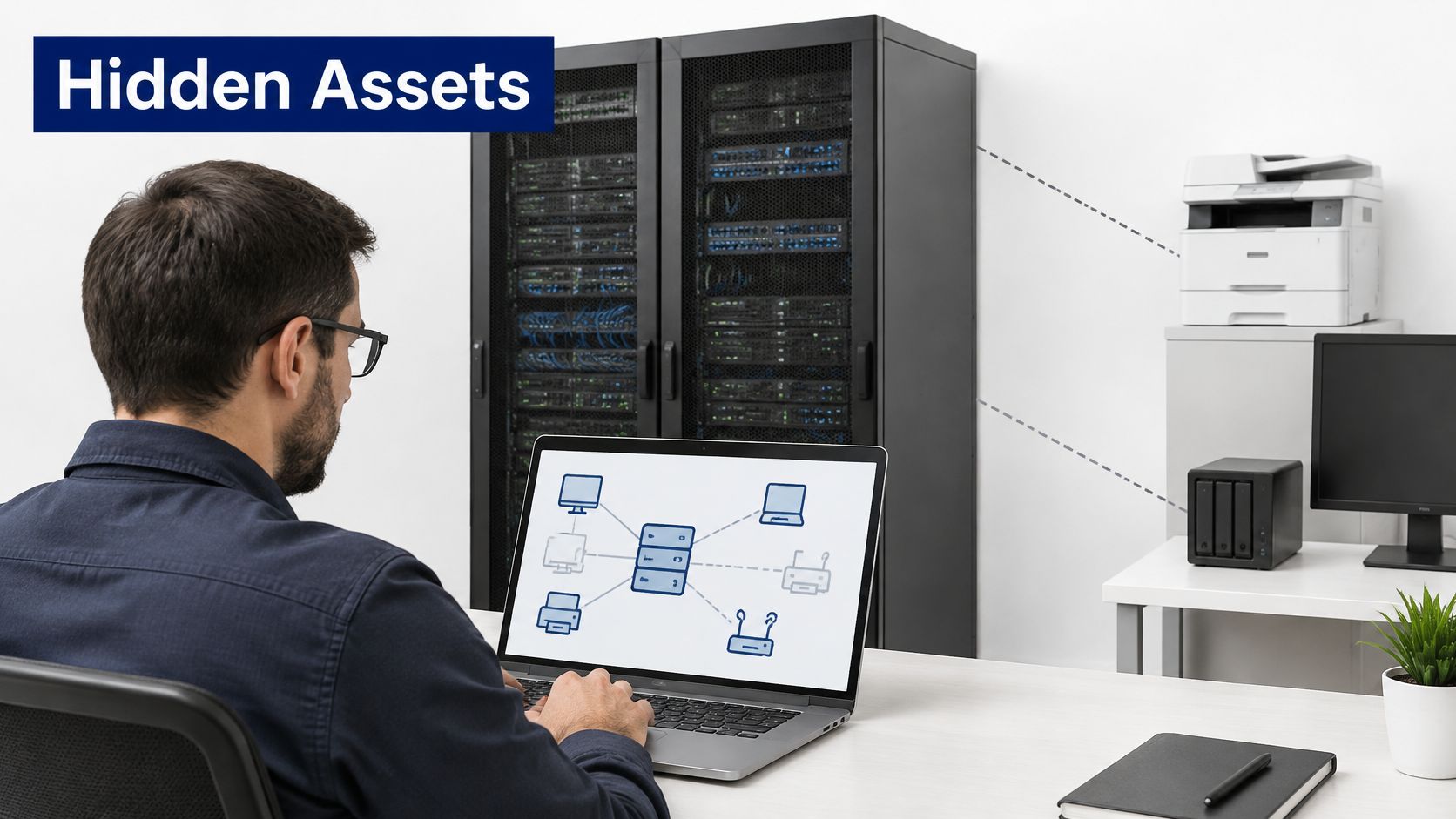
Lansweeper discovers what a scan server can reach. It doesn't automatically become the lifecycle system for everything your company owns. That gap, not scan quality, is what hybrid estates expose.
Reddit users asking how Lansweeper handles isolated networks ask how to scan isolated subnets, whether remote scanning servers incur additional licensing, and how to handle devices that never connect to the corporate network. Walk your own estate zone by zone and answer those questions before you sign.
Eight zones, eight answers
Headquarters. Expect the strongest agentless result where credentials and ports are open.
Branch offices. Isolated subnets may need extra scanning architecture, with remote scan-server licensing still an open commercial question.
Cloud workloads. Newer messaging points to broader cloud discovery, but get the migration path, license impact, and data-quality controls in writing.
OT and IoT. Passive and edge discovery are the stated direction. Confirm what your tier includes.
Remote endpoints. Devices that never touch the corporate network can stay invisible to agentless scans.
Air-gapped networks. Nothing reaches them by design. They need a local process, not a scan schedule.
Mobile devices. Decide which system owns them rather than assuming network discovery does.
Temporary equipment. Manually entered gear can duplicate when it later appears on the network.
Process for the unseen remainder
Every unseen asset still needs an owner, a source of truth, a reconciliation key, and a retirement step that doesn't depend on the next scan. Without those four items, your inventory is accurate only for the estate that's easiest to see.
Lansweeper can be excellent at discovery without owning ownership history or disposal. If IT, security, and procurement need one shared device and software view, evaluate that job on its own. It's separate from ticket workflow, and conflating the two is how buyers end up with a good scanner blamed for a missing lifecycle process.
Alternatives Reddit Users Compare
Name only what the threads name, and label it as thread-sourced. Forum comparisons are job-specific, so an alternative praised for ticketing tells you nothing about its discovery depth. Splitting alternatives by job keeps that confusion out of your shortlist.
The clearest signal is a departure rather than a recommendation. One team reported a steep subscription increase and moved to a different inventory product. Treat that destination as unverified where the thread doesn't substantiate it with deployment detail. The useful fact is the trigger. Commercial terms, not scan quality, caused the switch.
Split the shortlist by job
Inventory-only tools. For the discovery and license view, compare data depth and scanning setup, which is the angle taken in the Stackingo comparison of Fing and Lansweeper.
CMDB and ITSM suites. ServiceNow is the ticketing example threads reach for, because users find the Lansweeper helpdesk adequate only for basic work.
Monitoring platforms. For uptime and alerting, Reddit's position is consistent. Lansweeper doesn't replace them.
For each candidate, record what the thread reported on cost, data depth, and scanning setup. Flag anything resting on a single commenter. Single-comment claims are leads for your pilot, not selection criteria.
Ask three questions of every alternative. Does it cover the job you actually have, does it price the renewal path in writing, and does it reach the zones your network can't see?
Then price the survivor against the incumbent on the same asset count. An alternative that looks cheaper at today's inventory can cost more once your growth case is applied.
Run the Procurement Checklist
Decide only after six checks. A single fail on discovery scope or renewal math is a reason to pause, even if the pilot subnet looked clean. Everything else can be remediated later. Those two get locked into the contract.
Check | Pass looks like | Fail looks like |
|---|---|---|
Topology coverage | Pilot results for HQ, branch, cloud, OT/IoT, remote, and air-gap, plus a named process for unseen assets | Only a lab subnet was tested |
Scan infrastructure | Server count, credential domains, and remote-server license impact written down from the sizing steps | One server assumed for every site |
Renewal cases | Year-one, 1.5 times, and 2 times asset counts quoted with tier cliffs and notice period | Only the year-one price is known |
Helpdesk boundary | Excluded in writing, or quoted with SLA and knowledge-base limits | Assumed to replace ITSM |
Data quality | Reconciliation key, owner, and retirement step defined | Manual assets become duplicates |
Comparable quote | Same requirements priced through the Stackingo RFQ next to the incumbent renewal | A single opaque renewal |
What pass and fail mean for the decision
A pass on price means year-one, 1.5 times assets, and 2 times assets are all quoted, including tier cliffs and helpdesk if anyone still wants it. A pass on role means the contract buys inventory feeding ITSM, not a promise to replace monitoring or the helpdesk. A pass on operations means duplicate handling and retirement exist as written steps, not good intentions.
For the comparable quote, send the same asset count, sites, and growth cases through the Stackingo Lansweeper product page and RFQ. Put the reseller figure of $203.15 per 2,000 assets per month against the $239 list next to your vendor renewal, with the stated discount bounds. Same inputs, two numbers, one defensible decision.
Buy or renew when discovery passes and the renewal is capped in writing. Re-quote or plan an exit when the only obstacle is an unforecastable increase, since the threads show teams leaving for commercial reasons while scanning still works.
Do one thing this week. Freeze your asset and site counts, then request both quotes before the renewal notice window closes.
Stackingo turns opaque enterprise software renewals into comparable, written quotes across vendors, including Lansweeper at documented discount bounds with quotes inside one business day. Send your asset count, site list, and growth cases once, and compare the reseller figure directly against your incumbent renewal. Visit Stackingo to start that RFQ before your notice window closes.


