
Lansweeper Aymon Release: What It Is and Why It Matters
Updated: Oct 10
Is Lansweeper Aymon a separate product, or is it a release name that has been misunderstood? The answer matters because Aymon was Lansweeper's codename for its Spring 2022 release, not a standalone SKU. That release expanded discovery across physical, virtual, and software assets while improving Windows and Linux inventory collection, according to Lansweeper's Aymon release announcement.
What Lansweeper Aymon Actually Means
The most common mistake is treating Aymon as a separate Lansweeper product, sibling tool, or acquisition. It isn't. Aymon was the internal codename for Lansweeper's 2022 Spring Release, a platform milestone that expanded how the software discovered and organized technology assets.
Vendors often use codenames while developing major releases. Those names can later appear in release notes, community discussions, partner documents, and search results. That creates a simple decoding problem for buyers: the name sounds like a product, but it identifies a point in the platform's development timeline.
A useful analogy is Apple's use of California landmark names for macOS releases. A codename helps teams discuss a release before its final commercial positioning is settled. It doesn't automatically indicate a new license family or a product that must be purchased separately.
Practical rule: Treat Aymon as a release milestone, not as a SKU you should request in isolation.
The Lansweeper overview from Stackingo is useful when you need to place that milestone in the wider platform story. The Spring 2022 update was positioned as a major Technology Asset Intelligence step because it broadened discovery across physical, virtual, and software assets. Lansweeper also stated that the updates were live and ready for users immediately, with a 14-day free trial included for prospective customers in the release announcement.
This article therefore isn't a product comparison page for “Aymon” versus another Lansweeper edition. It explains what the codename represented, why the release remains relevant to buying decisions, and where broader discovery can create operational work.
Inside the Aymon Release and What It Added
Aymon is easiest to understand through three anchors: discovery, inventory, and cloud. Together, they show why the release represented more than a cosmetic dashboard update.
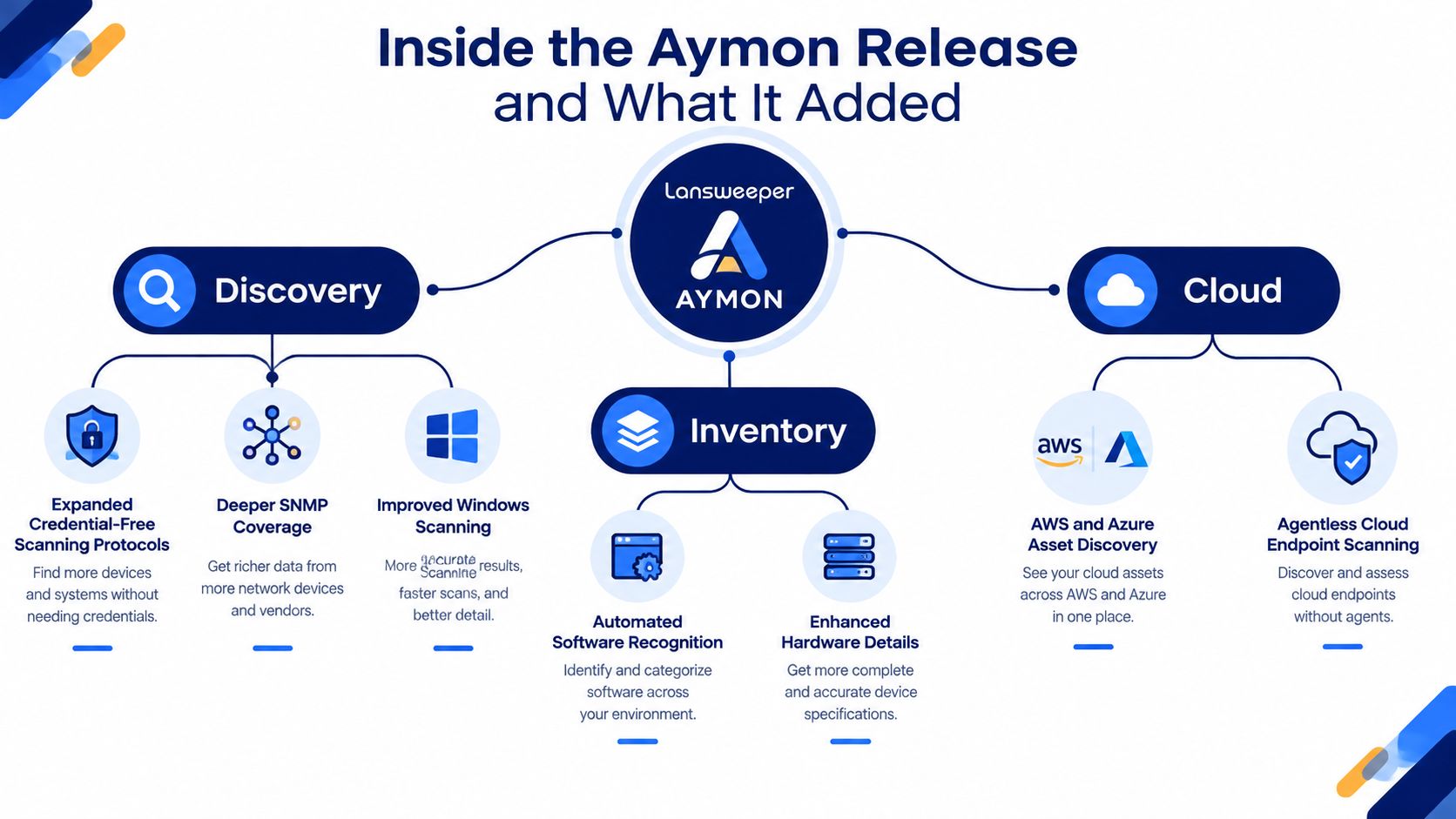
Discovery broadened the map
The release expanded Lansweeper's ability to identify assets across physical, virtual, and software environments. For an IT team, that means the platform's value isn't limited to answering “which devices are connected to this network?” It moves toward a broader question: “which technology assets exist across the estate, and what information can we associate with them?”
That distinction matters in hybrid environments. A laptop, virtual machine, network device, and installed application may belong to different operational owners, yet procurement and security teams still need a joined view.
Inventory became more useful downstream
Improved Windows and Linux inventory collection helps turn raw discovery into records that other teams can use. Procurement can work from a clearer asset population, IT operations can reconcile equipment with service records, and security teams can investigate gaps between expected and observed technology.
The practical takeaway is simple: discovery finds the object, while inventory gives the object context. Without that context, an asset list remains difficult to use for renewal planning or ownership decisions.
For a related view of Lansweeper's broader platform capabilities, see Lansweeper's full platform coverage. Buyers should still distinguish confirmed Aymon-era capabilities from features delivered in later releases.
Cloud changes the buying conversation
The release's importance also comes from its direction. By expanding the asset model beyond purely local infrastructure, Lansweeper moved closer to a hybrid asset intelligence platform. That matters because a modern estate rarely fits inside one office network or one hardware inventory.
A procurement leader should therefore read Aymon as an architectural signal. The release widened the scope of what Lansweeper was trying to represent, but the quality of the outcome still depends on deployment design, permissions, data ownership, and reconciliation.
Why IT and Procurement Teams Should Care About Aymon
Before a broader asset intelligence approach, many teams used discovery tools to answer “what is on my network?” Aymon's significance is that it pushed the answer toward “what technology do we have, where is it, and how can we use that information operationally?”
That shift directly affects procurement. A reliable asset view can support software renewal preparation, entitlement reviews, SaaS-sprawl investigations, and IT service management workflows. It can also expose the difference between what an organization believes it owns and what its systems show.
Consider a renewal review. The procurement team may need to compare installed software with contract records, identify apparently unused allocations, and ask business owners to validate exceptions. Lansweeper can contribute discovery and inventory evidence, but it won't replace commercial judgment or supplier negotiation.
Discovery supports several decisions
Renewal preparation: Establish which products and assets need validation before a contract discussion.
Ownership review: Identify records without a clear business or technical owner.
ITSM enrichment: Feed more complete asset information into service and configuration workflows.
License governance: Give software asset managers a starting point for reconciling installations and entitlements.
The Lansweeper Gartner discussion from Stackingo can help buyers frame the platform within a broader asset management conversation. For 2026 buyers, Aymon-era capabilities matter less as a historical label than as part of the baseline evolution that shaped the current platform. The procurement question isn't “Can I buy Aymon?” It's “Does the current Lansweeper edition provide dependable evidence for my licensing and ownership decisions?”
The Company Story Behind the Codename
Lansweeper's story began in Belgium in 2004, when the company focused on helping organizations discover technology connected to their networks. The product's role gradually expanded as estates became more distributed and asset information became more important to operations, security, and finance.
On June 2, 2021, Lansweeper secured a €130 million minority investment from Insight Partners to accelerate growth, as recorded in this Lansweeper ownership and growth timeline. The Aymon release sits within that broader progression. It represents a point where the platform was being positioned around wider technology asset intelligence rather than narrow local discovery.
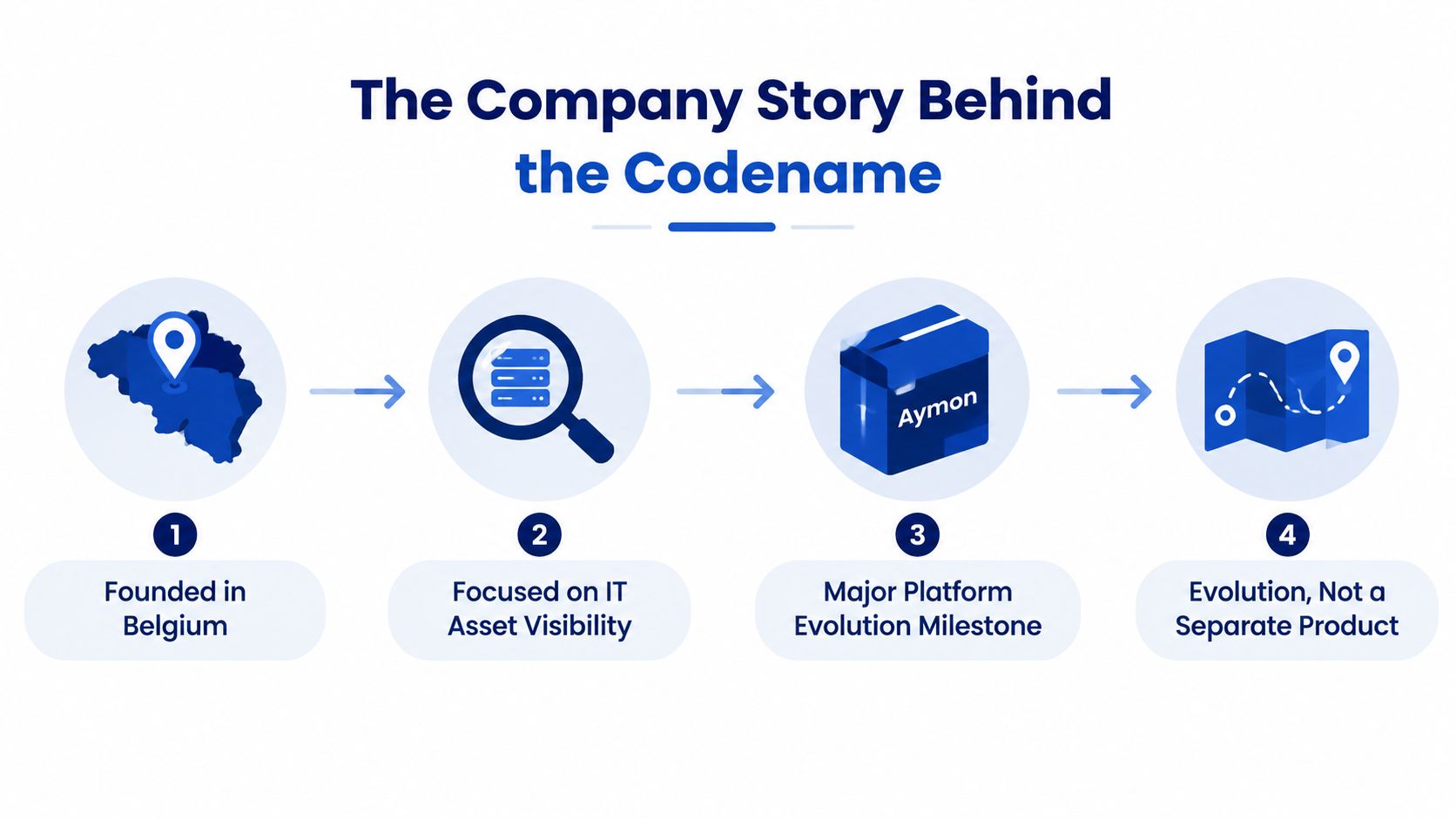
A helpful way to understand the evolution is to compare two operating models:
The metal detector: Finds nearby devices and produces a list.
The control room: Organizes findings, connects them to ownership, and supports decisions across regions and business units.
Aymon captures that transition. It isn't the complete Lansweeper product story, and it shouldn't be treated as one. On July 27, 2026, Bridgepoint announced an agreement to acquire a majority stake in Lansweeper, with completion expected by the end of 2026 subject to regulatory approval. Bridgepoint's announcement says Lansweeper is headquartered in Ghent, Belgium, has operated for more than 20 years, and serves thousands of organizations globally.
That ownership context reinforces a practical point. Evaluate the current platform, roadmap, support model, integrations, and commercial terms, rather than buying based on a historical codename.
Where Aymon Creates Real Operational Friction
More discovery doesn't automatically produce better decisions. If your organization lacks clear ownership rules, broader scanning can create duplicate records, stale information, unexpected network activity, and a larger exception queue.
Public community discussion shows why implementation questions matter. Users have asked about certificate scanning, while later changelog material has highlighted fixes involving indirect scans, LsAgent-only exclusions, reports affected by legacy scripts, and synchronization between Classic and LS Sites. Those details don't prove that the platform fails. They show that real-world value depends on topology, configuration, credentials, and lifecycle management.
Visibility only becomes useful when people trust the records and know who resolves exceptions.
Start with a limited network segment, define the authoritative source for each asset type, and compare results with endpoint management, finance, procurement, HR, and ITSM data. Assign someone to investigate duplicates and unexplained assets instead of allowing exceptions to accumulate without ownership.
Aymon friction and practical control
Friction | Likely Cause | Practical Control |
|---|---|---|
Duplicate records | Multiple discovery paths identify the same device | Define matching rules and a preferred asset identifier |
Stale software data | Scan timing doesn't match operational change | Set review intervals and flag outdated evidence |
Unexpected scan activity | Expanded coverage crosses network or security boundaries | Approve scan scope with network and security teams |
Cloud synchronization issues | Different environments use different connectors or permissions | Document credentials, owners, and failure checks |
Broken reports | Legacy scripts depend on older report structures | Test critical reports after upgrades and retire unsupported scripts |
For a focused troubleshooting example, review Lansweeper's RPC unavailable guidance. Buyers should ask not only what the platform discovers, but also how administrators diagnose failed scans and maintain confidence in the resulting data.
A Practical Buyer Checklist for Evaluating Aymon
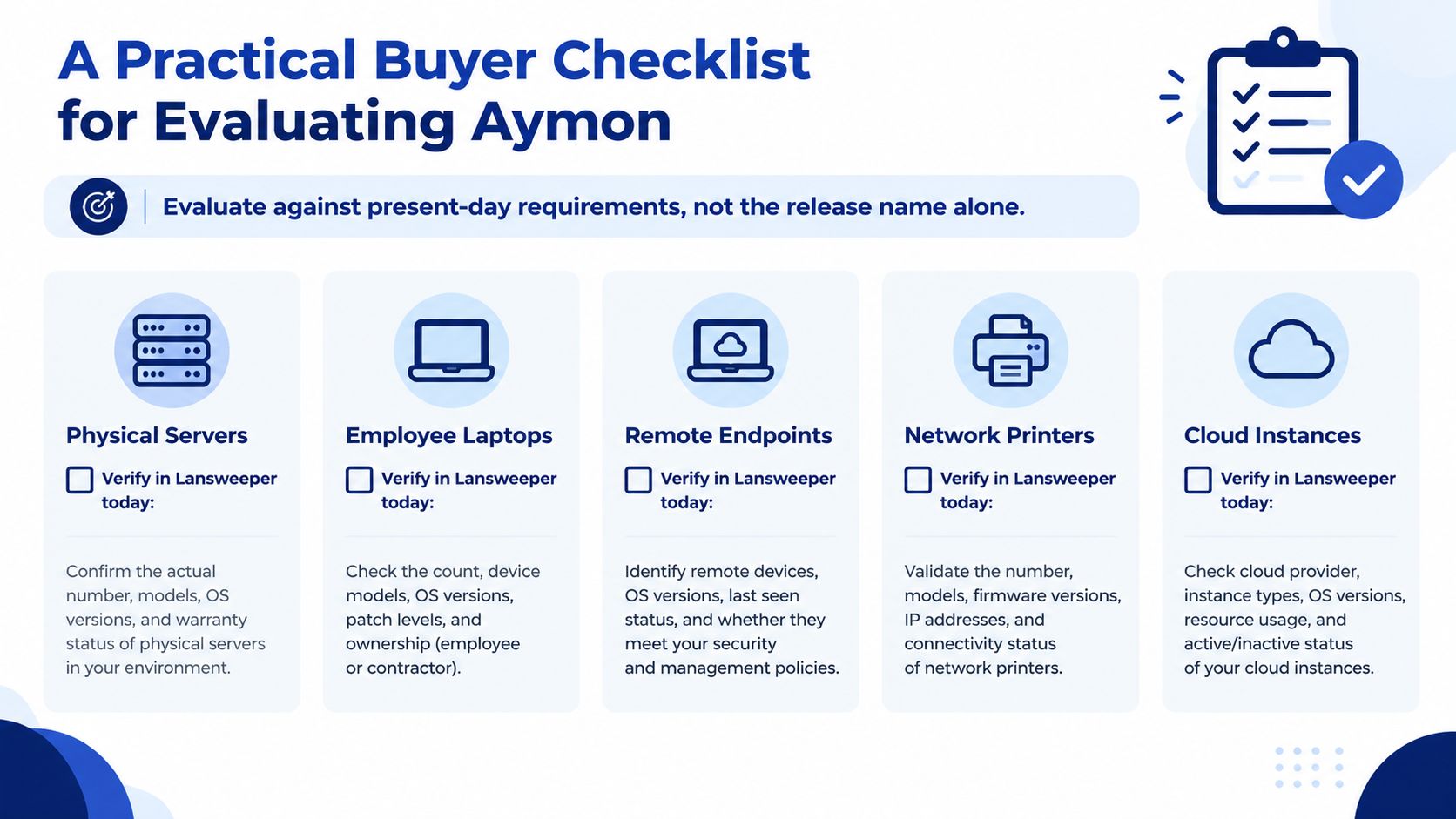
Don't evaluate Aymon by the release name alone. Evaluate the current Lansweeper environment against a representative sample of your estate and the decisions you need to make from its data.
Begin with these asset categories:
Physical servers: Verify operating-system, hardware, and ownership details.
Employee laptops: Check coverage for managed and remote endpoints.
Remote endpoints: Test how the platform handles devices outside ordinary network boundaries.
Network devices and printers: Confirm that discovery produces records your operations team can use.
Cloud-managed systems: Identify what data is available, how it is collected, and which permissions are required.
Then score the platform against practical criteria:
Discovery depth: Can it find the asset types that matter to your organization?
Deployment method: Does the approach fit your security policy and network design?
Credentials and access: Can administrators manage permissions without creating unnecessary exposure?
Data quality: How are duplicates, stale records, and conflicting ownership values handled?
License usefulness: Do records include product, publisher, version, installation evidence, and accountable owner?
Workflow compatibility: Can teams export or publish records without extensive manual cleanup?
Upgrade confidence: Can you test integrations, reports, and database behavior before production changes?
A low-risk pilot should measure administrator effort, reconciliation work, false positives, deployment time, and the time required to produce a report that procurement can act on. Document which system remains authoritative for contracts, financial ownership, identity, endpoint status, and configuration data.
How Lansweeper Aymon Fits a Multi-Vendor License Strategy
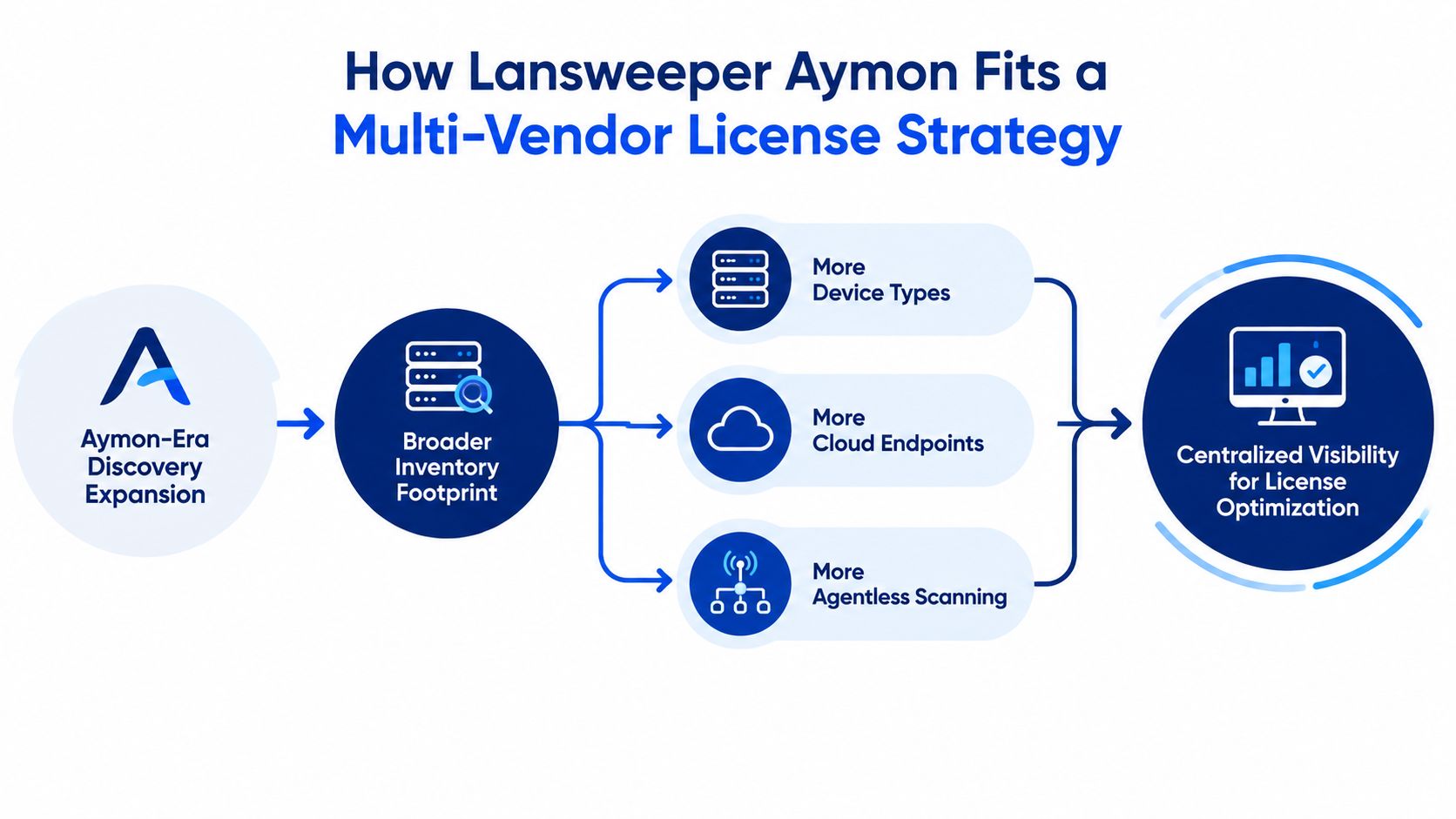
Aymon-era expansion makes the inventory foundation broader, but discovery isn't the same as sourcing. Lansweeper can help establish what appears to be installed or assigned. It doesn't replace a commercial process that compares suppliers, maps entitlements to purchasing options, or negotiates renewal terms.
Use the platforms as complementary layers:
Extract evidence: Pull a Lansweeper utilization or inventory report and validate the records with internal owners.
Normalize the commercial data: Map products and entitlements to the correct vendor SKUs, contract terms, and renewal dates.
Compare suppliers: Use a multi-vendor request for quotation to compare available commercial routes against the existing renewal path.
For example, Lansweeper might show a population of Microsoft 365 users or Adobe installations that requires review. The procurement team still needs to determine whether those records match contractual entitlements, which supplier should quote the requirement, and whether the proposed renewal reflects actual use.
Stackingo's Lansweeper pricing and procurement guidance fits the buyer workflow. Stackingo provides a marketplace-first route for comparing enterprise software licensing across vendors, while Lansweeper remains the discovery and inventory system. Separating those responsibilities can give procurement clearer control over evidence, supplier selection, and renewal decisions.
The ownership transition announced for 2026 makes this separation especially practical. Tooling and sourcing don't need to come from the same commercial party for the buyer to maintain influence.
FAQs on Lansweeper Aymon Buyers Ask Most
Is Aymon a separate Lansweeper product?
No. Aymon was the codename for Lansweeper's Spring 2022 release, which expanded discovery across physical, virtual, and software assets and improved Windows and Linux inventory collection. It doesn't identify a separate SKU or standalone product.
Do I need to upgrade specifically to Aymon?
No. Aymon describes a historical release milestone, and Lansweeper has continued developing the platform since then. Evaluate the current generally available capabilities, supported integrations, deployment model, and support terms instead of trying to obtain a release codename.
Does Lansweeper Aymon manage software licenses directly?
Lansweeper can provide inventory and software evidence that supports license management. It doesn't independently procure licenses, compare every supplier, or renegotiate commercial agreements, so sourcing and renewal decisions still require procurement ownership or a licensing partner.
Is Lansweeper still relevant after the ownership changes?
The 2026 Bridgepoint announcement describes Lansweeper as a Ghent-headquartered company that has operated for more than 20 years and serves thousands of organizations globally. Buyers should still validate the current roadmap, support commitments, security requirements, integrations, and commercial terms with their account team before committing.
If Aymon-era discovery has exposed a broader licensing or renewal requirement, use Stackingo to consolidate multi-vendor software requirements, compare supplier quotes, and turn validated Lansweeper inventory into a structured procurement decision. Start with the assets and entitlements you need to renew, then request a commercial comparison that your IT and finance teams can review together.