
How to Vet Lansweeper LinkedIn for Procurement Intel
Updated: Oct 10
Someone has put Lansweeper on your shortlist, and the next meeting is already on the calendar. Before you request a demo, you need to know whether you're evaluating a durable enterprise vendor or just repeating polished marketing claims. Lansweeper LinkedIn can provide useful procurement intelligence, but only if you treat the profile as evidence to verify, not as proof to accept.
Starting Your Lansweeper Vendor Research
Start with the official Lansweeper company profile, not a consultant's post or an employee's personal update. Search for the company name together with terms such as “IT asset management,” “technology asset intelligence,” or “asset discovery.” Then apply LinkedIn's company filter and check whether the result connects to Lansweeper's corporate website and consistent brand identity.
That first filter matters because procurement research can become contaminated quickly. A thought-leadership post may describe a product opinion, an employee profile may reflect an individual role, and an old agency page may preserve outdated information. None should replace the company page as your baseline record.

How do you confirm that the profile is genuine?
Look for a coherent company description, a link to the official website, a populated employee section, and activity that aligns with official announcements. Check whether employee profiles identify Lansweeper as their employer and whether their roles make sense for a software company selling asset discovery, ITAM, and cyber asset intelligence.
The profile identifies Lansweeper as founded in Belgium in 2004 and as a privately held company. Those details are useful starting points, but they aren't enough to establish financial or operational suitability. A founding date tells you about operating history, not whether the vendor's current product, support model, and commercial terms fit your environment.
Record the profile details in a simple vendor evidence sheet:
Corporate identity: Capture the official page URL, company description, website, headquarters information, and ownership status.
Business scale: Note the listed employee range, but preserve the date you observed it because LinkedIn profiles can change.
Product scope: Separate stated capabilities from features you still need to test.
Activity trail: Save relevant announcements, executive appointments, partnerships, and product updates.
Customer references: Treat named organizations as claimed adoption signals, not automatically as references for your particular use case.
For technical context, compare this baseline with Lansweeper's ITAM overview. The useful question isn't whether the page looks credible. It's whether the evidence gives your IT, procurement, security, and finance teams enough confidence to justify the next stage of diligence.
Reading the Company Page for Real Signals
Before you read a single post, split the company page into layers. The About section declares identity and positioning. The Life page shows how the vendor presents its people and culture. Updates reveal whether the business is communicating in a way that matches a real operating company, while employee profiles help you test whether the organization looks active and internally consistent.
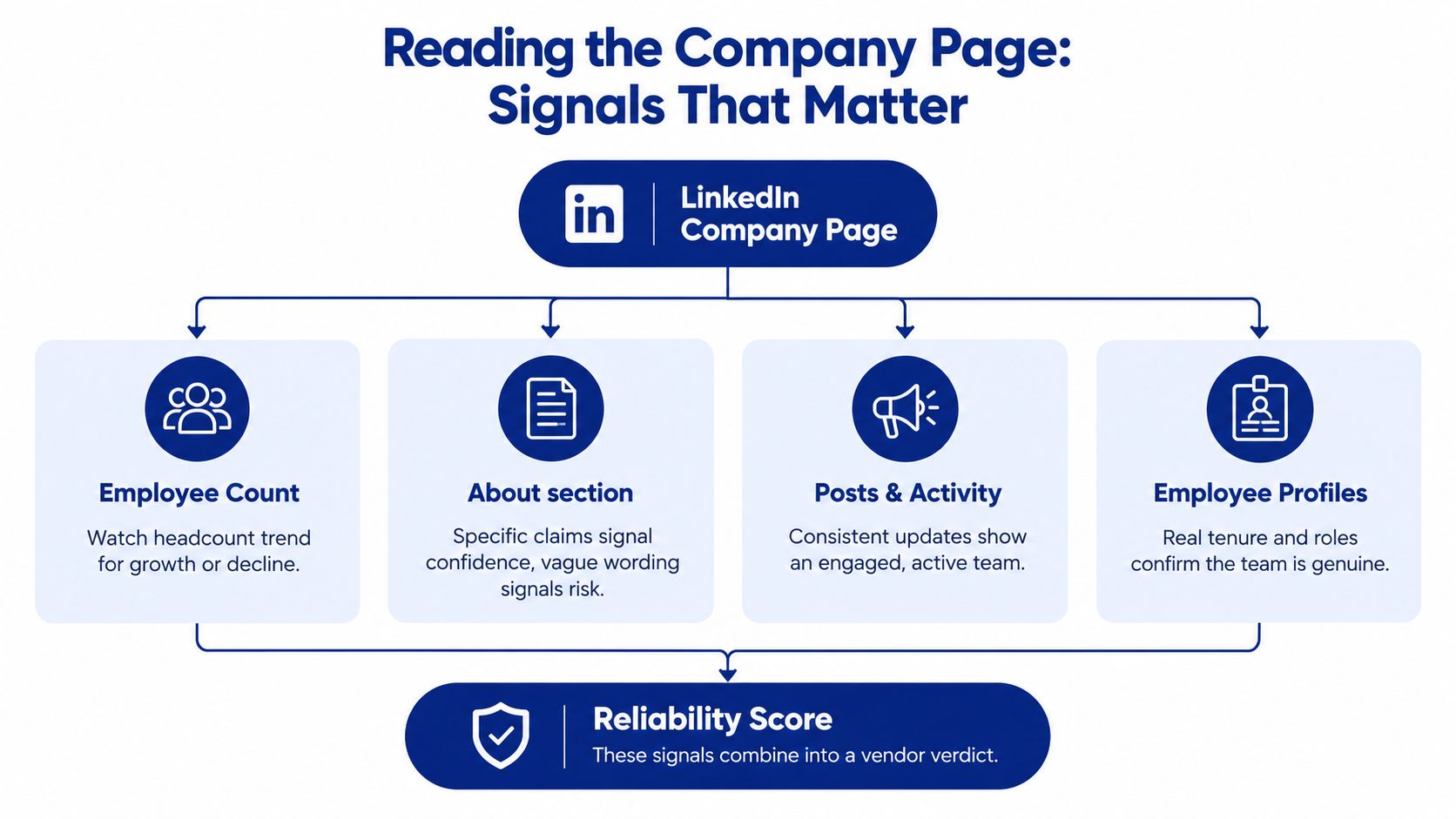
Which company-page details deserve procurement attention?
The employee range on Lansweeper's main LinkedIn profile is listed as 201–500 people, while the company also says it has more than 350 employees worldwide on its own site. That gap does not prove anything by itself. It does mean you should ask which figure the sales team wants procurement to use, and which teams sit behind product engineering, customer success, implementation, security, and regional operations.
The right question is not whether the numbers conflict. It is which number will go into your vendor file and why. A vendor can be credible while using different public figures, but your business case needs one dated figure you can defend later. For a separate perspective on the company's public footprint, see Lansweeper 360 research.
The same LinkedIn materials say Lansweeper discovers and monitors more than 80 million connected devices for over 25,000 customers. The profile also names organizations such as Mercedes, Michelin, Liverpool FC, Carlsberg, Nestlé, IBM, and Samsung, along with governments, banks, nongovernmental organizations, and universities. That signals reach. It does not prove the platform covers your remote endpoints, cloud accounts, operational technology, or licensing evidence requirements.
Profile signal | What it can indicate | What it cannot prove |
|---|---|---|
Founding date | Operating history and corporate continuity | Current product fit or service quality |
Employee range | Approximate organizational scale | Support capacity for your contract |
Named customers | Market adoption across recognizable organizations | Comparable results in your environment |
Executive updates | Active corporate communication | Leadership stability or roadmap delivery |
Product description | Declared platform scope | Verified discovery coverage or entitlement accuracy |
Use the profile as a living RFQ supplement. Capture the claims, then ask for evidence that connects those claims to your environment, your asset classes, and your commercial goals. If the vendor says the platform covers your use case, the burden is on them to show how.
Practical rule: Treat LinkedIn as a corporate signal layer. Treat a proof of concept, contract review, and reference call as separate evidence layers.
What does activity reveal that the About section misses?
Review whether posts describe product changes, partnerships, hiring, and customer-facing shifts. Lansweeper's official press archive lists developments including new managed service provider services, leadership appointments, a partnership with Luzmo, and the acquisition of Redjack, with announcements dated from 29 February 2024 through 17 July 2025 in the archive. That gives you a dated sequence you can interrogate, not just a static profile.
The quality of the activity matters more than the volume. Generic celebration posts tell you little. A steady trail of dated operational announcements gives you better material for questions about product investment, channel strategy, executive accountability, and integration priorities.
Verifying Scale and Growth Claims
The right response to a large device or customer claim isn't immediate acceptance or dismissal. Build a verification chain. Start with the company's stated figures, identify when they were published, and then look for supporting evidence in official announcements, employee activity, hiring patterns, and the vendor's answers during diligence.
Lansweeper's corporate history provides several points to test. The company was founded in 2004, Dovesco acquired it in 2018, and Lansweeper announced a €130 million minority investment from Insight Partners on 2 June 2021. The same announcement said headcount had grown more than fourfold since the 2018 acquisition, reaching more than 150 employees across Belgium, Spain, Italy, Ireland, the United Kingdom, and the United States, as documented in Lansweeper's investment announcement.
How should buyers test a vendor growth story?
Use the profile as a set of hypotheses, then ask for corroboration.
Timeline test: Put the founding date, ownership milestone, financing announcement, office expansion, executive appointments, and acquisitions in chronological order. A coherent sequence is easier to validate than a collection of isolated claims.
Organization test: Compare the public employee range with the vendor's explanation of regional coverage and customer-facing staffing. Ask who owns implementation, technical support, account management, security responses, and product escalation.
Customer test: Ask whether named organizations can be replaced with references that match your industry, geography, deployment model, and asset complexity. A recognizable logo is not a substitute for a relevant reference conversation.
Product test: Require the vendor to demonstrate how its discovery methods identify and reconcile assets in your environment. A headline device count doesn't establish coverage for your specific endpoints, cloud services, network infrastructure, or remote workers.
Commercial test: Ask how inventory records support renewal decisions, license reclamation, contract normalization, audit readiness, and sourcing. Discovery data has commercial value only when your organization can connect it to ownership, entitlement, utilization, and authority to act.
Lansweeper's documentation describes three discovery paths: network discovery, agent-based discovery, and cloud discovery across AWS, Azure, and Google Cloud. It also describes reconciliation intended to merge the same device when multiple discovery systems detect it. The documentation says full visibility can be achieved in under 30 minutes in most environments, but that is a vendor-published operational claim, not an independently verified success rate, as stated in the asset discovery documentation.
Your acceptance criteria should therefore focus on coverage by asset class and source, duplicate records after reconciliation, stale records, and time to a usable inventory. Don't confuse a fast initial scan with procurement-grade data.
For a broader market comparison, use Lansweeper and Gartner research as a starting point, then apply the same verification standard to every shortlisted platform. Consistent diligence is more valuable than a favorable interpretation of one vendor's profile.
Spotting Red Flags Before You Buy
A credible LinkedIn presence can still conceal procurement risk. The warning signs usually appear in the gaps between the About section, employee activity, official announcements, and the vendor's answers to detailed questions.
Start with consistency. If the company presents aggressive product expansion but provides little detail about ownership, implementation, support, or integration responsibilities, slow down the evaluation. If executive changes appear without clear role continuity, ask who owns your commercial relationship and escalation path after signature.
Which LinkedIn inconsistencies should delay an RFQ?
Look for these patterns:
Unexplained number changes: Different employee or device figures aren't automatically problematic, but the vendor should explain their dates, scope, and measurement method.
Vague customer language: Named logos without deployment context won't validate your use case. Request references that can discuss rollout conditions and operational limitations.
Irregular corporate communication: Long gaps followed by dense promotional activity may indicate a change in messaging, though they don't prove instability on their own.
Leadership ambiguity: New executives should have defined responsibilities, especially across revenue, operations, security, and product delivery.
Product narrative gaps: If the profile describes broad asset intelligence but the demo only shows a narrow endpoint inventory, require a written coverage matrix.
Commercial silence: A platform may discover software without proving license entitlement, contract ownership, or renewal liability. Those controls need explicit treatment in the RFQ.
A buyer should also compare LinkedIn claims with the formal buying process. The profile can support vendor maturity assessment, but it won't answer pricing, data residency, support levels, implementation fees, termination rights, or renewal protections. Those questions belong in the commercial and legal workstream.
Use Lansweeper pricing research as a procurement prompt, not as a final quote. Public pricing information, where available, should be reconciled with asset scope, user roles, modules, support, services, and contract duration before finance approves a business case.
A polished profile lowers the cost of initial research. It doesn't lower your evidence standard.
Turning Profile Insights Into RFQ Evidence
Your final evidence pack should convert public signals into questions that vendors must answer consistently. Record the source, date, claim, confidence level, and procurement implication. That format lets IT, finance, procurement, and security review the same facts without reading every post.
For Lansweeper, the record might include:
Corporate maturity: Founded in Belgium in 2004, with later ownership and financing milestones documented through official company materials.
Scale claim: More than 25,000 customers and over 80 million connected devices, treated as vendor-reported figures requiring scope clarification.
Organizational evidence: A 201–500 employee range on LinkedIn and a separate claim of more than 350 employees, with the discrepancy documented rather than ignored.
Technical validation: Network, agent-based, and cloud discovery tested against your asset classes, followed by reconciliation and stale-record checks.
Commercial validation: Inventory mapped to software editions, versions, owners, entitlements, renewal dates, and exception handling.
The core acceptance question is simple: can Lansweeper-derived records support an auditable, comparable commercial decision across multiple OEMs? If not, asset visibility may remain operationally useful without producing the savings or governance outcome your business case assumes.
Use Lansweeper Cleverbridge context alongside your RFQ documentation to keep licensing, procurement routes, and vendor evidence in the same review. Stackingo can help standardize requirements and compare quotes across technology suppliers, so Lansweeper is assessed against alternatives using consistent commercial criteria rather than profile prominence.
Frequently asked questions about Lansweeper LinkedIn
What can Lansweeper LinkedIn tell me about vendor maturity?
It can show the company's stated founding date, ownership status, employee range, customer claims, leadership activity, and public announcements. Those signals help establish a research baseline, but they don't replace contractual, technical, financial, or reference checks.
Are Lansweeper's customer and device figures independently verified?
The figures are company-reported claims presented through Lansweeper's LinkedIn materials. Ask the vendor to define the measurement period, customer scope, device categories, and whether the figures include all deployment types.
Why might Lansweeper's employee figures differ across pages?
LinkedIn lists an employee range of 201–500, while a separate company description reports a team of more than 350 employees. The difference may reflect update timing or reporting conventions, so ask which figure is current and what functions it includes.
Does asset discovery automatically prove software license compliance?
No. Discovery identifies technology records, but compliance and procurement decisions also require entitlement, ownership, contract, edition, version, utilization, and renewal evidence. Your RFQ should test those links explicitly.
Should LinkedIn research happen before a Lansweeper demo?
Yes. A focused profile review helps you arrive with questions about scale, leadership, coverage, references, and commercial governance. It won't select the platform for you, but it can prevent a demo from setting the evaluation agenda.
Stackingo helps enterprise buyers turn vendor research into structured, comparable RFQs across software and technology suppliers. Visit Stackingo to organize Lansweeper requirements, compare commercial options, and request quotes through one purchasing workflow.