
Lansweeper 360: What It Is and How Enterprises Buy It
Updated: Oct 12
Most buying advice about Lansweeper 360 starts with “single source of truth” and ends with a product demo. That's the wrong order. The decision turns on whether your scanning model works across real networks, whether the audit trail supports governance, whether support matches your operating hours, and whether your asset count lands cleanly inside the commercial bands. Lansweeper can be a strong asset intelligence layer, but it isn't a substitute for a complete ITSM, CMDB, or security operating model.
What Lansweeper 360 Actually Is Beyond the Marketing Pitch
Lansweeper 360 is not a product name: it was the title of Lansweeper's first user conference, a virtual event held in 2022. What buyers usually mean by it is the Lansweeper platform itself, a cloud-delivered asset intelligence layer connected to Lansweeper's discovery and inventory capabilities. It centralizes information from network, remote, and cloud environments, then enriches it with hardware details, installed software, user relationships, lifecycle status, vulnerability data, dashboards, and benchmarking. That makes it useful for answering “what do we have?” and “what condition is it in?” It doesn't automatically answer “what workflow should resolve it?” or “which service process owns the remediation?”
Lansweeper was founded in Belgium in 2004 and has more than two decades of operating history in asset discovery and inventory management, according to its company history. In June 2021, Insight Partners invested €130 million, a milestone that signaled substantial confidence in the platform's enterprise direction. By 2025, Lansweeper's positioning had expanded from inventory toward technology asset intelligence, with stronger emphasis on risk, lifecycle, dashboards, and spend decisions.
That evolution matters during procurement. You're not buying a blank SaaS database that replaces every existing management platform. You're buying a system that discovers and normalizes technology data, then makes that data more usable for reporting, risk analysis, and downstream processes.
Procurement view: Treat Lansweeper as an intelligence and evidence layer first. Budget separately for the ITSM, CMDB, security, and remediation processes that turn its data into action.
A practical evaluation should begin with your operating model, not the dashboard design. If your team needs deep asset lookup, software audit support, lifecycle visibility, and a normalized technology inventory, the platform deserves serious consideration. If you expect native service orchestration, complete patch management, or a fully managed CMDB operating model, set that expectation correctly before the quote reaches finance. The Lansweeper overview from Stackingo is a useful companion for comparing the broader product context.
Core Capabilities That Matter in a Real IT Estate
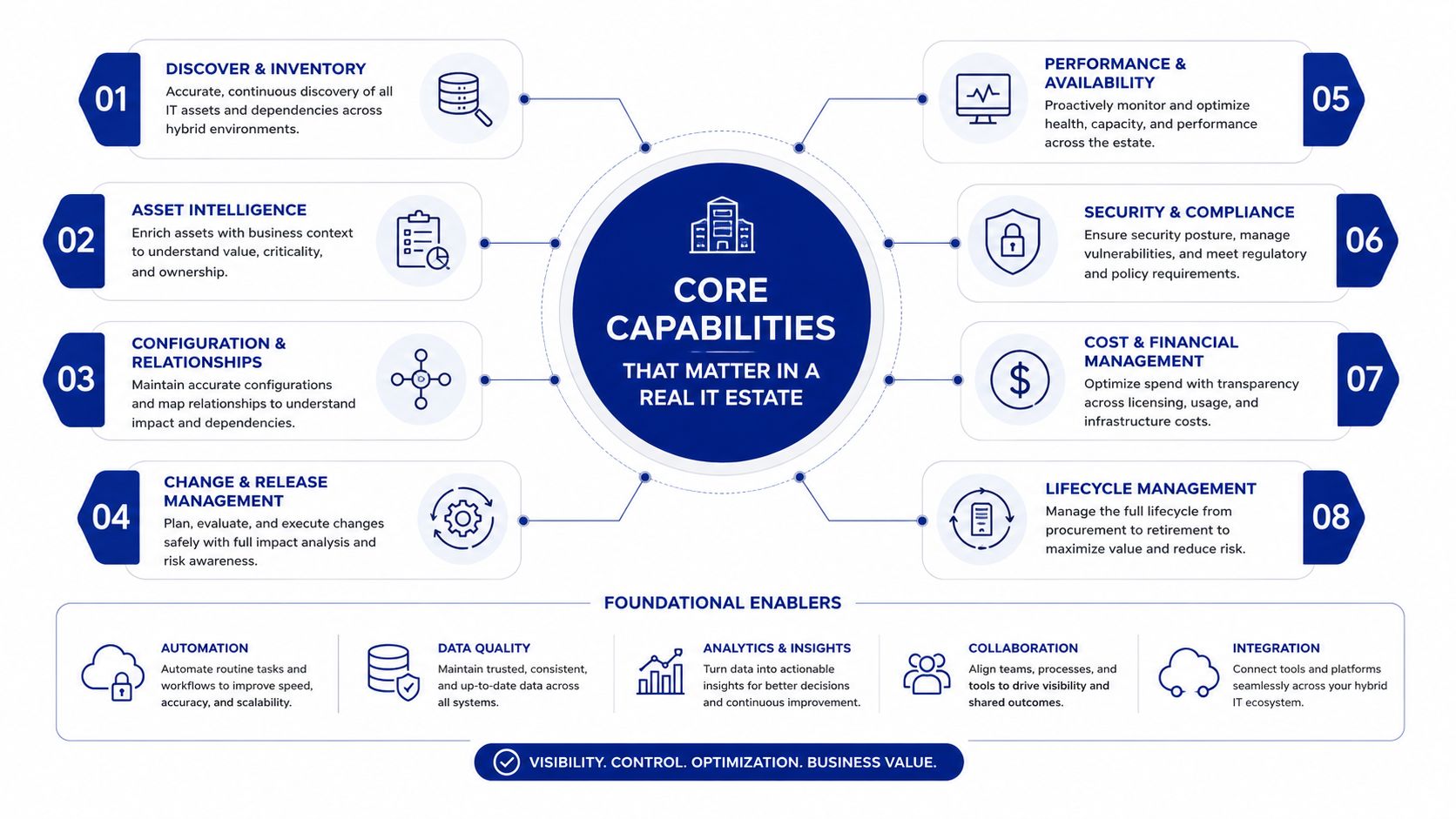
Lansweeper earns its place through three connected functions: discovery, normalization, and audit governance. It can identify IT, OT, IoT, and cloud assets across managed, unmanaged, and shadow environments. That breadth matters only if the resulting records remain accurate, reusable, and defensible during an audit or renewal review.
Discovery across mixed environments
Lansweeper supports network, remote, and cloud discovery. Buyers can combine network scanning with agent-based collection when routing limits, mobile endpoints, or access controls make agentless scans incomplete. The agent documentation requires outbound TLS 1.2 or higher connections through port 443. Its minimum host footprint is an x64 1 GHz single-core CPU, 2 GB RAM, and 500 MB of free disk space. The recommended configuration is an x64 2 GHz dual-core processor, 8 GB RAM, 1 GB of disk, and a 1 Gbps network connection, as detailed in the Lansweeper agent hardware and connectivity requirements.
The footprint suits many endpoint deployments, but the operating burden remains with the buyer. Assign owners for rollout, exclusions, updates, connectivity checks, and exception handling before approving the design. Scan reliability depends more on that operating discipline than on the headline discovery count.
Normalization that supports reporting
Discovery produces value when Lansweeper applies consistent structures to hardware, software, users, relationships, and lifecycle states. Its centralized model can enrich and normalize records across heterogeneous environments. Procurement teams still need naming standards, ownership rules, reconciliation policies, and data-quality thresholds. The Stackingo analysis of Lansweeper's CMDB model explains why normalization does not replace CMDB governance.
Audit evidence with a defined window
For Windows items, Lansweeper keeps hardware, software, and user history by default. Its audit trail records configuration changes, inventory edits, data exports, API access, and logins, together with the time those activities occurred. Audit data is stored securely for up to 12 months, according to the IP history and audit documentation.
Use that window deliberately. Set scan intervals, history tracking, asset relationships, and reports around your compliance and investigation needs. A retained history can support evidence collection, but it does not establish governance without defined ownership and review routines.
Edition Bands and Where Your Asset Count Lands
The first sizing exercise is simple. Count the assets you can prove, then place that number inside Lansweeper's published bands. Don't begin with a broad future-state estimate. It creates avoidable pricing ambiguity and can push the negotiation toward a larger edition before your deployment model is settled.
Lansweeper's pricing page identifies three commercial structures:
Edition | Typical Asset Band | Key Capability Gates |
|---|---|---|
Starter | Includes 2,000 assets | Core inventory and discovery requirements |
Pro | Starts at 2,000 assets and scales to 9,000 in 1,000-asset bands | Broader operational reporting and increased scale |
Enterprise | Starts at 10,000 assets and expands to any environment size in 2,000-asset bands | Enterprise-scale deployment and commercial support structure |
The exact commercial fit should come from a written quote tied to your verified inventory. The Lansweeper pricing structure establishes the asset mechanics, but it doesn't replace a deployment-specific scope review.
Use this sizing sequence
Separate discovered assets from licensed assets. Ask the vendor to define which asset classes count, including cloud, network, OT, IoT, and unmanaged devices.
Model the first production scope. Don't price every theoretical device if the rollout starts with a defined business unit, region, or environment.
Request adjacent bands. A quote that shows only one band hides the cost of growth. Ask for the next relevant options so finance can compare expansion paths.
Clarify feature gates in writing. Dashboards, lifecycle data, reporting depth, segmentation, support, and integrations may affect the final package. Don't assume that a higher asset band automatically means every desired capability is included.
The commercial risk isn't just the subscription price. It's the movement caused by scope changes, additional scanning infrastructure, premium support, or cloud functionality. Use the Lansweeper licensing guide from Stackingo to frame the broader buying discussion, then make the vendor map every requested feature to an edition and contract line.
Deployment Shapes and the Trade-offs Behind Each
There is no operationally neutral deployment model for Lansweeper. The architecture determines where credentials reside, how scans reach assets, which team owns the supporting infrastructure, and how quickly operators can isolate failures. Choose the simplest design that satisfies reachability, security, and audit requirements.
Centralized scanning
A central scan server gives administrators one control point for the scanning engine, database, credentials, schedules, and reporting pipeline. It fits environments where the server can reach required subnets and security teams approve the discovery methods.
The trade-off is concentrated failure risk. A routing change, credential error, firewall rule, or server outage can reduce visibility across several environments at once. The scan server also becomes a high-value administrative system, so assign clear ownership, restrict access, and include it in hardening and recovery procedures.
Centralization works best when network paths are stable and one team can operate the platform consistently. It becomes harder to defend when sites have separate security boundaries or unreliable connectivity.
Distributed agent collection
LsAgent suits roaming laptops, remote workers, and networks that block inbound reachability. Agents allow endpoint discovery from devices that can establish outbound connections to discovery gateways, rather than requiring a central scanner to reach every endpoint directly.
That model changes the operating workload. The endpoint team must track deployment coverage, version control, exclusions, failed check-ins, and user-impact concerns. A lightweight agent still creates another software lifecycle, and incomplete check-ins can leave stale inventory unless someone reviews status and last-seen data.
Use agent collection where endpoint mobility or segmentation makes direct scanning unreliable. Do not treat it as a way to eliminate administration. It moves administration into endpoint management.
Cloud-connected collection
Cloud connectivity reduces infrastructure ownership, while increasing reliance on outbound access, gateway availability, data handling, and regional connectivity. Before approval, security and privacy teams should document the data path, retention behavior, administrative access, and responsibility for incidents or delayed inventory.
Security review question: Ask which discovery data leaves each environment, where it is processed, how long it remains available, and which team owns an incomplete or delayed inventory record.
Hybrid designs can solve genuine segmentation problems, but they add operating paths and failure points. Use the Lansweeper Linux deployment discussion from Stackingo when comparing infrastructure choices involving Linux-based database or server components. Then test the selected design against support windows, scan reliability, and audit requirements before committing. Flexibility carries an operating cost.
Operational Gaps Buyers Consistently Underestimate
The buying risk sits outside the discovery demo. Your operating team will handle failed scans, unavailable support, and integrations that behave differently after a schema change. Evaluate those conditions before approving the platform.
Support coverage affects incident handling and renewal risk. Lansweeper's public support policy lists severity-one response times ranging from 12 support hours on Starter to 4 support hours on Enterprise, with support hours limited to Monday through Friday in CET. It does not promise follow-the-sun coverage for every plan. Globally distributed teams should therefore make timezone coverage a contract requirement, not a sales assumption. The Lansweeper support policy is the reference for checking the edition-specific commitment.
Scan reliability requires written acceptance criteria. Endpoint protection, credential policies, network segmentation, and egress restrictions can produce incomplete records. A failed scan can look like a missing asset unless the team tracks scan status, last successful scan, issue type, and stale records. Require these controls in the implementation plan, then test them across representative sites and asset classes.
Lansweeper states that it integrates with over 35 applications, according to its product site. That breadth may reduce integration gaps, but the count says nothing about the connector behavior your processes need. Confirm data direction, field mapping, error handling, update frequency, and ownership for each CMDB or ITSM integration. Treat every connector as a technical workstream with acceptance criteria.
Gap | Starter | Pro | Enterprise |
|---|---|---|---|
Support coverage | Verify the published response window and CET operating hours before purchase | Confirm escalation ownership for broader operational use | Validate the higher support commitment and named escalation path |
Scan reliability | Define scan success, stale asset, and exception reporting | Test multiple network and endpoint conditions | Require production acceptance criteria across sites and asset classes |
Integration depth | Prove the required connector and fields | Test synchronization and failure handling | Contract integration scope, ownership, and change management |
The recent Lansweeper changelog documents continued work on scan behavior, including a June 2026 correction involving LsAgent-only exclusions across scanning servers and indirect scans. That update does not disqualify the platform. It does require precise documentation of exclusions, scanning behavior, test ownership, and the process for validating changes before production rollout. Procurement should also confirm how support handles defects that affect inventory completeness.
Building the Real Three-Year TCO Case
A credible TCO model starts with more than the subscription quote. Include the scanning architecture, database ownership, integration work, administration, support requirements, and renewal terms in the same workbook. Otherwise, the license becomes the only visible cost while the operating burden sits in IT budgets.
I won't invent a three-year dollar estimate where the verified data doesn't provide one. The published pricing information establishes asset bands, not a universal list price per asset, and your final quote will depend on edition, scope, services, and commercial terms. A defensible model should therefore use your written quote as the input rather than a generic calculator.
Cost Line | Year 1 | Year 2 | Year 3 |
|---|---|---|---|
Subscription | Quoted edition and verified asset band | Renewal price under contract | Renewal price under contract |
Infrastructure | Scan servers, database, storage, and operations | Hosting and maintenance | Hosting and maintenance |
Integration | Initial ITSM, CMDB, identity, and reporting scope | Change requests and support | Change requests and support |
Administration | Deployment, tuning, exception handling, and reporting | Ongoing ownership | Ongoing ownership |
Commercial risk | Expansion, true-ups, and implementation variance | Band movement and renewal terms | Band movement and renewal terms |
Model value from decisions, not discovery volume
Asset visibility creates value only when someone acts on it. The strongest business cases usually connect inventory records to software reclamation, hardware lifecycle planning, vulnerability prioritization, audit evidence, or service ownership. Lansweeper's product positioning includes vulnerability data, lifecycle insights, and benchmarking, but those features don't guarantee savings without owners and decision rules. The Lansweeper and Gartner discussion from Stackingo can support a broader evaluation, but finance should still require your own baseline and approval logic.
Build three scenarios:
Conservative: Use the platform for inventory, audit evidence, and lifecycle reporting.
Operational: Add integration work and assign owners for remediation and reclamation.
Expansion: Include additional asset classes, business units, or cloud environments only when they have defined value cases.
Finance rule: Don't approve the platform because it finds more assets. Approve it when identified assets change a budget, risk decision, audit response, or operational workflow.
A Procurement Checklist for Negotiating Lansweeper
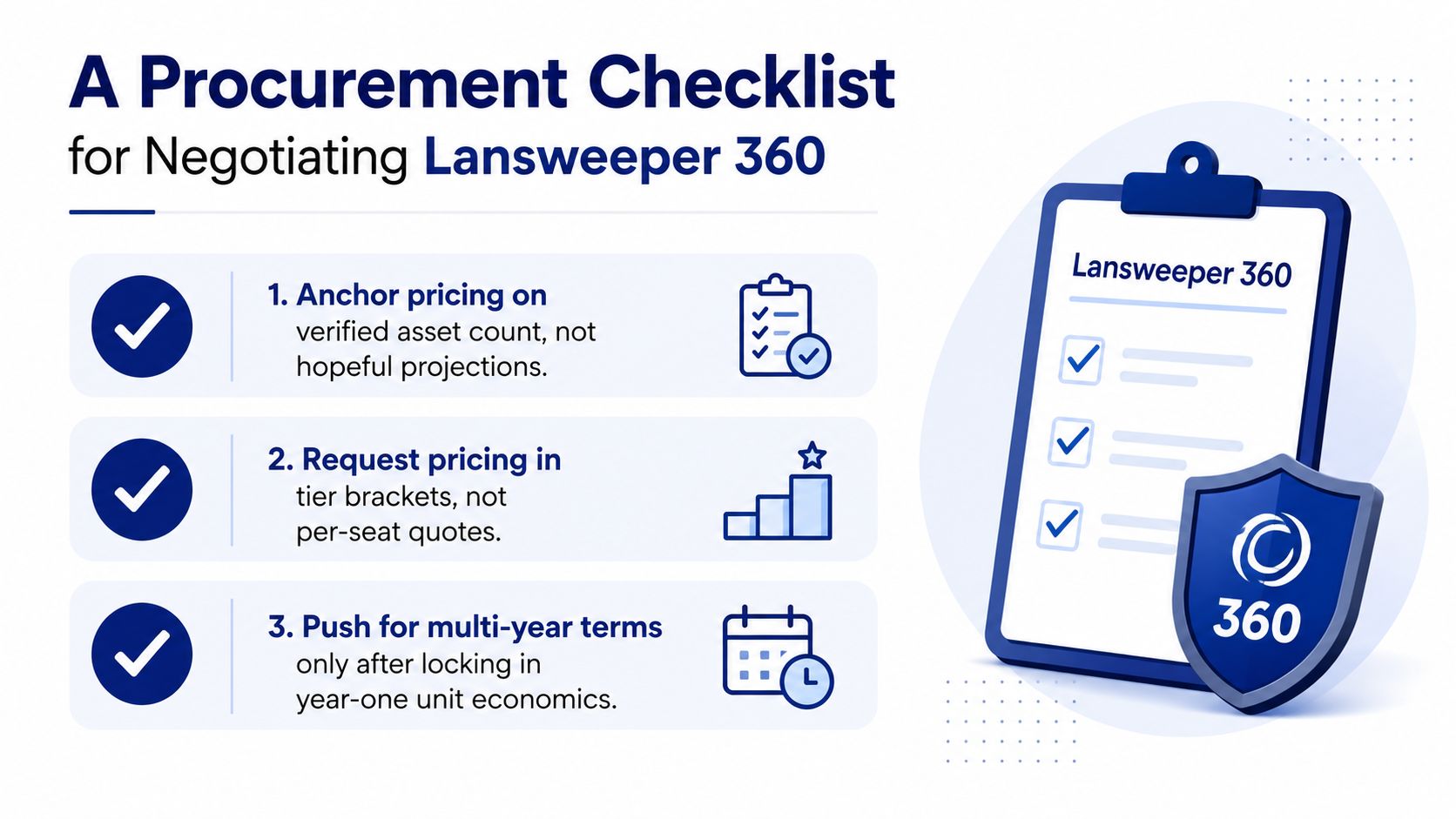
Your negotiating position depends on evidence. Start with the asset count you can verify, then define what the contract will count as billable. Require clear treatment for cloud, network, OT, IoT, unmanaged, and shadow devices. A discovery export should support the baseline before any quote is approved.
Put commercial mechanics in the quote
Reject a single opaque total. Request the starting edition band, the next expansion band, the true-up method, and the treatment of newly added asset classes. The public pricing model uses 1,000-asset bands for Pro and 2,000-asset bands for Enterprise. Have the vendor or reseller model your expected growth and show exactly when the contract moves into each band.
Use this checklist during negotiations:
Verify the baseline: Link the starting asset count to a discovery export or agreed inventory definition.
Separate license from services: List integrations, implementation, reporting, and architecture work as separate charges.
Define scanning responsibilities: Record server ownership, credentials, exclusions, agent scope, and troubleshooting duties.
Test support terms: Put response windows, operating hours, escalation contacts, and severity definitions in the contract.
Protect audit access: Confirm access to and export rights for history within the documented 12-month retention window.
Control renewals: Set renewal caps, co-terming rules, expansion pricing, and notice periods before signature.
The quote should also identify the operational handoffs. Confirm who owns renewal notices, pricing changes, contract amendments, and support escalation when a licensing partner is involved. A low initial price offers little protection if accountability for renewals or delivery remains unclear. Get those responsibilities in writing before approval.
When Lansweeper Fits and How to Source It Faster
Choose Lansweeper when you need broad discovery across a mixed technology estate, reliable asset normalization, software and hardware history, lifecycle visibility, and audit evidence. It's particularly compelling when your organization can operate a scanning layer and already has separate platforms for ITSM, CMDB workflow, endpoint management, vulnerability remediation, and service ownership.
It's a weaker fit when you expect a fully SaaS-managed experience with minimal infrastructure responsibility, or when your environment has little need for network and endpoint inventory. It also needs scrutiny when your teams operate globally outside CET support hours and require continuous follow-the-sun assistance.
The decision should pass four tests:
Coverage: Can your selected discovery methods reach the assets that matter?
Evidence: Does the audit history meet your governance and compliance requirements?
Ownership: Who handles scan failures, stale records, agents, credentials, and integrations?
Commercial fit: Does your verified asset count fit a stable edition band with acceptable renewal terms?
Lansweeper offers a 14-day free trial with full feature access, and its product site presents integrations with over 35 applications. Use that trial to validate scan coverage, data quality, history, exports, and the exact workflows your team expects. Don't use it as a dashboard tour.
Stackingo provides Lansweeper licensing and procurement through an authorized reseller channel, including RFQ-based purchasing, and can also support implementation work around discovery, asset relationships, cyber risk, CMDB and ITSM publishing, licensing, shadow IT, lifecycle, and network relationship mapping. That makes marketplace sourcing relevant when quote comparison, contract coordination, and deployment scope need to move together. Visit Stackingo to request a Lansweeper quote built around your verified asset count, edition band, deployment shape, and integration requirements.