
CBI Lansweeper: What It Means and How to Source It
Why would an enterprise buyer search for CBI Lansweeper instead of Lansweeper? Usually, the phrase points to a procurement route, not a separate product edition. Treat it as a commercial and integration question, then verify licensing, discovery coverage, API access, support, and reseller authority before you sign.
What CBI Lansweeper Actually Means for Enterprise Buyers
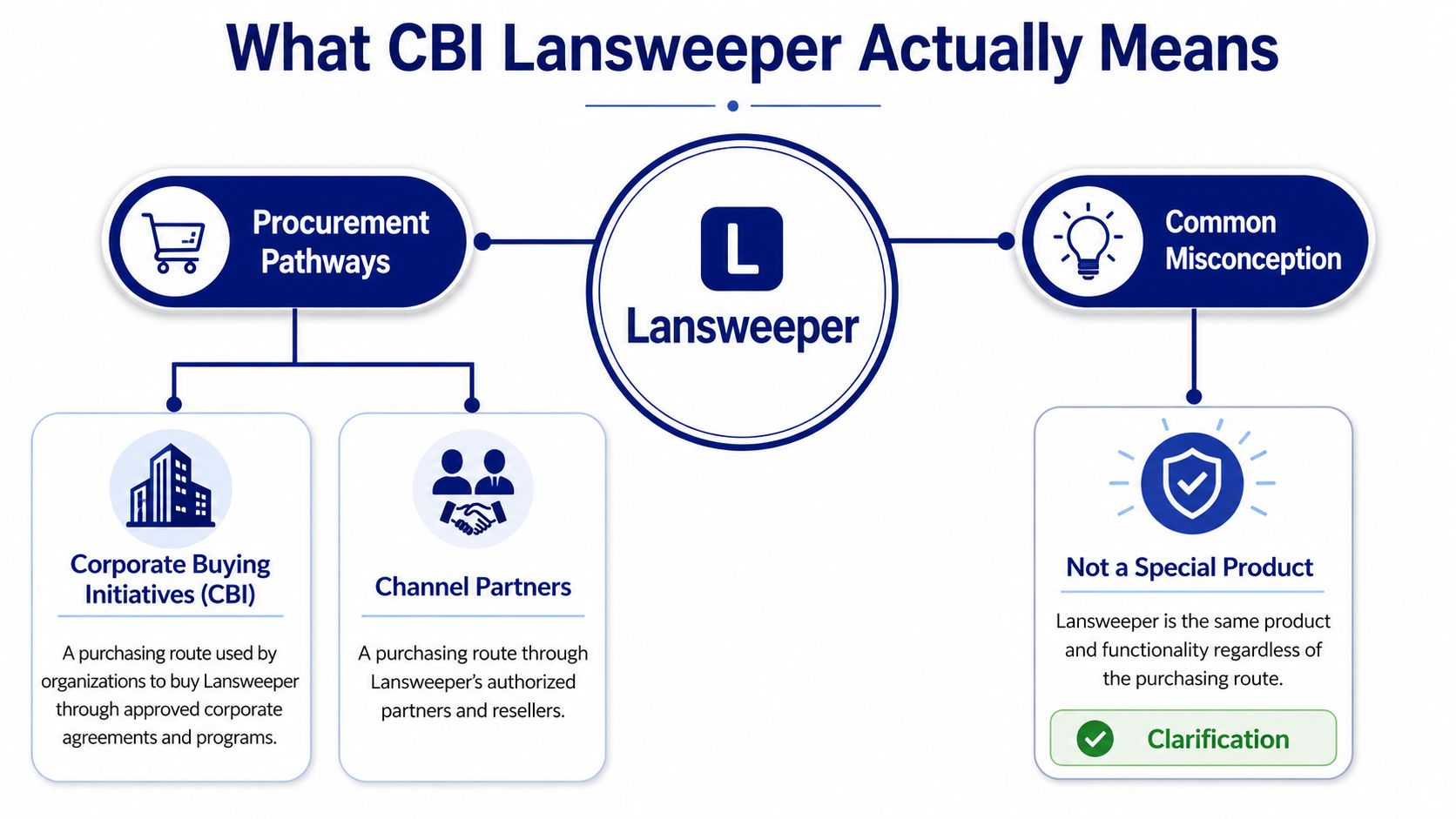
CBI Lansweeper is best understood as Lansweeper acquired through a Corporate Buying Initiative, channel partner, or structured procurement route. It doesn't identify a special Lansweeper build, private feature tier, or separate software product. The commercial wrapper may change how you buy, negotiate, renew, and consolidate the platform, but the underlying technology remains Lansweeper.
Lansweeper was founded in 2004 and has grown into an established software vendor with several hundred employees and multi-tens-of-millions in annual revenue. Independent market data estimates roughly 336 to 403 employees and approximately $40 million to $60 million in yearly revenue in recent years, while one industry source reported about €52.6 million in fiscal 2023 revenue. Those figures place Lansweeper well beyond startup stage and indicate a mature installed-base business. RocketReach's Lansweeper company profile provides the relevant company background.
Why the procurement wrapper matters
Enterprise buyers care about the CBI label because the buying motion can affect:
Commercial consolidation: Lansweeper can be evaluated alongside ITSM, CMDB, security, and infrastructure purchases.
Negotiating strength: A structured request for quotation can expose competing channel terms instead of leaving the buyer with one direct quote.
Renewal control: Co-terming and shared contract governance can reduce scattered renewal dates.
Administrative efficiency: Procurement, legal, finance, and IT can work through one commercial process.
The product itself is discovery-first IT asset management. It helps identify hardware and software across an estate, using network, agent, and cloud discovery methods. Its documented asset scope includes monitors, printers, routers, servers, mobile devices, operating systems, productivity software, databases, and security software. Lansweeper's asset documentation describes that scope in practical terms.
Procurement rule: Don't ask whether CBI is a Lansweeper edition. Ask who is authorized to sell the entitlement, what the SKU includes, how assets are counted, and which support rights transfer to your organization.
For a concise product orientation, see this Lansweeper overview for enterprise buyers. The answer is direct: CBI Lansweeper is a procurement motion, not a distinct product.
The Technical Architecture Behind Lansweeper
How should a CIO evaluate Lansweeper's architecture before approving a purchase? Treat it as a data-collection and asset-normalization layer whose integration behavior determines its procurement value. It is not a ticketing platform. Network Discovery, IT Agent Discovery, and Cloud Discovery provide separate collection paths for local networks, remote endpoints, and cloud environments. The reconciliation engine can merge duplicate matches into one asset record, as described in The Lansweeper discovery documentation.
The architecture has four practical layers:
Layer | Component | Function |
|---|---|---|
Discovery | Network Discovery, IT Agent Discovery, Cloud Discovery | Finds assets across network, endpoint, and cloud environments |
Collection | Scanning and agent data | Captures hardware, software, configuration, and relationship information |
Reconciliation | Matching engine | Merges duplicate observations into a consolidated asset record |
Integration | GraphQL Data API | Publishes selected asset data to CMDB, ITSM, procurement, and reporting workflows |
Discovery is broader than a single scan
Network Discovery targets reachable infrastructure and network-connected equipment. IT Agent Discovery supports endpoints that direct network access may not reach. Cloud Discovery covers assets outside the traditional corporate network. That combination suits hybrid estates better than relying on one collection method.
Credentialed collection can return deeper operating-system and software details. Credential-free recognition can reduce deployment work. Buyers should test both approaches across segmented networks, remote offices, unmanaged devices, and operational technology. Public product material positions Lansweeper for visibility across IT, OT, IoT, and cloud, but does not quantify coverage thresholds or the manual normalization required in every environment. Lansweeper's platform positioning supports the broad visibility claim, not a universal accuracy guarantee.
The Data API is the integration spine. Lansweeper's current Data API uses GraphQL through a fixed HTTPS POST endpoint, with JSON payloads and authentication through a Personal Access Token or OAuth bearer token. The official Data API quickstart documents this connection model. GraphQL allows an integration to request only the fields it needs for CMDB publishing, procurement analysis, and discovery workflows.
Software reconciliation merits a separate review. The query returns assets associated with a specified software title. supports cursor-based pagination for site software data. The assetsWithSoftware reference helps buyers assess entitlement checks, because installations must be mapped to devices before renewal decisions are credible.
A buyer's architecture review should test API completeness, authentication governance, pagination behavior, duplicate handling, and the destination system's data model. For the CMDB implications and field-mapping considerations, use this Lansweeper CMDB integration guide. That review should happen before commercial comparison, because integration rework can erase the value of a lower initial quote.
Integration Scenarios and Where Lansweeper Fits
Lansweeper belongs below the workflow layer. It discovers what exists, enriches the record with technical context, and publishes information to systems that manage incidents, changes, configuration, compliance, or software entitlements. It isn't a replacement for ServiceNow, Jira Service Management, a dedicated CMDB, or a software asset management platform.
Where the data normally goes
A ServiceNow integration can use discovered asset information to improve change and incident context. Microsoft Intune data can be enriched with broader inventory information where endpoint management alone doesn't provide enough context. Cherwell and Jira Service Management can receive asset relationships for service workflows, while SAM tools can consume software installation data for entitlement reconciliation.
The architecture decision is usually one-way or bidirectional:
One-way export: Lansweeper publishes authoritative discovery data to another platform.
Bidirectional synchronization: Systems exchange updates, ownership, status, or lifecycle fields.
Selective publishing: Only approved asset classes, sites, or fields move downstream.
Bidirectional sync sounds attractive, but it creates ownership disputes unless every field has a defined system of record. A practical design often keeps Lansweeper authoritative for observed technical attributes, while the CMDB or ITSM platform owns service relationships, business ownership, approval state, and workflow status.
Lansweeper compared with adjacent tools
Capability | Lansweeper | CMDB, such as ServiceNow | ITSM Suite | SAM Tool |
|---|---|---|---|---|
Network and endpoint discovery | Strong fit | Often dependent on discovery modules or integrations | Usually secondary | Limited |
Configuration relationships | Useful source data | Strong governance and service modeling | Workflow-oriented | Focused on license relationships |
Incident and change workflow | Not the primary role | Strong | Strong | Limited |
Software entitlement reconciliation | Valuable installation evidence | Possible with dedicated modules | Usually limited | Core capability |
Asset data API | GraphQL-based Data API | Platform-specific APIs | Suite-specific APIs | Tool-specific |
System of record role | Observed asset state | Governed configuration state | Work and service state | License position |
The operational risk isn't the existence of an integration. It's an integration that moves stale or poorly normalized data into a system users trust. Configure credential storage, scan schedules, API limits, error handling, and ownership rules before connecting production workflows. Buyers evaluating ticket context can also review this Lansweeper ticketing integration discussion.
Enterprise Use Cases and Measurable Benefits
Lansweeper's strongest enterprise case is not a feature checklist. It's the reduction of uncertainty around what the organization owns, runs, connects, and needs to renew. That value becomes defensible when procurement and IT security translate discovery data into decisions.
Four use cases deserve priority
Hybrid asset visibility comes first. A distributed organization may have office infrastructure, remote endpoints, cloud resources, network equipment, and OT environments that no single collection method sees consistently. Lansweeper's three discovery systems create a broader evidence base, but the buyer should validate coverage through a controlled pilot rather than accept a generic “complete visibility” claim.
Software license reconciliation follows. The query can connect software titles to the assets where they appear. That gives procurement a stronger starting point for reviewing Microsoft, Adobe, SAP, and other publisher agreements, although installation evidence isn't the same as a legally complete entitlement position.
Security and patch posture can improve when vulnerability or patch tooling receives reliable installed-software context. Lansweeper should supply the observed inventory, while the vulnerability platform determines exposure and remediation priority.
End-of-life planning benefits from hardware age, model, operating system, and location data. Procurement can use those fields to organize replacement waves and avoid renewing support for equipment that no longer fits the operating model.
Use Case | Typical Trigger | Measured Outcome |
|---|---|---|
Hybrid asset visibility | Mergers, estates with multiple sites, cloud expansion | A consolidated inventory suitable for validation and downstream publishing |
Software reconciliation | Publisher renewal or audit preparation | A defensible installation baseline for entitlement review |
Security context | Vulnerability or patch investigation | Better correlation between software exposure and affected assets |
Lifecycle planning | Hardware refresh or support expiry | Prioritized replacement and renewal decisions |
The benefits are measurable, but the measurement must come from your baseline. Track inventory completeness, duplicate records, reconciliation exceptions, time spent preparing audit evidence, unresolved software ownership, and renewal decisions supported by observed data. Don't promise reclaimed spend or cycle-time reductions without measuring your own starting position.
Lansweeper's company scale also matters to a CIO assessing vendor durability. Its ownership and investment history includes acquisition by Dovesco in 2018 and a reported €130 million investment from Insight Partners. More recent reporting described nearly 400 employees and about $100 million in annual recurring revenue by mid-2025, while separate workforce data indicated growth from 367 employees in 2023 to 451 in 2026, an increase of about 22.9%. Bitscale's Lansweeper profile contains the relevant growth and investment references. For a broader product view, see this Lansweeper asset management resource.
Security, Compliance, and Data Governance Considerations
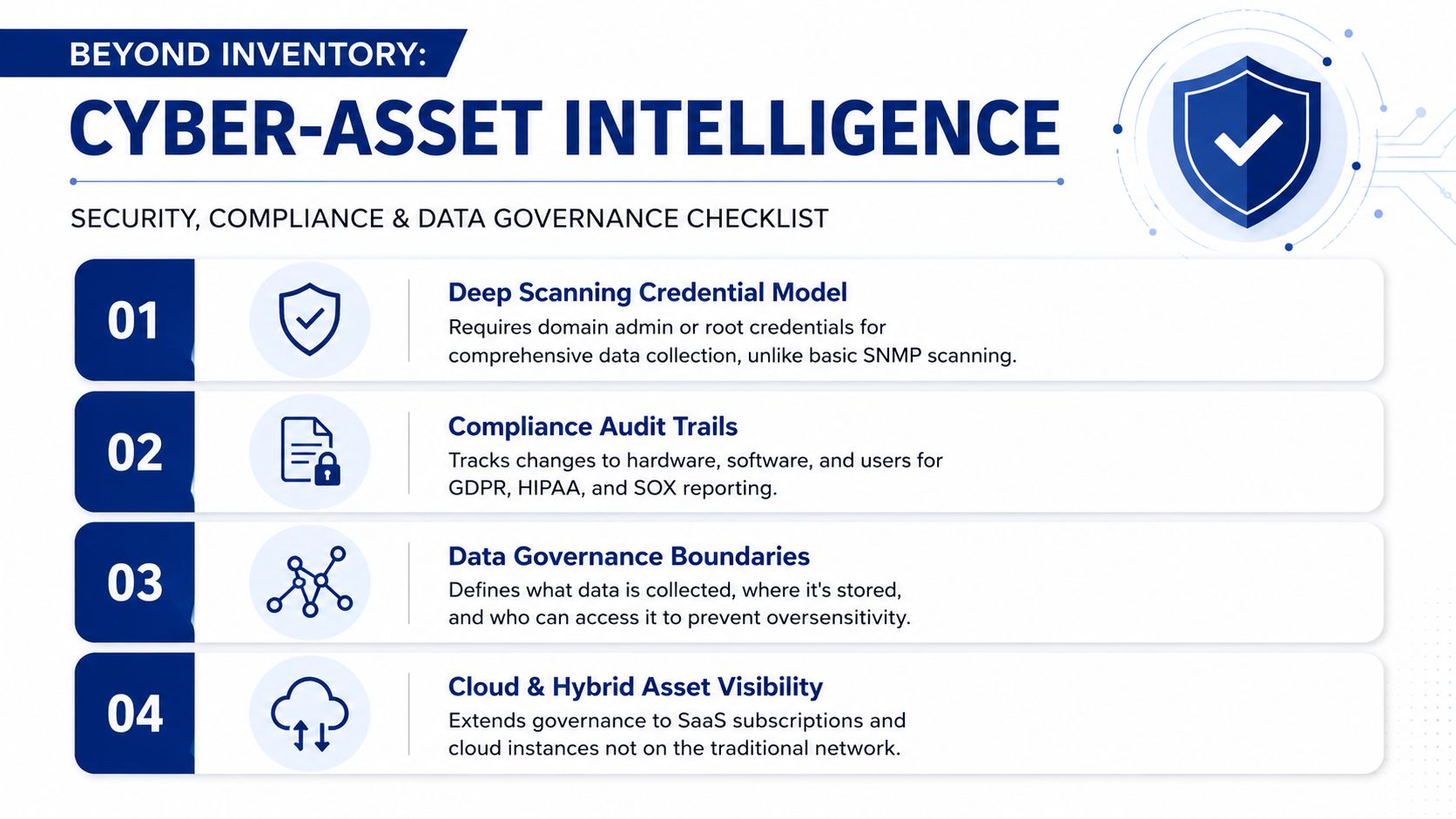
Lansweeper shouldn't be governed like a passive spreadsheet. Discovery can expose device identities, software installations, users, network relationships, configurations, and cloud assets. The platform may become a sensitive operational data store, particularly when credentialed collection is enabled.
The privilege model needs executive ownership
Credentialed scanning can provide deeper technical information, but credentials create risk. Store them in a controlled vault, restrict access, rotate them through established processes, and document which accounts can scan which environments. Credential-free recognition can reduce the number of privileged connections, but it may not provide the same depth across every operating system or segmented network.
Scope discovery deliberately:
Separate environments: Treat corporate IT, OT, medical devices, laboratories, and production systems as distinct scan domains.
Approve targets: Require asset owners to approve sensitive ranges and collection methods.
Limit fields: Collect what downstream decisions require, not every available attribute.
Review retention: Define how long historical asset and user information remains available.
Control access: Map administrator, analyst, procurement, and auditor roles to least-privilege permissions.
GDPR, ISO 27001, and SOX evidence requirements don't become satisfied merely because an inventory exists. Lansweeper can support evidence collection and control monitoring, but your organization still needs documented processing purposes, access controls, retention rules, change governance, and evidence review. European buyers should also confirm hosting, transfer, and data-residency requirements before selecting a hosted deployment model.
Cyber-asset intelligence changes the buying question
The product's positioning now extends across IT, OT, IoT, and cloud, with CIS Control support. That's commercially meaningful, but buyers should ask where discovery stops, how duplicate records are resolved, what confidence level applies to each asset, and how much human normalization is required before audit or risk use.
Security decision: The more Lansweeper feeds SIEM, vulnerability management, CMDB, or audit workflows, the more rigorously you must govern its collection scope and data quality.
A syslog integration can be useful where asset context needs to support monitoring and investigation. Review this Lansweeper syslog integration resource, then have security architecture approve the data flow rather than treating it as a routine connector.
Licensing, Pricing, and Procurement Implications
Lansweeper licensing should be evaluated through the definition of a billable asset, the selected deployment model, included modules, support rights, and renewal mechanics. Don't approve a quote until the supplier explains how physical devices, virtual machines, containers, mobile devices, software installations, and cloud resources are treated under the proposed entitlement.
Verify the commercial model before comparing quotes
Ask for a written answer to five questions:
What is counted? Confirm the asset categories included in the metric.
What is included? Check whether cloud capabilities, premium reporting, and Data API access sit inside the quoted SKU.
What changes at renewal? Request the renewal basis, uplift language, and true-up process.
Who supports the customer? Identify the support tier, escalation route, and reseller responsibilities.
Can the entitlement transfer? Confirm rights during restructuring, divestiture, and reseller changes.
Subscription licensing can provide automatic updates, support, and hosted dashboard access, depending on the tier. Perpetual licensing may suit organizations that prioritize on-premises control and reduced recurring fees, but it can shift more responsibility toward maintenance, upgrades, and license-key governance. Feature availability and commercial terms must be validated against the current order form.
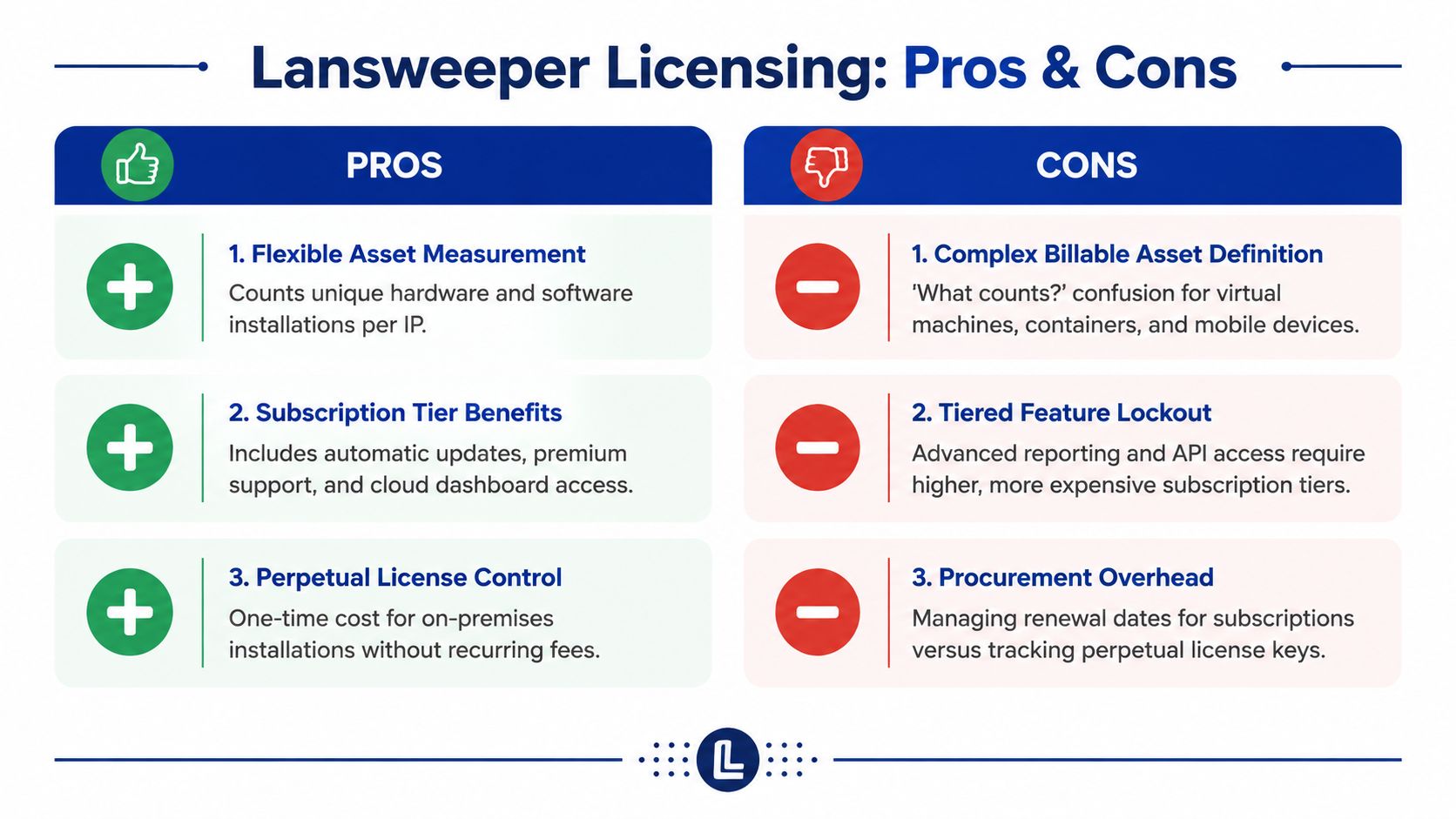
Procurement risk usually appears after deployment. A workload migration can change the number of virtual machines. A merger can introduce new sites. A new cloud initiative can create assets that weren't in the original commercial baseline. Regional pricing, renewal cliffs, and separate add-ons can make an apparently simple quote difficult to forecast.
A structured RFP should compare like-for-like SKUs, support, API rights, deployment, term length, true-up language, and co-terming. The objective isn't a lower unit price. It's a contract that finance can forecast and IT can administer without repeated disputes over what the organization owns.
Sourcing Lansweeper Through a Multi-OEM Marketplace
Treat Lansweeper as one component of an enterprise asset and operations stack, not an isolated vendor transaction. A multi-OEM marketplace can place Lansweeper beside complementary CMDB, ITSM, security, and licensing options so procurement can compare the full commercial scenario rather than optimize one SKU in isolation.
What a serious channel review should confirm
Before issuing an order, verify:
Authorization: Confirm the reseller can provide valid Lansweeper entitlements.
SKU coverage: Check whether the quote includes the Data API, cloud functionality, reporting, and required support.
Entitlement evidence: Require license documentation, provisioning details, and renewal ownership.
Contract alignment: Ask whether manufacturer co-terming and multi-year framework terms are available.
Escalation: Document who handles technical support, billing issues, renewals, and transfer requests.
Stackingo operates as a marketplace-first enterprise IT licensing platform, aggregating software and hardware licensing options into an RFQ-led purchasing experience. For CBI Lansweeper, that model is relevant because the buyer can compare Lansweeper procurement with adjacent platform requirements and manage the commercial process through a unified front.
Procurement Factor | Direct OEM Purchase | Stackingo Marketplace |
|---|---|---|
Quote structure | Usually centered on one vendor's products | Can organize requirements across multiple OEMs |
Commercial comparison | Buyer manages comparison independently | RFQ process can standardize quantities and scenarios |
Renewal governance | Often separated by vendor | Can support consolidated commercial planning |
Channel evaluation | Buyer validates partners directly | Buyer still verifies authorization and entitlement terms |
Bundle analysis | Limited to vendor ecosystem | Allows comparison with complementary enterprise tools |
Procurement workload | Multiple vendor processes may remain | A unified commercial front can reduce channel coordination |
The marketplace doesn't remove the need for technical validation. You still need a discovery pilot, security review, data governance approval, API test, and licensing baseline. It can, however, compress the buying cycle by organizing requirements, quotes, partner options, and procurement logistics in one process.
For CIOs, the recommendation is straightforward. Use Lansweeper when you need a discovery and asset intelligence layer, don't mistake it for an ITSM workflow engine, and make API quality and data governance conditions of purchase. Source it through a channel structure that gives you comparable terms, clear entitlement documentation, and control over renewals.
Stackingo offers a marketplace-led way to source CBI Lansweeper alongside complementary enterprise software, with structured RFQs, comparable commercial options, and procurement coordination. Visit Stackingo to request a Lansweeper quote and evaluate the licensing, integration, and renewal terms before committing.